DyssomniaNN: Modeling Human Sleep Disorders with Spiking Neural Networks
DyssomniaNN uses multiscale neural modeling to show that neurodynamics — not sleep duration — determines restorative quality.
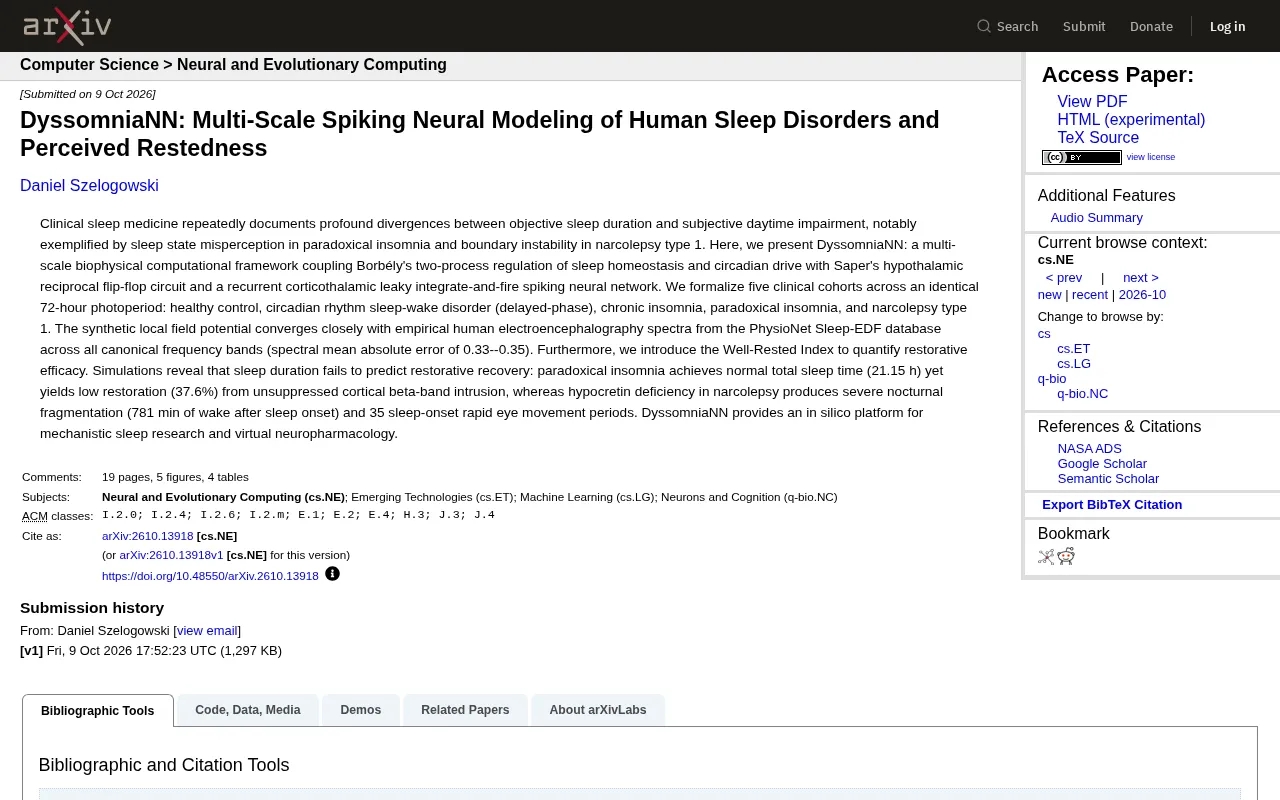
DyssomniaNN is a computational study coupling macroscopic sleep regulation theory with microscopic spiking neural networks to explain the clinical paradox between sleep duration and subjective restoration. It integrates Borbély's Two-Process Model, Saper's hypothalamic flip-flop circuit, and a corticothalamic LIF network to simulate five clinical groups under identical 72-hour conditions. Synthetic EEG spectra match real recordings with errors as low as 0.33–0.35. Key findings: paradoxical insomnia patients achieve normal sleep duration yet show only 37.6% restorative efficacy due to unsuppressed cortical beta activity, while narcolepsy type 1 patients accumulate 781 minutes of nighttime wakefulness from hypocretin deficiency. The framework serves as a controllable in silico platform for sleep mechanism research and virtual neuropharmacology.
Sleep medicine has long grappled with a paradox that confounds clinicians: objective sleep duration and subjective feelings of restoration often diverge dramatically. Some patients sleep a full night yet remain exhausted throughout the day, while others feel as though they never slept at all — despite monitoring data showing otherwise. A study called DyssomniaNN proposes a multiscale biophysical computational framework designed to explain this gap at the level of neural mechanisms.
Why Sleep Duration Can't Predict Restorative Quality
The most striking clinical examples are paradoxical insomnia and narcolepsy type 1. Patients with paradoxical insomnia often show normal sleep duration on objective monitoring, yet subjectively insist they barely slept — a phenomenon known as "sleep state misperception." Narcolepsy type 1, on the other hand, is characterized by instability at the sleep-wake boundary: patients struggle to maintain wakefulness during the day while their nighttime sleep becomes highly fragmented.
These phenomena suggest that evaluating sleep quality purely by "how many hours" a person slept is insufficient. The researchers aimed to build a model capable of capturing both the macro-level rhythms of sleep and the micro-level neural dynamics — one that could explain why equal amounts of sleep can yield such drastically different restorative outcomes.
DyssomniaNN's Multiscale Architecture
DyssomniaNN's core innovation lies in coupling three classical sleep regulation theories into a unified computational framework.
Three-Layer Mechanistic Coupling
- Borbély's Two-Process Model: Describes how homeostatic sleep pressure (sleep drive accumulation) and circadian rhythm drive jointly determine sleep propensity.
- Saper's hypothalamic bistable flip-flop circuit: Explains the rapid switching mechanism between sleep and wake states.
- Corticothalamic leaky integrate-and-fire (LIF) spiking neural network: Simulates the generation of electrophysiological brain activity at the neuronal level.
This multiscale coupling — from macroscopic rhythms down to microscopic neuronal firing — allows the model to reproduce both the temporal structure of sleep and realistic neural electrical signals.
The Borbély Two-Process Model (proposed in 1982) is a cornerstone of modern sleep regulation theory. It posits that sleep propensity is governed by two independent processes: Process S (homeostatic sleep pressure), which accumulates during wakefulness and dissipates during sleep — closely tied to the buildup of sleep-promoting substances such as adenosine — and Process C (circadian rhythm), controlled by the suprachiasmatic nucleus (SCN) and oscillating on an approximately 24-hour cycle to regulate alertness thresholds. Sleep is only triggered when S exceeds the threshold set by C; together, the two processes describe the dynamic changes in sleep timing and depth.
The Saper hypothalamic flip-flop circuit explains the "all-or-nothing" nature of sleep-wake transitions: sleep-promoting neurons in the ventrolateral preoptic area (VLPO) and wake-promoting monoaminergic neurons in the brainstem and hypothalamus mutually inhibit each other, forming a positive feedback loop that keeps the brain stably in either sleep or wakefulness rather than an ambiguous intermediate state. This mechanism also explains why narcolepsy patients — who lack hypocretin, the key stabilizer of this switch — experience frequent, uncontrollable transitions between wake and sleep states.
Five Clinical Cohorts in Virtual Experiments
Under identical 72-hour light-dark cycle conditions, the study simulated five clinical populations:
- Healthy controls
- Circadian rhythm sleep-wake disorder (delayed sleep phase type)
- Chronic insomnia
- Paradoxical insomnia
- Narcolepsy type 1
The uniform experimental conditions allowed direct comparison of differences between pathological mechanisms — something that is rarely feasible in real clinical research.
Strong Agreement Between Synthetic and Real EEG
The model's credibility depends on whether the signals it generates resemble those of a real human brain. The researchers compared synthetic local field potentials (LFPs) produced by DyssomniaNN with real human electroencephalography (EEG) spectra from the PhysioNet Sleep-EDF database.
Across all classical frequency bands, the mean absolute spectral error between the two was only 0.33–0.35 — a remarkably close match. This means the model doesn't merely "look like sleep" on a timeline; its underlying neural oscillation structure also approximates real physiological states, providing a solid foundation for subsequent mechanistic inference.
Core Findings from the Well-Rested Index
To quantify the "restorative efficacy" of sleep, the study introduced a Well-Rested Index. The simulation results yielded several striking numbers:
- Paradoxical insomnia: Total sleep time reached normal levels (21.15 hours), yet restorative efficacy was only 37.6%. The reason: cortical beta-band activity was not sufficiently suppressed, leaving the brain in a relatively active state during "sleep" — providing a neural-level explanation for why these patients feel as though they never fell asleep.
- Narcolepsy type 1: Due to hypocretin deficiency, nighttime sleep was severely fragmented, with wake after sleep onset (WASO) reaching 781 minutes and 35 sleep-onset REM periods (SOREMPs) occurring.
These results mechanistically validate a well-established clinical intuition: sleep duration does not predict restorative quality. Recovery depends on the neurodynamic state during sleep, not the simple accumulation of hours.
Cortical beta-band activity (approximately 13–30 Hz) should be markedly suppressed during normal deep sleep — particularly during slow-wave sleep — replaced instead by low-frequency, high-amplitude delta waves (0.5–4 Hz). Persistent beta activity is typically associated with cortical arousal, reflecting a brain actively engaged in information processing and cognitive computation. In patients with paradoxical insomnia, cortical beta activity remains abnormally elevated even when polysomnography (PSG) indicates sleep — suggesting the brain never truly enters a restorative resting mode during nominally "sleeping" periods. This aligns closely with patients' subjective experience of wakefulness, providing an electrophysiological mechanistic account of "sleep state misperception," and underscoring why sleep staging criteria based on macroscopic EEG waveforms alone are insufficient to assess actual restorative quality.
SOREMP (Sleep-Onset REM Period) refers to the occurrence of REM sleep within 15 minutes of sleep onset — a hallmark of narcolepsy. In healthy individuals, REM sleep typically takes 60–90 minutes to appear after sleep onset.
A Platform for Mechanistic Research and Virtual Pharmacology
DyssomniaNN's significance extends beyond explaining these phenomena. As an in silico platform, it provides a controlled experimental environment for mechanistic sleep research and can be applied to virtual neuropharmacology — testing how pharmacological interventions affect neural circuits within the model, without requiring direct clinical trials.
For the intersection of neuroscience and computational modeling, frameworks that combine classical theory, spiking neural networks, and real-data calibration represent a promising research paradigm: using interpretable biophysical models to bridge macroscopic clinical presentations and microscopic neural mechanisms. That said, synthetic models are ultimately simplifications of reality, and their clinical conclusions still require further experimental validation.
Related articles

David Fincher's New Film Accused of Being AI-Generated? The Truth Behind the Controversy
David Fincher's new film *The Further Misadventures of Cliff Booth* is accused of using AI, with a carriage shot in the trailer sparking controversy. Netflix's acquisition of Ben Affleck's AI company and Fincher's own openness to AI keep suspicions alive. This article sorts out the controversy and the views of all sides.

FCC Clears SpaceX's Space-Based AI Data Centers: A Debate Over Regulatory Boundaries
The FCC approved SpaceX's plan to deploy AI data centers in space but dismissed opponents' key concerns about scientific research impacts as beyond its regulatory authority. This article analyzes the regulatory boundary issues behind the decision, the deeper tensions of space-based AI infrastructure, and its implications for the industry.

Why Are Latinos Nearly Half of the U.S. Border Patrol?
Latinos hold nearly half of the U.S. Border Patrol and about 30% of ICE. Vox's Khalil Green explores their motivations, identity tensions, and why enforcement work ≠ MAGA.