E Ink Launches Kaleido 4 Color E-Paper: Improvements in Both Color and Refresh Rate

E Ink launches Kaleido 4 color e-paper, upgrading color e-readers in color, refresh, and contrast
E Ink has officially announced its next-generation Kaleido 4 color e-paper technology, focusing on color saturation, refresh speed, and contrast improvements. As the de facto standard in color e-readers—adopted by Kobo, PocketBook, Boox, and Kindle Colorsoft—this upgrade will impact the entire category. Kaleido 4 addresses the previous generation's "washed-out color mode" through optimized filter light transmission and improved panel structure. However, existing Kaleido 3 users need not rush to upgrade, as it takes months for end products to reach market.
The screen experience of color e-readers is likely about to level up again. E Ink has officially announced its next-generation Kaleido 4 color e-paper technology, bringing multiple improvements to address the shortcomings of the current Kaleido 3 in color saturation, refresh speed, and contrast. Most color e-readers on the market today—including products from Kobo, PocketBook, and Boox, as well as the custom version used in Amazon's Kindle Colorsoft—are based on the Kaleido series, so the impact of this upgrade is quite broad.
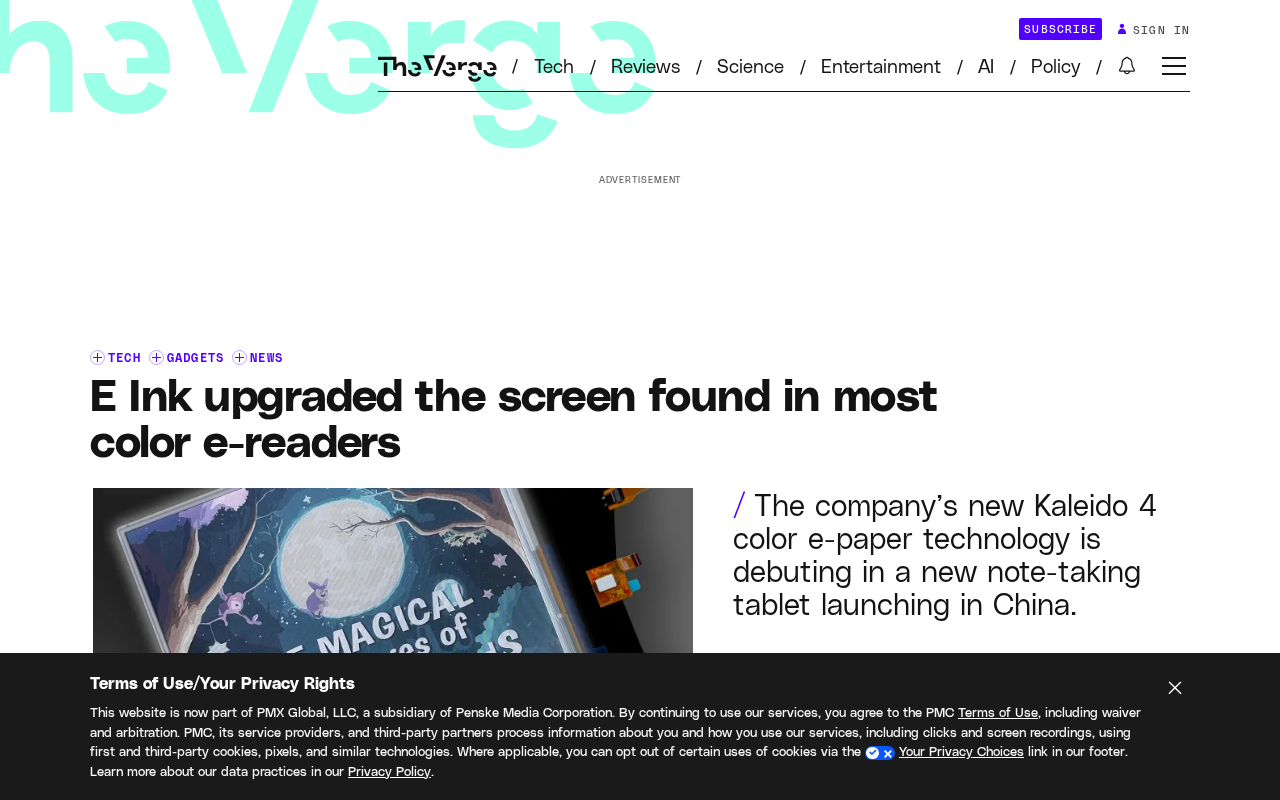
What Exactly Has Kaleido 4 Changed
E Ink officially positions Kaleido 4 as "next-generation color e-paper," with core improvements focused on three areas: color performance, refresh performance, and contrast.
According to the official statement, Kaleido 4 delivers a noticeable improvement in color saturation. The light transmission efficiency of the color filter layer has been optimized, so displaying color content no longer looks as washed-out and dim as the previous generation. For content like comics, illustrations, and color magazines, the visual improvement will be quite noticeable.
In terms of refresh rate, Kaleido 4 supports faster page update speeds. E-paper refresh has always been a pain point for user experience, especially when turning pages, zooming, and browsing color content, where ghosting and flickering issues are prominent. The optimization in this new generation means color e-readers will feel closer to regular tablets in terms of interaction smoothness.
Contrast is also a key improvement area mentioned. Kaleido 3's color mode contrast was relatively low, and text edges weren't sharp enough under color display. Kaleido 4, through adjustments to panel structure and driving solutions, delivers clearer rendering for both black-and-white text and color images.
Who's Using It and How Big the Impact Is
The Kaleido series is the de facto standard in today's color e-paper market. Kobo's Libra Colour, PocketBook's Color series, and multiple Boox color devices all rely on Kaleido 3 at their core. Although Amazon's Kindle Colorsoft uses a custom version, its technical foundation also comes from Kaleido.
This means the release of Kaleido 4 isn't just a technology iteration for E Ink alone—it's a foundational upgrade for the entire color e-reader category. Once the panels enter mass production and are made available to partner manufacturers, the next generation of color readers and tablets will likely collectively switch to the new platform.
From a competitive landscape perspective, E Ink's dominant position in the e-paper field remains solid. Although other color e-paper solutions exist on the market (such as the Gallery series), Kaleido firmly holds the mid-range color e-reader market thanks to its cost and yield advantages. The introduction of Kaleido 4 further widens the gap with other solutions in overall experience.
Kindle Colorsoft is Amazon's first color e-reader, launched in 2024, with its screen solution custom-developed by E Ink for Amazon. Although the custom name Saffron hints at differences from standard Kaleido 3, the core technical principle is still based on Kaleido's color filter architecture. Amazon has done additional color calibration and dithering algorithm optimization at the software level to improve the display of color content. This means Kaleido 4's technological advances could similarly be passed on to Amazon's future color Kindle products through custom partnerships. For the entire industry, when the largest e-reader brand is also using Kaleido's underlying technology, E Ink's technology iterations effectively determine the experience ceiling for the entire color e-reader category.
The Bottleneck and Breakthrough of Color E-Paper
Color e-paper has long faced a fundamental contradiction: to have color, you need to add color filters, and filters significantly reduce light transmission, causing the screen to darken and contrast to drop. The criticized "washed-out color mode" of Kaleido 3 stems from exactly this.
Kaleido 4's improvement approach is to simultaneously optimize filter materials, pixel structure, and driving algorithms. E Ink hasn't disclosed specific light transmission figures, but judging from the improvement magnitude described officially, this generation should deliver perceptible gains in color brightness and refresh response.
Another dimension worth noting is power consumption. One of e-paper's core selling points is ultra-long battery life, and any performance improvement at the expense of battery life would trigger user dissatisfaction. E Ink emphasized in its announcement that the new technology still maintains e-paper's low power consumption characteristics—a key signal for e-reader manufacturers.
Color Filter Array is key to understanding color e-paper. E Ink's e-paper is essentially a reflective display technology: tiny charged particles move up and down under electric field driving to form black-and-white pixels. To make these black-and-white pixels display color, a color filter layer needs to be overlaid on top of the screen—each pixel is divided into red, green, blue, and white sub-pixels, with the white sub-pixel having no filter treatment and the other three each covered by a filter layer of the corresponding color. The problem is that red, green, and blue filters absorb most of the incident light, allowing only about one-third of the visible spectrum to pass through, which causes overall brightness to drop significantly. The saturation and contrast of color images are also limited as a result, visually manifesting as "washed-out." This is the root cause of the Kaleido series' long-standing criticism, and it's also the direction where E Ink needs to continuously optimize material light transmission and pixel arrangement.
The Gallery series is another color e-paper product line under E Ink, taking a different technical approach from Kaleido. Kaleido is based on the color filter solution, while Gallery uses a microcup structure, where each microcapsule contains cyan, magenta, yellow, and white pigment particles. Different voltages drive specific color particles to float to the surface, achieving color display. Gallery doesn't require an additional filter layer, theoretically offering higher color saturation, but the drawbacks are extremely slow refresh speeds, high cost, and low yield. Therefore, it's mainly used in electronic shelf labels, public displays, and other scenarios with low refresh requirements, and is rarely applied in consumer e-readers. Kaleido, with its mature manufacturing process and lower cost, has become the mainstream choice for mid-range color e-readers—which is the context behind the article's mention that "Kaleido firmly holds the mid-range market thanks to its cost and yield advantages."
What It Means for Regular Users
If you're considering buying a color e-reader, the release of Kaleido 4 provides a clear reason to wait. The shortcomings of existing Kaleido 3 devices in color display are widely acknowledged, and if the new generation delivers on its promises in color and refresh, the experience gap will be quite obvious.
For users who already own Kaleido 3 devices, there's no rush to upgrade in the short term. It typically takes months from E Ink's technology announcement to end products hitting the market, and first-batch devices featuring Kaleido 4 may be priced on the higher side. Waiting until the technology matures and more manufacturers follow suit before considering an upgrade is more rational.
From a longer-term perspective, color e-paper is gradually narrowing the gap with LCD/OLED in color display while maintaining advantages in eye protection and battery life. Kaleido 4 is an important step on this evolutionary path, but there's still a distance to go before "color e-readers completely replace tablets." Refresh rate, color accuracy, and cost remain hurdles that need continuous breakthroughs.
One-line Summary
E Ink launches Kaleido 4 color e-paper technology, upgrading the color e-reader experience in color, refresh, and contrast
Paragraph Summary
E Ink has officially announced its next-generation Kaleido 4 color e-paper technology, focusing on improvements in color saturation, refresh speed, and contrast. As the de facto standard in the color e-reader market, the Kaleido series is widely adopted by Kobo, PocketBook, Boox, and Kindle Colorsoft, so this upgrade will impact the entire category. Kaleido 4 addresses the previous generation's core pain point of "washed-out color mode" by optimizing color filter light transmission efficiency and improving panel structure and driving solutions. However, it typically takes months from technology announcement to end products hitting the market, so existing Kaleido 3 users need not rush to upgrade—waiting until more manufacturers follow suit before considering a switch is more rational.
Related articles

Cursor AI Programming in Practice: Build a Student Management System from Scratch in 30 Minutes
A Bilibili creator demonstrates Cursor AI programming: generating a student management system in 30 minutes with natural language. Details on Agent mode, Claude selection, prompt techniques, and thresholds.

Top 20 AI Coding Tools Ranking: From Rock-Solid to Lackluster, a Scored Matrix
Bilibili creator releases top 20 AI coding tools ranking, tiered T0–T4 from rock-solid to lackluster, with Claude Code and Codex tied at T0. This article details the scoring dimensions (capability, reliability, robustness, durability, cost, domestic availability) and tool performances to help developers choose the right AI coding assistant.

Vibe Coding Systematic Tutorial: Master AI-Assisted Programming from Zero
A three-month Vibe Coding tutorial from a Bilibili creator covering Codex, ClaudeCode, and Cursor, from core logic to commercial project practice for beginners.