EDA Framework: How Traceable Evidence Restructures Multimodal Depression Analysis

The EDA framework splits depression assessment into Observe, Verify, Assess, producing a traceable evidence chain.
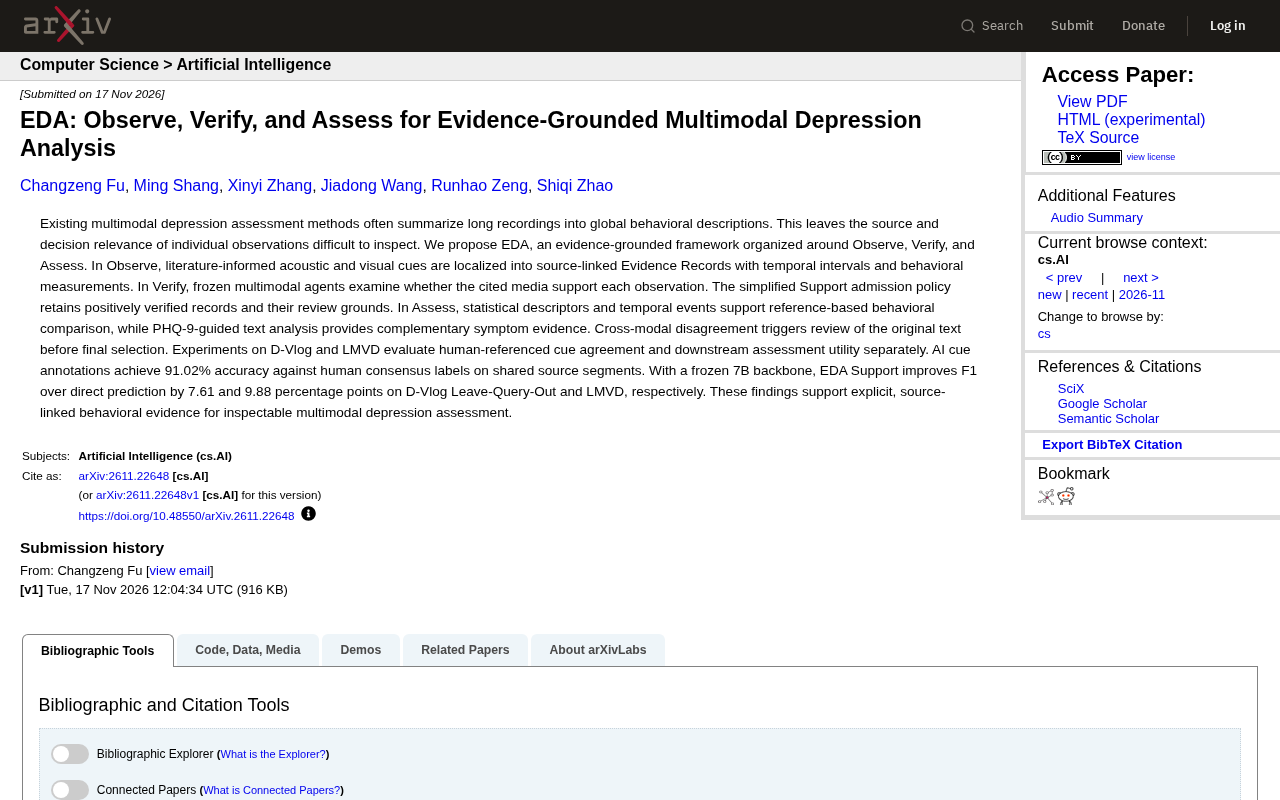
To address multimodal depression models that score but can't explain, researchers propose EDA. Observe locates acoustic and visual cues to time intervals as evidence records bound to source segments; Verify uses a frozen multimodal agent to keep only supported evidence, hitting 91.02% accuracy vs. human labels; Assess combines statistical descriptors with PHQ-9-guided text analysis and reviews conflicts. With a frozen 7B backbone, F1 improves 7.61 and 9.88 points on D-Vlog and LMVD.
Multimodal depression assessment has long faced an awkward problem: models can produce a score, but it's hard to explain where that score comes from. When long recordings are compressed into a single global behavioral description, the source and decision relevance of individual observations become difficult to trace. To address this pain point, researchers propose the EDA (Observe, Verify, Assess) framework, which breaks depression analysis into an inspectable evidence chain.
From Global Summaries to Evidence Records: Designing the Observation Stage
The first step of EDA, Observe, does not make predictions directly. Instead, it locates existing acoustic and visual cues from the literature to specific time intervals, generating Evidence Records with behavioral measurements. These records are bound to source media segments, so every observation can be traced back to the specific piece of audio or video it came from.
This design contrasts with traditional end-to-end methods. The latter often encode an entire interview into a single vector, losing the temporal location of local behavioral cues. EDA explicitly writes out "what the model saw," providing an actionable object for subsequent verification.
The Verification Stage: Letting a Frozen Multimodal Agent Review Evidence
The Verify stage introduces a frozen multimodal agent that checks one by one whether the cited media segments actually support the corresponding observations. The system adopts a simplified Support admission policy: only records that pass positive verification, along with their review rationale, are retained.
According to the original paper, AI cue annotations achieve 91.02% accuracy against human consensus labels on shared source segments. This means automatically generated evidence records approach the quality of manual annotation, providing reliable input for downstream assessment. The use of a frozen model also shows that the value of evidence filtering does not depend on fine-tuning the backbone network.
"Frozen backbone" refers to a pretrained large model that remains unchanged throughout the method pipeline and does not participate in gradient updates. Its parameters are completely fixed, and it is used only as a feature extractor or inference agent, so it consumes no additional fine-tuning compute and carries no overfitting risk from small downstream datasets. In this kind of evidence-filtering framework, the frozen model plays two roles at once: first, it provides a stable multimodal judgment baseline so that evidence admission criteria do not fluctuate with training; second, it keeps the method plug-and-play, allowing researchers to apply the same Observe-Verify-Assess pipeline directly to any off-the-shelf multimodal model. The cost is that the model cannot adjust its internal representations for a specific dataset, and the performance ceiling is constrained by the original model's capability—which also explains why the experiments emphasize that improvements under the "frozen 7B" condition are comparable.
The Assessment Stage: Complementary Statistical Descriptions and Symptom Text
The Assess stage uses statistical descriptors and temporal events for reference-based behavioral comparison, while PHQ-9-guided text analysis provides complementary symptom evidence. When cross-modal inconsistency occurs, the system triggers a review of the original text before making the final choice.
This design places structured behavioral signals and scale-guided semantic analysis on the same decision chain rather than simply concatenating features. The mechanism for handling cross-modal conflicts is especially critical, as it prevents misjudgments from a single modality from propagating directly to the final conclusion.
PHQ-9 (Patient Health Questionnaire-9) is a widely used nine-item depression screening scale in clinical practice, covering dimensions such as anhedonia, depressed mood, sleep disturbance, fatigue, appetite changes, self-negation, concentration difficulties, psychomotor retardation, and suicidal ideation. Its total score ranges from 0 to 27, with 5/10/15/20 commonly used as reference thresholds for mild, moderate, moderately severe, and severe depression. In multimodal analysis, PHQ-9 is not only a source of labels; its item wording can also serve as a semantic prior for text analysis: the system can search interview transcripts for corresponding descriptions around the scale's symptom expressions, thereby mapping free-form narratives onto structured symptom dimensions. This scale-guided text analysis complements acoustic and visual statistical descriptors—the former provides semantic-level symptom evidence, while the latter provides behavioral-level quantitative evidence, and the two cross-validate each other on the decision chain rather than being simply concatenated.
Experimental Performance: The Gains from Evidence Support
On the D-Vlog and LMVD datasets, experiments evaluated the consistency between cues and human references as well as downstream assessment utility. Under the frozen 7B backbone condition, EDA Support improved F1 by 7.61 and 9.88 percentage points over direct prediction on D-Vlog Leave-Query-Out and LMVD, respectively.
These numbers should be understood in context: the gains do not come from a larger model or more training, but from how the evidence is organized. A frozen backbone means the method can be layered directly onto existing models, lowering the barrier to deployment.
D-Vlog and LMVD are two commonly used multimodal depression detection datasets. D-Vlog is based on video blog (vlog) style self-narratives and contains segment-level emotion and depression-related labels, making it suitable for examining fine-grained cues; LMVD targets interview-style scenarios and includes structured Q&A and scale ratings. Leave-Query-Out, mentioned in the text, is a leave-one-query-out cross-validation protocol: each time, a query sample or query group is completely excluded from the reference set, a behavioral comparison reference baseline is built from the remaining data, and then the held-out sample is evaluated. This protocol is stricter than random splitting and can test whether the model truly relies on generalizable behavioral evidence rather than memorizing patterns of specific subjects. F1 is the harmonic mean of precision and recall; in depression binary classification or threshold determination, it better reflects balanced positive identification than accuracy alone.
Why Inspectability Matters
Depression assessment is a high-stakes application scenario, and clinical users need to know the basis for a judgment. The core contribution of EDA is not topping some leaderboard metric, but making every behavioral observation traceable and reviewable. When model outputs disagree with clinician judgments, evidence records provide concrete handles for discussion.
Of course, the completeness of the evidence chain still depends on the coverage of the cue library, and the review logic for cross-modal conflicts needs validation in more scenarios. But introducing "inspectability" as a first-class citizen into multimodal depression analysis is a direction worth watching.
One-line Summary
The EDA framework breaks depression assessment into three stages—Observe, Verify, Assess—generating a traceable evidence chain.
Paragraph Summary
To address the problem that multimodal depression assessment models can produce scores but struggle to explain their basis, researchers propose the EDA (Observe, Verify, Assess) framework. The Observe stage locates acoustic and visual cues to specific time intervals, generating evidence records bound to source media segments, replacing the global vector compression of traditional end-to-end methods. The Verify stage uses a frozen multimodal agent to review each piece of evidence for segment support, retaining only records that pass positive verification; AI cue annotations achieve 91.02% accuracy against human consensus labels. The Assess stage combines statistical descriptors with PHQ-9-guided text analysis and triggers original text review when cross-modal inconsistency occurs. Under the frozen 7B backbone condition, EDA Support improves F1 by 7.61 and 9.88 percentage points on D-Vlog and LMVD, respectively, showing that the gains come from how evidence is organized rather than model scale.
Related articles
ClawDOS: Bringing AI Coding Capabilities to DOS
ClawDOS is an AI coding agent project for DOS, exploring the possibility of bringing AI coding assistance into resource-constrained retro computing environments. This article analyzes its positioning, use cases, and community response.

Baseten Releases Bison-1 and Groundhog-1, Topping the Decision Model Leaderboard
Baseten releases open-weight decision models bison-1 and groundhog-1 built on Gemma 4; bison-1 scores 76 on the AA Decision Index v2.1 to top the leaderboard. Both support 128k context and image input—here we analyze their capability combination, benchmark significance, and selection advice for developers.

Cline CLI v3.0.75 Released: Yolo Mode Now Default for One-Shot Runs
Cline CLI v3.0.75: one-shot runs now default to yolo mode, --timeout and Ctrl+C can interrupt the first round, read_files is no longer truncated to 8k chars, plus reasoning parameter fixes and 94 new providers.