EFF Urges Appeals Court: ALPR Searches Require a Warrant

EFF argues to an appeals court that ALPR database searches require a warrant, drawing a judicial review red line for automated surveillance.
The Electronic Frontier Foundation (EFF) filed a legal brief with an appeals court requiring law enforcement to obtain a warrant before conducting large-scale searches of automated license plate recognition (ALPR) databases. The article notes that while a single ALPR scan seems harmless, data aggregation can reconstruct a person's long-term travel history, making it as intrusive as a traditional search. The EFF invokes Fourth Amendment privacy logic, emphasizing that judicial review is a necessary procedure to prevent abuse of power. Hacker News discussion is divided, with one side worried about privacy erosion and the other concerned that warrants would slow urgent-case law enforcement. The article argues the case essentially draws a procedural legal red line for AI-driven automated surveillance, reminding tech practitioners that convenience and privacy bottom lines require ongoing institutional negotiation.
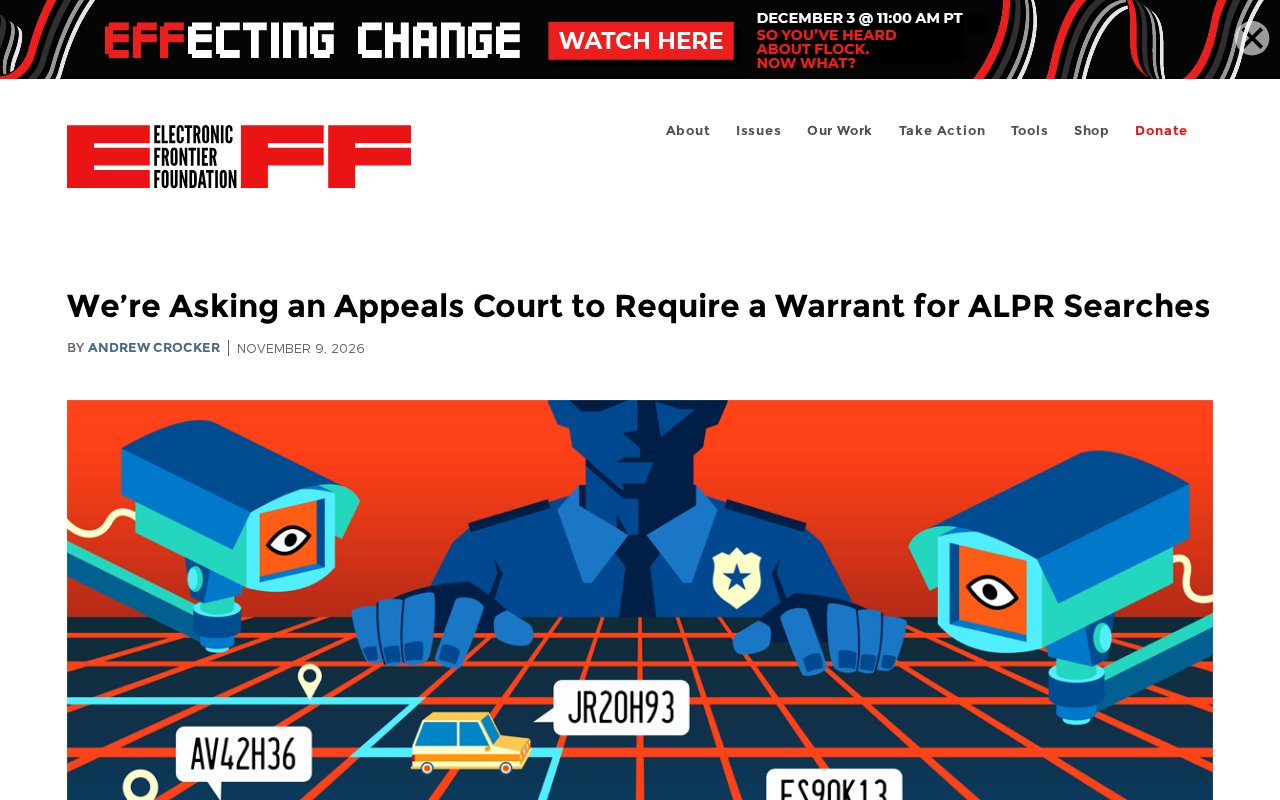
The Electronic Frontier Foundation (EFF) recently filed a legal brief with an appeals court arguing that law enforcement agencies must obtain a warrant before conducting large-scale searches of automated license plate recognition (ALPR) systems. The motion directly targets the legal gray area surrounding current surveillance technology and once again pushes the conflict between "technological convenience and citizen privacy" to the forefront of the judiciary.
What Is ALPR, and Why It Deserves Caution
Automated License Plate Recognition (ALPR) systems use cameras to continuously scan vehicle license plates on the road, recording plate numbers, timestamps, and geographic locations. A single scan may seem like nothing more than taking a photo, but the real risk lies in data aggregation: when data from thousands of cameras is fed into a single database, law enforcement can retrace any vehicle's travel history and reconstruct a person's daily movement patterns.
This capability goes beyond "observation" in the traditional sense. In its brief, the EFF points out that a broad query of an ALPR database is essentially long-term, systematic surveillance of a person's public activities—an intrusion comparable to a traditional search.
The Fourth Amendment is the core provision of the U.S. Constitution protecting citizens from unreasonable searches and seizures. It states that the right of the people to be secure in their persons, houses, papers, and effects against unreasonable searches and seizures shall not be violated, and that no warrants shall issue but upon probable cause, supported by oath or affirmation. Around this amendment, U.S. judicial practice has long debated whether individuals have a reasonable expectation of privacy in their activities in public spaces. Traditionally, police visually observing vehicles on public roads did not constitute a search under the Fourth Amendment, but ALPR's continuous recording and data aggregation blur this distinction. The EFF's argument seeks to invoke the "mosaic theory"—that when scattered pieces of information are aggregated to reveal the overall picture of a person's life, it should be treated as an independent search, thereby triggering the warrant requirement.
The EFF's Legal Argument: A Warrant Is the Baseline
The EFF's core demand to the appeals court is clear: law enforcement agencies should obtain a warrant based on probable cause before searching an ALPR database. This argument rests on the privacy protection logic of the Fourth Amendment—when the government seeks to obtain detailed information about a person's life, it should not bypass judicial review.
The EFF is not opposed to law enforcement's use of technology, but demands that such use be subject to the same legal constraints as other searches. An ALPR search without a warrant means law enforcement can query citizens' travel records in bulk without any external oversight—a power lacking checks and balances.
Probable cause is the core evidentiary standard in the U.S. warrant system, requiring law enforcement to present specific facts to a judge sufficient to make a reasonable person believe that a crime has occurred or that evidence exists in a particular place. This standard is higher than the "reasonable suspicion" required for a stop-and-frisk and higher than the "reasonableness" standard in administrative inspections. In the ALPR dispute, if law enforcement can show that a specific vehicle is connected to a crime under investigation, it can apply for a warrant targeting that vehicle; what the EFF opposes is the practice of bulk retrieval of all vehicles' historical travel records based on broad queries without any individualized connection. Notably, some states have passed legislation requiring ALPR data to be deleted after a short period (e.g., a few weeks) or restricting its use for immigration enforcement—state-level practices that provide a reference for the appeals court's ruling.
Community Reaction and Points of Contention
In the Hacker News discussion (the post received 260 points and 72 comments), developers and privacy advocates showed clear divisions. Supporters argue that the aggregation effect of ALPR data makes it more intrusive than single-instance surveillance, and that the law must keep up with technological reality; opponents worry that mandatory warrants would slow law enforcement efficiency and cause delays in urgent cases (such as missing persons or violent crime investigations).
The essence of this debate is: are we willing to cede some unsupervised surveillance power in exchange for efficiency? The EFF's position is that judicial review is not the opposite of efficiency, but a necessary procedure to prevent abuse of power.
Hacker News is a tech community operated by Y Combinator, known for its high concentration of developers, entrepreneurs, and privacy researchers, with post popularity driven by both votes and comments. 260 points and 72 comments represent a moderately high level of discussion in this community, typically indicating that a topic has touched on controversial territory in tech ethics. Discussions of surveillance issues in this community often show two typical positions: one camp emphasizes verifiable institutional constraints and code transparency, while the other defends technology deployment from the standpoint of engineering efficiency and security needs. This division is no accident—it reflects the lack of consensus among tech practitioners on the question of "what purposes the tools we build are used for," and explains why the EFF's legal action struggles to gain unanimous support within the community.
Broader Implications for AI and Surveillance Technology
ALPR is just one of many automated surveillance tools. As AI visual recognition capabilities improve, similar systems are being applied in more scenarios—from traffic management to crowd analysis. The EFF's legal action is, in effect, drawing a procedural red line for all surveillance technologies based on large-scale data collection: the more automated the technology, the more it needs a clear judicial authorization mechanism to constrain its scope of use.
For tech practitioners, this is a reminder: the convenience of tools and society's privacy bottom line require ongoing institutional negotiation, not merely the self-restraint of technical teams.
Related articles

No Coding Required: He Shipped an App Store App by 'Cutting Features' and Nitpicking with AI
A game designer with zero frontend/backend skills shipped a dual-platform App Store app with AI—not via one-click generation, but by cutting scope and nitpicking like a demanding client.
What Is Harness Engineering? From Concept Origins to Enterprise-Level Agent Implementation
What is Harness Engineering? This article traces the concept's origins and analyzes enterprise-level Agent requirements for tool call fault tolerance, data security, tenant isolation, and memory gaps.

Coze in Practice: A Three-Tier Agent Classification and a Multi-Agent Collaboration Guide
A Bilibili tutorial breaks down the multi-agent collaboration toolchain into three categories: building platforms like Coze Studio and Dify, Agent software like Claude Code, and development frameworks like LangChain—plus a Coze demo of industry templates, three-platform interoperability, local Agent integration, and the trade-offs of credit consumption.