Email Identity Management for Multiple AI Agents: Aliases, Dedicated Inboxes, or API Solutions?
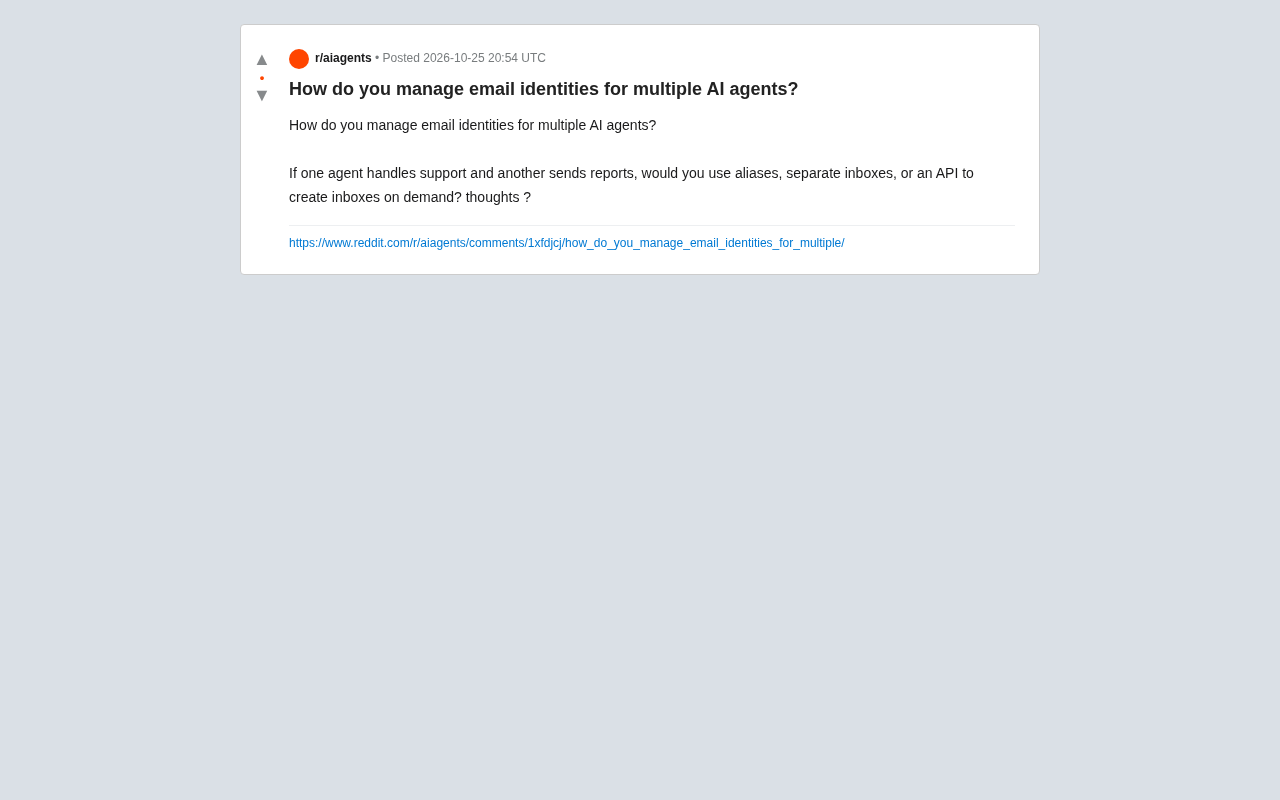
Email identity management for multiple AI agents requires layered management by role, trading off between isolation and operational cost.
The article explores email identity management challenges in multi-AI-agent deployment, noting that email identity is both a security boundary and a collaboration entry point. It analyzes three approaches—email aliases (low cost, weak isolation), dedicated inboxes (thorough isolation, heavy ops burden), and API on-demand creation (suited for dynamic and multi-tenant scenarios)—and recommends layered management by agent role and risk level, emphasizing separation of sending and receiving identities, unified inventory management, and least privilege.
When an enterprise deploys multiple AI agents, a seemingly minor issue that directly impacts operational efficiency comes to the surface: does each agent need its own email identity? And how should these identities be managed? A developer's question on Reddit sparked discussion: with one agent handling customer service and another sending reports, should you use email aliases, dedicated inboxes, or create inboxes on demand via API?
Behind this question lies an "identity infrastructure" challenge that inevitably arises as AI agents move from single-point experiments to large-scale deployment. Email, as the most universal asynchronous communication protocol, often becomes the first entry point for interaction between agents and humans, and between agents and external systems.
Why Email Identity Management Has Become a New Pain Point in Agent Operations
Managing a single AI agent with one dedicated email account isn't complicated. But when the number of agents grows to three, five, or even dozens—each responsible for different duties like customer service, reporting, alerting, and approvals—email identity becomes infrastructure that requires systematic design.
The core tension is that email identity is both a security boundary and a collaboration entry point. A customer service agent's inbox needs to be publicly accessible and receive messages from unknown users; a reporting agent's inbox is primarily for internal sending and should not be exposed externally. If all agents share one inbox, permissions cannot be isolated, and a single misdirected email could let the customer service agent read a financial report intended only for management. Conversely, if each agent gets a brand-new inbox, accounts proliferate, and credential management, monitoring, and archiving all become cumbersome.
The three approaches listed by the Reddit questioner—aliases, dedicated inboxes, and API on-demand creation—correspond precisely to three management philosophies ranging from lightweight to heavyweight, and from static to dynamic.
Approach 1: Email Aliases—Lightweight but with Blurred Boundaries
Email aliases are the easiest approach to get started with. Configure aliases like support@, reports@, and alerts@ under the same primary mailbox, and all emails ultimately land in the same inbox, with agents distinguishing tasks by recipient address.
The advantage of this approach is extremely low configuration cost—one domain and one email service provider account can cover multiple agent identities. For small teams or early validation stages, aliases are sufficient. But its drawbacks are obvious: all agents share the same underlying mailbox credentials, making security isolation essentially nonexistent. Once a processing logic flaw appears in one agent, or one agent needs to be outsourced to a third party, the shared inbox becomes a data leakage risk.
Additionally, the alias approach lacks flexibility in email routing. If the customer service agent needs to auto-reply and trigger a ticketing system, while the reporting agent needs to store attachments in cloud storage, a shared inbox means all automation logic must be squeezed into the same entry point for routing, and complexity grows linearly with the number of agents.
Email Alias is a basic routing mechanism in email systems: multiple recipient addresses are registered under the same underlying mailbox account, and the mail server delivers emails to the same inbox based on the recipient address. Aliases do not create new storage space or independent credentials, so all aliases share the same set of authentication information and quotas.
In self-hosted email systems, aliases are typically implemented through Postfix's virtual_alias_maps or Dovecot's alias configuration; in cloud email services, alias records are added through the management console or API. The key point to understanding aliases is this: what it changes is the "address" rather than the "identity"—the recipient sees support@ or reports@, but the underlying mailbox remains the same. This means aliases can provide multiple external addresses at low cost, but cannot provide true permission isolation or independent audit trails.
Approach 2: Dedicated Inboxes—Thorough Isolation but High Operational Cost
Creating a dedicated mailbox account for each agent is the most thorough approach to security isolation. Each agent has its own address, credentials, and storage space, with clear permission boundaries, and audit logs are easier to split by agent dimension.
But the price of dedicated inboxes is operational burden. Each mailbox needs separate configuration, monitoring, renewal, and password rotation. When agents need temporary scaling or decommissioning, manually creating and cleaning up mailboxes cannot keep pace with changes in the agent lifecycle. For teams that need to rapidly experiment with new agent scenarios, this static mailbox allocation approach slows down iteration.
Another easily overlooked issue is email reputation. Newly created dedicated mailboxes often have no sending history, and emails sending reports or notifications easily end up in recipients' spam folders. If each agent uses a brand-new mailbox for outbound email, the accumulation of domain reputation is fragmented, and overall deliverability actually declines.
Email Reputation is a mechanism used by email service providers and recipients to assess the trustworthiness of sending sources, primarily based on a domain's SPF, DKIM, and DMARC configuration as well as historical sending behavior (complaint rate, bounce rate, spam trap hit rate, etc.). New domains or new mailboxes have no sending history, leaving recipients without a basis for judgment, so they often first route them to spam folders or apply stricter filtering.
Building domain reputation takes time and a stable sending pattern. If multiple agents each use dedicated mailboxes but share the same domain, any improper sending behavior by one agent (such as high-frequency sending or recipient complaints) can drag down the reputation of the entire domain, affecting all agents. Therefore, while the dedicated inbox approach improves isolation, it also requires unified governance of sending behavior; when necessary, subdomains or independent sending IP pools can be configured for sending scenarios of different risk levels.
Approach 3: API On-Demand Inbox Creation—Dynamic but Requires Governance
The approach of creating inboxes on demand via API suits scenarios where the number of agents changes dynamically or a multi-tenant architecture is adopted. Through the API provided by the email service provider, a dedicated inbox is automatically created when an agent starts and automatically reclaimed when the agent goes offline, binding identity to lifecycle.
This approach achieves a good balance between flexibility and isolation. Each agent still has an independent identity, but the creation and destruction processes are automated without manual intervention. For customer service scenarios that require temporarily allocating email identities for each customer session, the API approach is almost the only viable choice.
However, the API approach introduces new governance issues. Automatically created inboxes need to be incorporated into unified naming conventions and metadata management, otherwise they quickly become a pile of "orphan mailboxes" whose ownership cannot be traced. At the same time, API credentials themselves become high-value targets; once leaked, attackers can create mailboxes in bulk for spam or phishing. Therefore, the API approach must be paired with strict access control, rate limiting, and creation auditing.
Multi-tenancy refers to a single system instance providing services to multiple isolated tenants (customers or business units), where each tenant can only access its own data and configuration. In email identity management, multi-tenancy means dynamically allocating independent email identities for each tenant or each session, avoiding cross-tenant data interference.
API on-demand inbox creation is a common means of supporting multi-tenant email isolation: when an agent serves a tenant, it instantly creates an inbox dedicated to that tenant through the email service provider's API, and reclaims it after the session ends. This requires the email service provider's API to support programmatic creation, configuration, and deletion of mailboxes, and to provide tenant-dimension metadata tagging for subsequent auditing and billing. In multi-tenant scenarios, namespace design for email identities, quota isolation, and cross-tenant access control are core issues that must be planned in advance.
How to Choose: Layer by Agent Role and Risk Level
The three approaches are not mutually exclusive. A more pragmatic approach is to manage them in layers according to agent role and risk level.
For externally facing agents, such as customer service and sales, it is recommended to use dedicated inboxes or API dynamic creation to ensure isolation from internal systems and facilitate a professional external image. For internally facing agents, such as reporting and alerting, aliases or shared inboxes can be used, routing by recipient address to reduce operational costs. For temporary, experimental agents, API on-demand creation is most suitable—use and discard, leaving no long-term burden.
Regardless of which approach is chosen, three bottom lines are worth upholding: First, separate sending identity from receiving identity, avoiding an agent using the same mailbox to both receive user input and send outbound email, reducing the risk of forgery and abuse; second, incorporate all email identities into a unified inventory management, recording the owning agent, purpose, and lifecycle; third, configure least privilege for email identities, so that agents can only read and process emails within the scope of their responsibilities.
Email identity management may seem like a peripheral detail in agent architecture, but it directly relates to the trust boundaries between agents and the professionalism of external interaction. As the number of agents grows, designing email identity as infrastructure early on is far less effort than remediating later.
One-line Summary
Email identity management for multiple AI agents requires layered management by role, trading off between isolation and operational cost.
Paragraph Summary
The article explores the challenges of email identity management in multi-AI-agent deployment, noting that email identity is both a security boundary and a collaboration entry point. The author analyzes three approaches: email aliases have low configuration cost but weak security isolation, suitable for internal low-risk agents; dedicated inboxes provide thorough isolation but carry heavy operational burden and fragment domain reputation; API on-demand inbox creation suits dynamic and multi-tenant scenarios but requires accompanying naming conventions, access control, and auditing. The article recommends layered management by agent role and risk level: use dedicated or API-created inboxes for external agents, aliases for internal ones, and API dynamic creation for temporary experiments, while emphasizing three bottom lines: separation of sending and receiving identities, unified inventory management, and least privilege.
Related articles
The LLM Price War: Why Did OpenAI and Anthropic Cut Prices by 80%?
OpenAI and Anthropic cut LLM prices by up to 80% in months. This article analyzes the competition, technology costs, business model shifts, and industry impact behind the price war.
iFixit Teardown of iPhone Duo: Uncovering Foldable Screen Crease and Hinge Flaws
iFixit tears down the iPhone Duo, revealing crease-hiding technology and hinge design, giving a 5/10 repairability score, and analyzing screen and hinge damage causes and impacts on users.
Long Computers, Short AI Infrastructure: One Investor's Contrarian Logic
An investor on Hacker News argues for being long computers but short the AI infrastructure boom. We unpack why technological certainty and capex returns are two different things.