Ember: A Free, Open-Source Slack Alternative for One-Click Deployment on Cloudflare
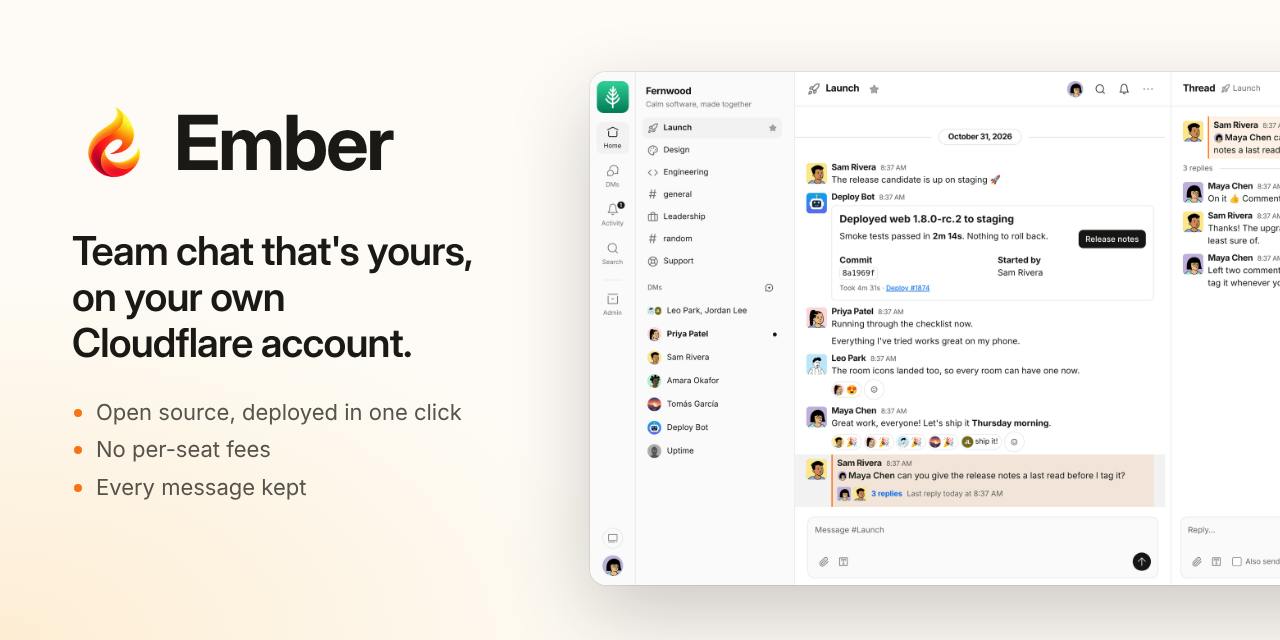
Ember is a free, open-source chat tool with one-click deployment to Cloudflare's free tier, Slack compatibility, and a built-in AI assistant.
Ember is a free, open-source chat tool launched on Product Hunt, inspired by Slack and Campfire, featuring one-click deployment to Cloudflare's free tier for zero-cost hosting. It supports Slack-compatible payloads for easy migration of existing bots and includes a built-in AI assistant and media attachments. Data is stored in the user's own Cloudflare account, making it suitable for privacy-conscious small teams or developers. However, Ember lacks depth in features, missing video conferencing and workflow automation, with unknown mobile support, and its community activity and long-term maintenance as a new project remain to be seen. The article suggests that for technically capable, budget-limited small teams, Ember is worth trying; otherwise, mature solutions like Slack or Mattermost are safer.
Introduction
In the team collaboration tools space, Slack has long held a dominant position, but its high subscription fees and closed-source nature deter many teams. Recently launched on Product Hunt, Ember aims to change this: it's a free, open-source chat tool inspired by Slack and Campfire, with support for one-click deployment to Cloudflare, leveraging the free tier for zero-cost hosting.
Ember was developed by Kevin Rose and currently has 65 votes, ranking 19th for the day. Despite zero comments, its selling points of "free hosting" and "Slack compatibility" have caught the attention of some developers and startup teams. This article analyzes Ember's potential and limitations from the perspectives of features, deployment, and use cases.
Core Features: Slack Compatibility and AI Assistant
Ember isn't a simple clone—it emphasizes interoperability with Slack. According to its description, Ember supports Slack-compatible payloads, meaning existing Slack apps or bots may be migrated without extensive modifications. Additionally, Ember includes a built-in AI assistant and media attachments, aiming to provide a more modern experience on top of basic chat.
For small teams, these features are sufficient to cover daily communication needs. The AI assistant can help summarize conversations or answer questions, while media attachments support image and file sharing. However, Ember hasn't disclosed details about the AI assistant's implementation (such as which model it uses or whether customization is supported), which may affect technical teams' evaluation.
Slack-compatible payloads refer to Ember's ability to parse and generate JSON data structures in the same format as the Slack API. Slack's Events API, Webhooks, and interactive components all use specific fields (such as type, channel, text) to transmit information. If Ember follows this specification, existing Slack bots only need to change the request endpoint URL to continue working. This reduces migration costs, but the degree of compatibility depends on how much of the Slack API subset Ember implements. Currently, Ember hasn't published its compatibility matrix, so developers need to test key features (such as slash commands and button interactions) themselves to see if they work.
One-Click Deployment and Zero-Cost Hosting
Ember's biggest highlight is one-click deployment to Cloudflare. With Cloudflare's free tier, users can run Ember on the edge network without building their own servers or paying for cloud hosting. The official claim is "hosting costs $0," thanks to Cloudflare's free quotas (such as Workers, D1 database, etc.).
This model is highly attractive to individual developers, open-source projects, or budget-constrained startups. However, note that free tiers typically have limits on requests, storage, etc. If the team grows or message volume surges, an upgrade to a paid plan may be necessary. Ember hasn't specified these limits on its Product Hunt page, so users need to check Cloudflare's pricing documentation themselves.
Cloudflare Workers and D1 database are key to understanding Ember's hosting model. Workers is Cloudflare's serverless computing platform that allows developers to run JavaScript code on edge nodes, with a free tier providing 100,000 requests per day. D1 is Cloudflare's lightweight relational database based on SQLite, with a free version offering 5GB of storage and 5 million read operations per day. Ember uses these two services to store chat messages and enable real-time interaction, giving users a globally distributed, low-latency experience without managing servers. However, the free tier's request limits mean highly active teams may quickly hit quotas, requiring an upgrade to the Workers Paid plan (starting at $5/month) or architecture optimization to reduce calls.
Open Source and Data Sovereignty
As an open-source project, Ember allows users to review code, modify features, and fully control their data. Compared to SaaS services like Slack, Ember stores data in the user's own Cloudflare account, avoiding privacy concerns associated with third-party hosting. For teams focused on data security (such as in healthcare or finance), this could be a key decision factor.
However, open source also means maintenance responsibility shifts to users. Ember's update frequency, community activity, and security patch response times are unclear. The Product Hunt page shows zero comments, and the GitHub repository's star count and issue status aren't mentioned, so its long-term sustainability remains to be seen.
Mattermost is a mature open-source Slack alternative mentioned in the article, often used as a comparison reference. It offers a self-hosted version with rich enterprise features (such as LDAP integration, compliance exports, multi-factor authentication), but requires users to maintain their own servers and databases, making deployment more complex than Ember's one-click Cloudflare model. Mattermost's community edition is free, while the enterprise edition is priced per user. Ember is positioned as more lightweight, suitable for small teams that don't need complex management features, while Mattermost is better for mid-to-large organizations with compliance requirements. The maturity gap in the open-source ecosystem is significant: Mattermost has thousands of contributors and comprehensive documentation, while Ember is in its early stages.
Use Cases and Potential Challenges
Ember is suitable for the following scenarios:
- Small teams or side projects: Need a lightweight chat tool and want to control costs.
- Developer teams: Familiar with the Cloudflare ecosystem and willing to deploy and maintain it themselves.
- Organizations sensitive to data privacy: Want full control over chat data.
But the challenges are also clear:
- Insufficient feature depth: Compared to Slack, Ember lacks a rich integration ecosystem, video conferencing, workflow automation, and other advanced features.
- Unknown mobile experience: The page doesn't mention whether a mobile app is available, and mobile work has become the norm.
- Community and support: As a new project, documentation, tutorials, and community support may be incomplete.
Conclusion
With its "free open source + one-click Cloudflare deployment" approach, Ember offers small teams and developers a lightweight, controllable Slack alternative. Its Slack compatibility and AI assistant add practicality, but feature depth, mobile support, and long-term maintenance remain unknown. If you're looking for a zero-cost, data-sovereign chat tool and your team has some technical capability, Ember is worth a try. Otherwise, mature solutions like Slack or Mattermost may be safer bets.
This article is based on public information from Product Hunt and has not involved actual deployment testing of Ember.
Related articles

Gemini 4 Neon Review: Benchmark Scores Rival Carbon, API Pricing and Quota Breakdown
Google Gemini 4 Neon is now live, benchmark scores closely tracking Carbon, API pricing 3/15 at twice Hydrogen's rate. This article compiles Bilibili creator testing: Neon can replace 90% of Carbon scenarios, AntiGravity quota consumption is only one-third of Carbon, plus subscription channel restrictions and 2API ban risks.

Gemini 4 Helium Coming Soon? Signals of Google Loosening Subscription Restrictions
Google team member hints releases will continue; community speculates Gemini 4 Helium (Flash Lite) may be next. Subscription ban controversy gets a response as product lead says "Soon," suggesting restrictions may be lifted. This article covers Gemini developments, OpenAI Coding Agent and risk management, Doubao real-time audio-video API, and compute business dynamics.

AI-Assisted React Development in Practice: Optimizing a Video App and Handling Errors
A 14-year veteran developer demonstrates AI-assisted React video app optimization: compressing video from 80MB to 5MB (~94%) via ImageKit, plus reliable error handling and retry mechanisms. Includes planning, code understanding, and verification methods for working with AI.