Ember's New Temperature-Controlled Mug Review: Ditch the App, Enjoy Your Tea More Freely

Ember's new temperature-controlled mug drops app-based temperature adjustment, letting intelligence retreat into seamless experience.
Ember's new temperature-controlled mug's core change is adjusting temperature on the mug body without opening the phone app, simplifying daily use. The article argues true intelligence should retreat into the background and reduce interruptions. Removing app dependence lowers the barrier to use, suits bedside and desk scenarios, and reduces Bluetooth failure points. Specific parameters like temperature range and battery life remain undisclosed. Temperature-controlled mugs solve a narrow need—keeping hot drinks palatable—and suit users with fixed hot drink habits and temperature sensitivity. Price and positioning remain key variables.
From "Smart" to "Seamless": The Evolution of Ember's New Temperature-Controlled Mug
Ember's temperature-controlled mug has always been a somewhat contradictory product: it keeps your drink at the ideal temperature, yet requires you to pull out your phone, open the app, and slide to adjust—a process that itself interrupts half the leisure of "drinking tea." The biggest change in the new Ember mug is precisely the removal of this step: you no longer need to open the app to adjust the drink's temperature. According to the original review, this change makes the "nightly tea ritual" much smoother.
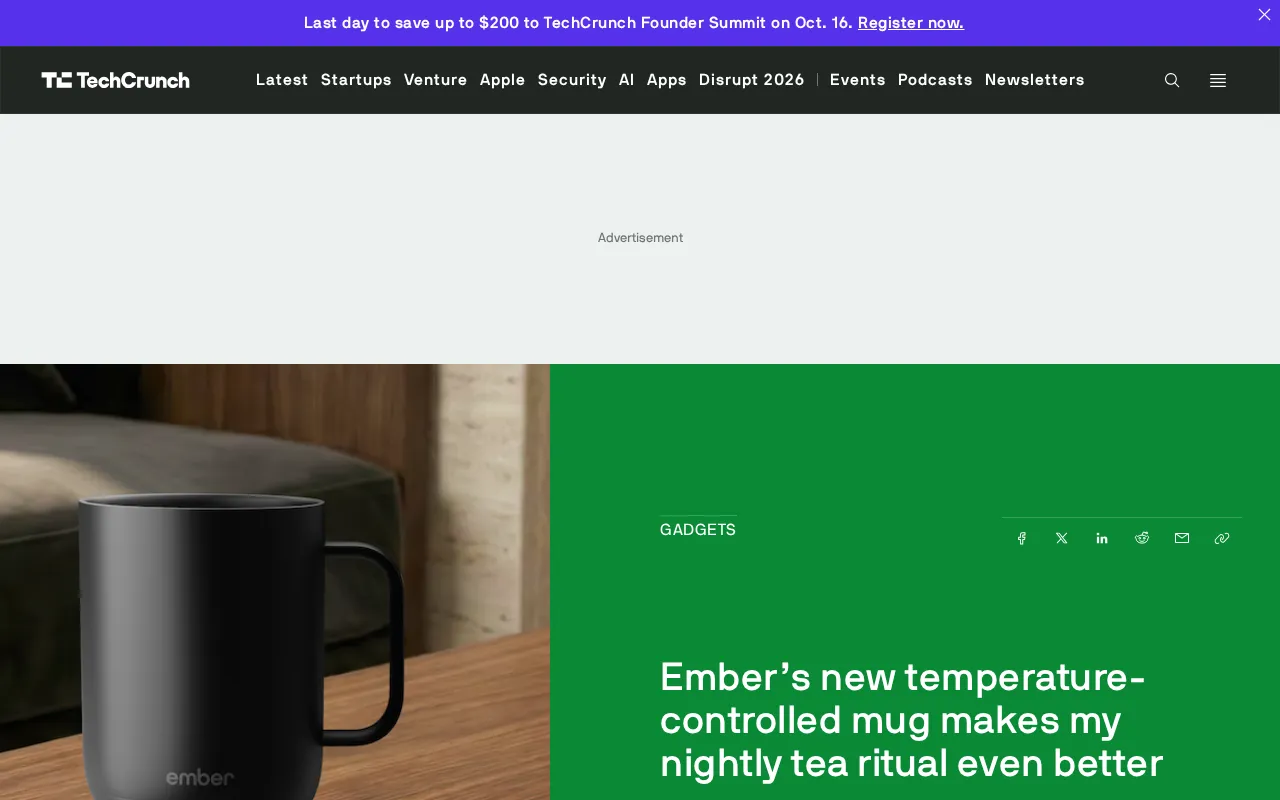
This sounds like a minor change, but it touches on a core proposition of smart home products: true intelligence should retreat into the background. When a temperature-controlled mug requires frequent phone operation to function, it feels more like "a cup with a heating function + a remote control"; when the adjustment action returns to the mug itself, it begins to approach "a cup of tea that automatically stays warm."
"Seamless Interaction" in Smart Homes
"Seamless" is an important design concept in the smart hardware field in recent years, referring to devices automatically completing the services users need in the background without requiring users to actively initiate operations or intervene frequently. It emphasizes embedding smart functions into the behavioral flow of everyday objects, rather than mediating through additional interfaces (such as phone apps or voice assistants). Typical examples of seamless interaction include desk lamps that automatically adjust brightness, air conditioners that automatically start and stop based on ambient temperature, and the Ember mug in this article that adjusts temperature without opening an app. Its core value lies in reducing cognitive load and operational costs, letting technology serve habits rather than interrupt them. Achieving seamless interaction typically relies on localized control (such as physical buttons or touch areas on the mug body) and stable automatic logic, reducing dependence on networks and external devices.
What Is the Practical Value of a Temperature-Controlled Mug
The core scenario of a temperature-controlled mug is not complicated: keeping coffee or tea at a palatable temperature for an extended period, avoiding repeated reheating or rapid cooling. For people with fixed tea-drinking habits, this need is real—especially for evening tea, where the temperature often drops faster than one can finish drinking.
Ember's previous generations have already established the basic product logic: mug body heating, app-based temperature setting, and battery-powered endurance. The new version takes temperature adjustment out of the app, meaning the phone is no longer a necessity in daily use. For users who don't want to install another app for a daily item, this change significantly lowers the barrier to use.
What Removing App Dependence Means
The "app dependence" of smart hardware has long been criticized by users: features hidden in mini-programs or apps, interface changes after updates, unstable Bluetooth connections. The new Ember puts temperature adjustment directly on the mug, and the practical effect is reducing failure points in the usage chain. You don't need to first find your phone, unlock it, open the app, and wait for a connection before you can drink a cup of tea at the right temperature.
This also makes the product more suitable for scenarios like the bedside or desk where "you don't want to be disturbed by your phone." The ritual of evening tea should never include an app pairing session.
The Difference Between Phase-Change Materials and Active Temperature Control
Common "thermos cups" on the market mainly rely on vacuum insulation layers or thick-walled structures to passively slow heat loss, and cannot actively heat or precisely control temperature. Temperature-controlled mugs like Ember are active temperature control devices, with built-in heating elements and temperature sensors, maintaining the set temperature through battery power. The two differ fundamentally in principle and experience: passive thermos cups can only delay cooling and will eventually approach ambient temperature; active temperature-controlled mugs can stabilize drinks within a certain temperature range (such as 50–55°C) for several hours. The cost of active temperature control is higher cost, weight, and battery life requirements, which is one reason temperature-controlled mugs are priced much higher than ordinary thermos cups. Understanding this difference helps determine whether the product meets one's real need for "temperature stability."
Common Failure Points of Bluetooth Pairing
Many smart hardware devices rely on Bluetooth to communicate with phone apps, and Bluetooth connections are prone to pairing failures, disconnections, and delays in actual use. Common causes include: differences in phone Bluetooth version compatibility, slow reconnection after device sleep, surrounding 2.4GHz signal interference, and apps being cleared from the background by the system. For devices like temperature-controlled mugs that require immediate response, a failed connection means users cannot adjust the temperature right away, greatly degrading the experience. Putting temperature adjustment on the mug body itself essentially replaces the wireless communication link with local physical interaction, thereby bypassing the above failure points. This is also the direct reliability benefit of "de-app-ification."
Trade-offs from a Review Perspective
Judging from the original review's wording, the author's evaluation of this mug centers on "better ritual sense"—a typical experience-based judgment rather than a specification-based one. The value of products like temperature-controlled mugs is inherently difficult to measure by specs: whether the temperature is held accurately, whether operation is smooth, whether cleaning is convenient—these details determine whether it will be used daily or put in a cabinet.
In currently available public information, specific parameters such as the new mug's temperature control range, battery life, and body material have not been elaborated in the original material. What is certain is that Ember chose to focus its product iteration on simplifying interaction rather than stacking new features. This direction is reasonable for a daily item: users' complaints about temperature-controlled mugs are usually not "not enough features" but "too troublesome to use."
Price and Positioning Remain Key Variables
Ember's temperature-controlled mugs have always been priced high, belonging to "upgrade-type" small appliances rather than necessities. While simplifying interaction, whether the new version can offer a more convincing justification on price will directly affect its audience range. For someone who just wants tea to cool more slowly, a thick-walled thermos cup might suffice; a temperature-controlled mug needs to convince those who have clear temperature preferences and are willing to pay for them.
Who Is This Mug Suitable For
If you have fixed hot drink habits—a cup of tea every night, a cup of coffee every morning—and are sensitive to "drinking temperature," the usage logic of the new Ember temperature-controlled mug holds up: set it once, then operate via the mug body, and the phone can be put away entirely.
If you only occasionally drink hot beverages or have no particular temperature requirements, the premium of such products will be hard to amortize through daily usage frequency. A temperature-controlled mug is not a universal mug; it solves a specific and narrow problem: keeping a hot drink at the temperature you want when you want to drink it.
The improvement direction of the new Ember mug is commendable—hide the intelligence, give the mug back to you. As for whether it's worth buying, it depends on how much you care about "temperature stability" and whether you're willing to pay for a mug that doesn't require opening an app.
One-line Summary
Ember's new temperature-controlled mug removes app-based temperature adjustment dependence, letting intelligence retreat into the background and returning to a seamless experience.
Paragraph Summary
The core change of Ember's new temperature-controlled mug is that you can adjust the temperature on the mug body without opening the phone app, simplifying the daily usage flow. The article argues that this change touches on the core proposition of smart homes: true intelligence should retreat into the background and reduce operational interruptions. Removing app dependence lowers the barrier to use, making the product more suitable for scenarios like the bedside or desk where you don't want to be disturbed by your phone, and also reduces failure points such as Bluetooth connections. The original review is experience-oriented, emphasizing the improvement in "ritual sense," but specific parameters such as temperature control range and battery life have not been elaborated. Temperature-controlled mugs solve a specific and narrow need—keeping hot drinks at a palatable temperature when drinking—and are suitable for users with fixed hot drink habits who are sensitive to temperature. Price and positioning remain key variables; temperature-controlled mugs are upgrade-type products rather than necessities.
Related articles

Thunderduck: Building a Modular Data Warehouse for AI Agents
Thunderduck is a DuckDB-based modular data warehouse giving AI agents isolated engines, cross-source SQL across Postgres, BigQuery, Iceberg & S3 without ETL, pre-query pricing, and managed cloud, BYOC, or on-prem deployment.

Cosyra: Control Your AI Coding Agent Remotely via a Cloud Terminal on Your Phone
Cosyra is a mobile programming tool for iPhone and Android that lets you launch and control AI agents running on a cloud Ubuntu terminal—no VPS needed. We analyze its positioning, how it differs from mobile IDE approaches, trade-offs of the cloud terminal model, and who it's for.

Zerg Client: A Coding Agent That Opens Its Own Terminal Panes
Zerg Client is a coding agent harness that drives its own terminal panes, running interactive programs like Vim and htop, with nested agents and models. A look at its positioning, pane mechanics, and target users.