EmoHarness: Meta-Framework Evolution Improves Multimodal Emotion Understanding in Small Models
EmoHarness uses a frozen model plus external framework to organize multimodal evidence, significantly boosting small models' emotion recognition.
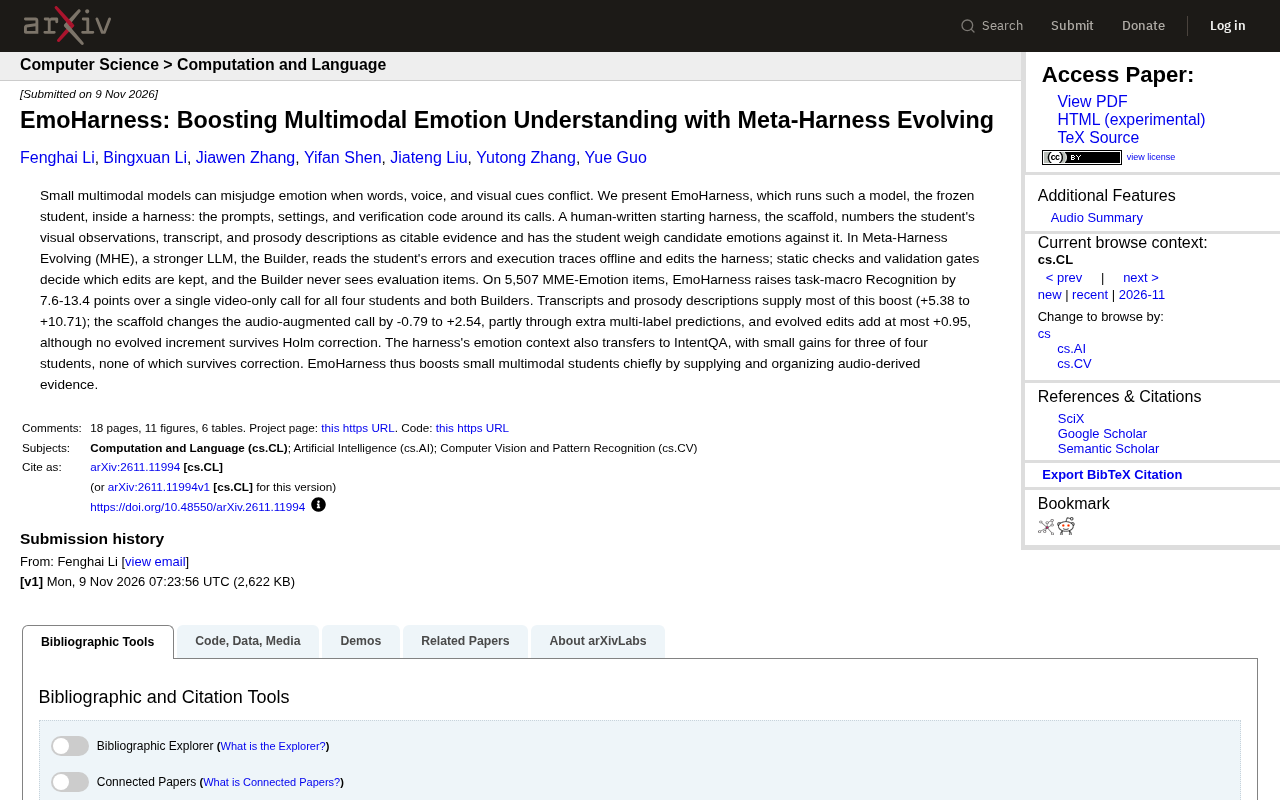
EmoHarness tackles the problem of small models being dominated by a single modality in multimodal emotion recognition by keeping student model weights frozen and using a manually written scaffold to number visual observations, transcribed text, and prosody descriptions as citable evidence, forcing the model to compare modalities before judging; a stronger Builder LLM then evolves the framework offline based on error traces. On 5,507 MME-Emotion samples, the method improved macro-average recognition by 7.6–13.4 percentage points over video-only single calls. Gains mainly come from audio-derived transcription and prosody evidence (+5.38 to +10.71), while automatic evolution added at most +0.95 (not significant), and transfer to IntentQA also failed the correction test.
Small models often make judgment errors in multimodal emotion recognition when textual, vocal, and visual cues conflict. A recent study proposes EmoHarness, which organizes evidence through an external framework and significantly improves recognition accuracy across multiple small models.
Core Problem: The Emotional Judgment Dilemma of Small Models
Multimodal emotion understanding requires models to simultaneously process language content, vocal tone, and visual expressions. When these three channels send contradictory signals, small models with limited parameter counts tend to be dominated by a single modality, leading to misjudgments. Traditional fine-tuning methods require updating model weights, which is costly and may harm generalization ability.
EmoHarness takes a completely different approach: it keeps the student model entirely frozen and instead designs the prompts, configurations, and validation code that the model calls externally—the "harness"—to guide the model in making better use of multimodal evidence.
Multimodal Emotion Recognition is a core task in affective computing that aims to determine a speaker's emotional state by integrating information from multiple modalities such as text, speech, and vision. Compared with unimodal tasks, multimodal input provides complementary cues but also introduces the challenge of inter-modal conflicts—for example, a person may smile while saying something negative in a low tone. Resolving such conflicts requires models to have cross-modal semantic alignment and evidence-weighing capabilities, which smaller models often lack, making them prone to degenerating into reliance on a single modality (usually text) for judgment.
Method: Scaffold and Meta-Framework Evolution
EmoHarness consists of two core components.
Initial Scaffold: Structured Evidence
Researchers first manually wrote a starting framework called the "scaffold." It numbers the student model's visual observations, transcribed text, and prosody descriptions as citable evidence, and requires the student model to compare candidate emotions against this evidence one by one. This design forces the model to reference multiple modalities before making a judgment, rather than relying on a single signal.
Prosody refers to the suprasegmental features of speech that go beyond segmental phonemes, primarily including pitch (fundamental frequency), duration, intensity, and their patterns of variation. In emotion recognition, prosody is a key acoustic cue for conveying emotion: for example, anger typically manifests as high pitch, fast speech rate, and strong stress, while sadness manifests as low pitch, slow speech rate, and weak stress. The "prosody description" in this article refers to the textual transcription of such acoustic features of speech by tools or models, enabling the frozen small model to access information at the pure text level that would otherwise require an audio encoder to capture, thereby compensating for its limited acoustic perception capability.
Meta-Harness Evolving: Offline Evolution
In the Meta-Harness Evolving (MHE) stage, a more capable LLM (called the Builder) reads the student model's errors and execution traces offline and edits the framework accordingly. Static checks and validation gates determine which modifications are retained, and the Builder never accesses the evaluation items, ensuring evaluation fairness.
Holm correction (Holm-Bonferroni correction) is a statistical correction method used for multiple hypothesis testing. When a study tests multiple hypotheses simultaneously, the probability of committing a Type I error (false positive) accumulates and inflates; Holm correction controls the overall error rate by sorting p-values from smallest to largest and progressively tightening the significance threshold. In this article, evolutionary edits produced multiple incremental hypotheses, so correction is necessary when determining whether these increments are significant; after correction, none of the evolutionary increments passed the significance test, meaning the observed improvements may simply be random fluctuation and it cannot be asserted that the evolution mechanism is truly effective.
Experimental Results: Significant Improvement in Recognition Rate
On 5,507 MME-Emotion samples, EmoHarness improved the task-macro Recognition rate of four student models and two Builders by 7.6 to 13.4 percentage points compared with a single video-only call.
In detail, transcribed text and prosody descriptions contributed most of the gains (+5.38 to +10.71). The scaffold's effect on audio-enhanced calls ranged from -0.79 to +2.54, partly due to additional multi-label predictions. The increments from evolutionary edits were at most +0.95, and after Holm correction none of the evolutionary increments passed the significance test.
Furthermore, the emotional context provided by the framework also transferred to the IntentQA task, with three of the four student models showing small improvements, though these also failed to pass the correction test.
Macro-averaging is an aggregation method commonly used in multi-class or multi-task evaluation: it first computes the metric for each class (or task) separately, then takes the arithmetic mean of these metrics without considering differences in sample size across classes. In contrast, micro-averaging weights by sample size. The use of "task-macro recognition rate" in this article means that the accuracy of each emotion recognition subtask is treated equally, preventing categories with large sample sizes from dominating the overall score, thereby more fairly reflecting the model's balanced performance across different emotion categories.
Analysis: Audio Evidence Is Key, Evolution Mechanism Yet to Be Explored
The experimental results point to a clear conclusion: the gains from EmoHarness mainly come from providing and organizing audio-derived evidence, rather than from automatic framework evolution. The addition of transcription and prosody descriptions gives the model acoustic cues beyond text, which is precisely what small models tend to overlook.
MHE's evolutionary contribution is limited, possibly because the initial scaffold already covers the key evidence organization methods, making it difficult for automatic editing to find more valuable modifications within a limited number of steps. This also suggests that future work could explore more efficient search strategies or richer editing spaces.
Implications and Limitations
EmoHarness demonstrates a low-cost path to enhancing the multimodal capabilities of small models: rather than updating weights, it optimizes input organization and validation logic through an external framework. For resource-constrained deployment scenarios, this approach is attractive.
The limitations are equally clear: the actual effect of the evolution mechanism did not reach statistical significance, and the framework's transferability was only validated on some models. Future research requires larger-scale evaluation and more robust evolutionary design.
Overall, this work emphasizes the central role of audio evidence in multimodal emotion understanding and provides a new perspective for enhancing the capabilities of small models.
One-line Summary
EmoHarness organizes multimodal evidence through a frozen model plus external framework, significantly improving small models' emotion recognition rates.
Paragraph Summary
EmoHarness addresses the problem of small models being easily dominated by a single modality in multimodal emotion recognition by proposing an external framework approach: keeping the student model's weights entirely frozen, using a manually written initial scaffold to number visual observations, transcribed text, and prosody descriptions as citable evidence, forcing the model to compare multiple modalities before making judgments; then a more capable Builder LLM evolves the framework offline based on error traces. On 5,507 MME-Emotion samples, this method improved the macro-average recognition rate of four student models by 7.6 to 13.4 percentage points compared with a single video-only call. Analysis shows the gains mainly come from audio-derived evidence provided by transcription and prosody descriptions (+5.38 to +10.71), while the increment from automatic framework evolution is at most +0.95 and not significant, and the improvement transferred to IntentQA also failed to pass the correction test.
Related articles

Gemini 4 Neon Review: Benchmark Scores Rival Carbon, API Pricing and Quota Breakdown
Google Gemini 4 Neon is now live, benchmark scores closely tracking Carbon, API pricing 3/15 at twice Hydrogen's rate. This article compiles Bilibili creator testing: Neon can replace 90% of Carbon scenarios, AntiGravity quota consumption is only one-third of Carbon, plus subscription channel restrictions and 2API ban risks.

Gemini 4 Helium Coming Soon? Signals of Google Loosening Subscription Restrictions
Google team member hints releases will continue; community speculates Gemini 4 Helium (Flash Lite) may be next. Subscription ban controversy gets a response as product lead says "Soon," suggesting restrictions may be lifted. This article covers Gemini developments, OpenAI Coding Agent and risk management, Doubao real-time audio-video API, and compute business dynamics.

AI-Assisted React Development in Practice: Optimizing a Video App and Handling Errors
A 14-year veteran developer demonstrates AI-assisted React video app optimization: compressing video from 80MB to 5MB (~94%) via ImageKit, plus reliable error handling and retry mechanisms. Includes planning, code understanding, and verification methods for working with AI.