Empowering AI Agents with Skills to Automate WeChat Official Account Analytics

Use Skill-powered AI Agents to automate WeChat Official Account data collection and Excel reporting.
This article explores how combining AI Agents with Skills can fully automate WeChat Official Account analytics — from logging into the backend and scraping paginated post data to generating sorted Excel reports. It covers the technical architecture behind Agents, the role of Skills vs. traditional RPA, MCP protocol standardization, and key considerations around authorization and data security.
From Manual Tracking to Intelligent Automation
For content creators, regularly compiling data from WeChat Official Account dashboards is a tedious, time-consuming chore. After publishing each week, you have to log into the backend, flip through page after page of post records, and manually copy metrics like read counts and likes into an Excel spreadsheet for analysis — a process that's both slow and error-prone.
With the combination of AI Agents and Skills, this entire workflow is being fundamentally transformed. Users simply describe what they need in natural language, and the Agent autonomously handles everything — from logging into the backend and scraping data to generating the final report. This article breaks down a real demo case to explain exactly how Skills help an Agent complete a WeChat Official Account data analysis task.
What Is a Skill-Powered AI Agent?
AI Agent: The Leap from "Answering Questions" to "Getting Things Done"
An AI Agent is an AI system capable of perceiving its environment, planning autonomously, and executing multi-step tasks — fundamentally different from traditional single-turn question-answering language models. Its core architecture typically consists of three key components: a perception layer (receiving user instructions and environmental feedback), a planning layer (using a large model to decompose tasks and make decisions), and an execution layer (invoking tools, APIs, or external services to carry out actual operations).
Underpinning these three layers is the synergy of several critical technologies. The planning layer typically relies on Chain-of-Thought reasoning to help the model break complex goals into executable sub-steps, while the execution layer maps abstract instructions to API requests or UI interactions via Tool Calling mechanisms. The ceiling of current Agent capabilities largely depends on the underlying model's context window length and instruction-following precision — which is why long-context models like GPT-4o and Claude 3.5 Sonnet tend to perform better in Agent scenarios. Leading Agent frameworks such as LangChain, AutoGPT, and OpenAI's Function Calling mechanism are all exploring how to extend models from "understanding language" to "operating the world." The Skill mechanism is the core abstraction of the execution layer — it encapsulates domain-specific operational logic into reusable capability units, so Agents don't have to reason from scratch each time they need to complete a specific task.
The Core Role of Skills
In the context of AI Agents, a Skill can be thought of as an ability pack that grants the Agent specific capabilities. Native large language models excel at understanding and generating text, but lack the ability to perform concrete operations — such as logging into websites or reading and writing spreadsheets. Skills are the key to bridging this gap, injecting the executable logic an Agent needs to complete specific tasks.
It's worth noting that the concept of "Skill" takes different forms across AI platforms, but the underlying logic is remarkably consistent: exposing external capabilities to large models in a structured, callable way. OpenAI calls them "Function Calling" or "Tools"; Anthropic's Claude uses "Tool Use"; and within the Microsoft Copilot ecosystem, the equivalent is the "Plugin" and "Connector" system. From a technical standardization perspective, MCP (Model Context Protocol), proposed and open-sourced by Anthropic in late 2024, is emerging as a unified interface specification for connecting AI models to external tools — analogous to what USB is for hardware devices — allowing any Skill to be invoked by any compatible Agent, breaking down capability silos across platforms.
MCP's design philosophy resembles LSP (Language Server Protocol) for code editors: enabling any client (Agent) to seamlessly invoke any server (Skill/tool), dramatically reducing integration costs. Hundreds of MCP Servers have already been contributed by the open-source community, covering core scenarios such as file operations, database queries, and browser control. The maturity of this ecosystem will directly determine how quickly the vision of "natural language driving everything" becomes reality.
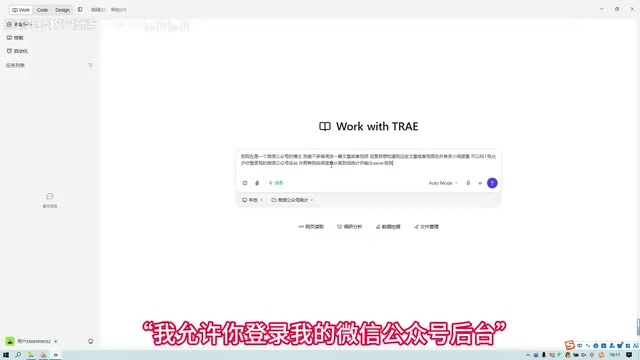
In this case, after the creator selects a target folder and enters the instruction: "I publish one piece of content per week. I authorize you to log into my WeChat Official Account backend and compile the data into an Excel file sorted by read count from lowest to highest." This natural language statement contains a clear goal (Excel report), a data source (Official Account backend), and a sorting rule (ascending by read count) — enough for the Agent to take action.
Translating Intent into Execution
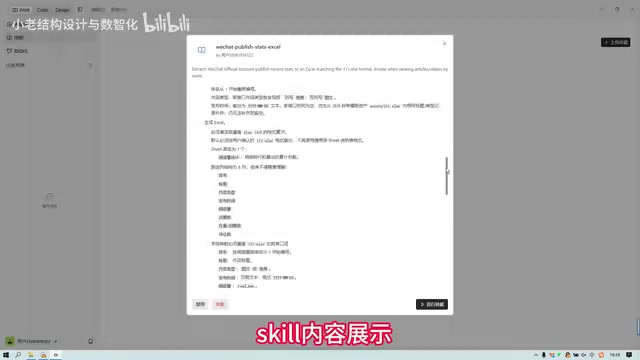
Once the user clicks run, the Agent invokes the corresponding Skill to decompose and plan the task: how to log in to the backend, which pages to navigate, which fields to extract, how to sort, and what format to output. With Skills providing the execution logic, abstract natural language intent is transformed into a concrete, actionable sequence of operations.
The Complete Automated Data Collection Workflow
Step 1: Autonomous Backend Login
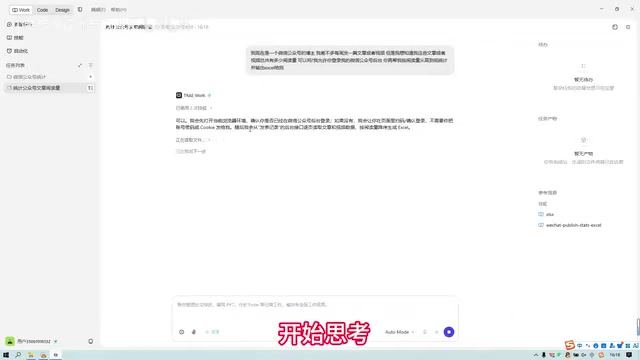
After receiving user authorization, the Agent logs directly into the WeChat Official Account backend and navigates to the post history page. This step demonstrates the Agent's autonomous navigation capability — no manual step-by-step guidance required; it locates the target interface on its own based on the task goal.
Step 2: Paginated Data Scraping
Once inside the post history, the Agent begins iterating through all pages. Since historical articles in an Official Account are typically spread across multiple pages, the Agent recognizes the pagination structure and sequentially scrapes key metrics — article titles, read counts, and more — from each page, ensuring complete and uninterrupted data collection.
This automatic traversal capability represents a fundamental departure from traditional RPA (Robotic Process Automation) tools like UiPath or Blue Prism, which generate fixed scripts by recording user actions. The moment a target website is redesigned, these scripts break and require costly maintenance. Their core limitation is fragility: scripts based on coordinate positioning or fixed DOM paths can fail entirely from even minor UI changes. AI Agents, by contrast, introduce multimodal perception — particularly screen understanding via Vision-Language Models (VLMs) — enabling them to comprehend interfaces at the semantic level rather than the pixel level, resulting in far greater generalization. This paradigm shift is known in the industry as "Cognitive Automation," representing the evolution from rule-driven to intent-driven automation, giving Agents a robustness when dealing with frequently updated platforms like WeChat Official Account that traditional RPA simply cannot match.

Step 3: Generating and Saving the Excel Report
Once data collection is complete, the Agent sorts the results according to the user's specified rule (read count, ascending), automatically generates an Excel file, and saves it to the folder the user designated in advance. The entire process requires zero human intervention — start to finish.
The Value and Implications of This Approach
Dramatically Lowering the Automation Barrier
Traditional automation scripts (such as Python scrapers) require a certain level of programming knowledge, and must be maintained whenever a page's structure changes. Skill-powered AI Agents, through natural language interaction, encapsulate complex operations inside Skills, allowing operations staff without technical backgrounds to benefit from the same automation-driven efficiency gains.
Authorization Boundaries and Data Security
It's worth noting that in this case, the user explicitly stated: "I authorize you to log into my WeChat Official Account backend." In scenarios where an Agent can operate sensitive accounts on a user's behalf, permission granting and data security are unavoidable topics.
From an industry best-practices perspective, mature authorization solutions should follow the OAuth 2.0 protocol — an open standard developed by the IETF (RFC 6749) and currently the most widely adopted authorization framework on the internet. Its core mechanism is "token-for-permission": users authorize a third-party application through an authorization server, which issues an Access Token. The token can be scoped and time-limited, enabling fine-grained permission control without exposing account credentials, and can be revoked at any time. In Agent scenarios, the ideal authorization model should also incorporate Human-in-the-loop confirmation nodes — meaning the Agent must explicitly obtain real-time user confirmation before executing high-risk operations (such as writes or deletions), rather than relying solely on a one-time initial authorization statement.
However, the WeChat Official Account backend currently does not expose standard OAuth interfaces to third-party Agents. This means Agent login often relies on users directly providing credentials or on browser session hijacking, creating a certain security gray area. When using such tools, users should prioritize platforms that support the principle of least privilege (the Agent can only access the minimum data necessary to complete the task) and operation auditability (providing complete operation logs), in order to establish a trustworthy boundary between convenience and risk. Users need to be clear about what data the Agent will access and what actions it will take, in order to strike a reasonable balance.
The Future Direction of Agent Capabilities
Automating WeChat Official Account analytics is just one small example of Skills empowering Agents. As the Skill ecosystem continues to grow, Agents are poised to handle far more operational scenarios — extending from data reporting to content formatting, comment management, and cross-platform data aggregation and analysis. When AI truly evolves from "answering questions" to "completing tasks," its transformation of productivity tools will have genuinely begun.
Conclusion
The practice of using Skill-powered AI Agents to automate WeChat Official Account data collection reveals a clear trend: AI is evolving from an assistive tool into an autonomous execution entity. For content creators and operations teams, mastering these tools means breaking free from repetitive labor and redirecting energy toward creative content production. Underlying all of this is the Skill mechanism — the very thing that enables general-purpose large language models to operate effectively within specific business contexts. From the standardized tool-calling interfaces driven by the MCP protocol, to the leap in UI comprehension brought by cognitive automation, to an ever-richer cross-platform Skill ecosystem, the capability boundaries of AI Agents are expanding outward at a pace that's hard to anticipate.
Related articles
What Is Vibe Coding? The AI Programming Skill Every Developer Needs
What is Vibe Coding? Learn how AI programming is reshaping dev teams, why traditional programmers face displacement, and why Cursor & Claude Code matter.
Making Rocks Think: A Philosophical Exploration of Generative AI and Information Compression
From a viral Reddit post to deep AI theory: why compression equals understanding, the Library of Babel thought experiment, semantic compression, and the Hutter Prize.
Irregular Warns: Four AI Lab Security Breaches Traced to the Same Root Cause
Irregular reveals four AI lab security breaches share a single root cause, exposing systemic risks from technology stack homogeneity across the AI industry.