Engineering Vitals in the AI Era: A New Perspective on Engineering Effectiveness from HN
AI coding tools distort traditional output metrics, requiring a rebuilt engineering health framework based on change quality, understanding debt, and collaboration rhythm.
Starting from a Hacker News discussion about "Engineering Vitals in the Age of AI," the article borrows the medical metaphor of "vitals" to explore how to measure engineering team health as AI becomes deeply embedded in development workflows. It argues that traditional output metrics like lines of code and commit frequency assume human input drives output, an assumption AI completion and generation are undermining—rising metrics may only mean tools are typing, not that judgment has improved. It proposes three observation points closer to system health: change quality metrics (rework and rollback rates), understanding debt (review challenges and new-member ramp-up time), and human-AI collaboration rhythm (focus duration and tool-call frequency). It concludes that Goodhart's Law is sharper in the AI era, and measurement should serve team self-diagnosis, not performance scorecards.
Introduction: When AI Enters Engineering
A discussion thread titled "Engineering Vitals in the Age of AI" recently appeared on Hacker News. Although it didn't get much engagement, the title itself raises a question worth digging into: now that AI tools have deeply penetrated the software development workflow, what kind of "vitals" should we use to measure the health of engineering teams and individuals?
The metaphor is an interesting one. In healthcare, vitals refer to basic indicators like blood pressure, heart rate, and body temperature. They don't tell you the cause of an illness directly, but they quickly reveal whether a system has drifted outside its normal range. Apply the same thinking to engineering, and the question becomes: in the AI era, which metrics still genuinely reflect engineering effectiveness? And which have already become distorted?
The Risk of Traditional Engineering Effectiveness Metrics Breaking Down
Over the past decade, the mainstream approach to measuring engineering effectiveness has revolved around metrics like lines of code, commit frequency, PR merge time, and defect density. These metrics share a common assumption: output is primarily driven by human input, so efficiency can be evaluated through an input-output ratio.
The spread of AI coding assistants is shaking that assumption. When autocomplete, generation, and refactoring suggestions become part of everyday work, the "unit cost of human effort" behind code output changes structurally. If we still measure productivity by lines of code or commit frequency, we can easily reach misleading conclusions—a rise in the metrics may simply mean the tool is doing your "typing," not that your engineering judgment has improved.
This is where the "Engineering Vitals" framing has value: it suggests we need an observation framework closer to system health rather than continuing to pile up output-based metrics.
Several Categories of "Engineering Vitals" Worth Watching in the AI Era
Change Quality, Not Change Quantity
With AI assistance, the absolute number of changes naturally balloons. A more informative observation point is the rework rate and rollback rate of changes, along with how strongly changes are correlated with alerts after they reach production. These metrics reflect "whether judgment was validated," not "whether the hands were fast enough."
Change Failure Rate is one of the four core DORA metrics. It refers to the proportion of changes deployed to production that require a rollback, hotfix, or cause service degradation. It is more valuable as a reference in the AI era because it measures the outcome of changes once they enter the real runtime environment, rather than the level of activity at the point where changes are produced. It is paired with Mean Time to Recovery (MTTR), which reflects how quickly a team can restore service after a change causes an incident. Together, these two metrics can distinguish between two very different team states: frequent changes with a low failure rate and fast recovery indicate that engineering judgment and automated safeguards are in place; frequent changes with a high failure rate and slow recovery may mean the team is using tools faster than its ability to validate them. Note that Change Failure Rate depends on reliable deployment-to-alert correlation data. If observability infrastructure is weak, this metric itself will become distorted.
Visibility of Understanding Debt
AI-generated code may be syntactically correct and pass tests, but the depth of developers' understanding of its internal logic may decline. One concern implicit in the HN discussion is exactly this: as teams rely more and more on tool-generated code, are the "explainability" and "maintainability" of the codebase being quietly eroded? Using the number of substantive challenges raised in code reviews, and the time it takes a new team member to get up to speed on the same module, as observation points can partially capture this kind of understanding debt.
The Rhythm of Human-Tool Collaboration
Another easily overlooked vital is the change in work rhythm. AI tools shorten the path from idea to runnable code, but they may also bring more frequent context switching. Observing how long a developer stays continuously focused on a task, and the frequency with which tool calls alternate with manual edits, can help determine whether the collaboration pattern enhances flow or shatters it.
Context switching cost is a classic concept in cognitive psychology and productivity research. It refers to the attentional rebuilding cost people pay when moving between different tasks or modes of thought. Research generally shows that after an interruption, it takes anywhere from a few minutes to twenty minutes on average to return to a state of deep work, and the more frequent the switches, the lower the effective output per unit time. AI coding assistants affect context in both directions: on one hand, they compress friction like "looking up documentation, writing boilerplate, finding syntax" into seconds, reducing low-value switching; on the other hand, frequent completion suggestions, conversational queries, and reviewing generated results introduce new attention interruption points. So observing the frequency with which tool calls alternate with manual edits is essentially measuring which side of this double-edged effect dominates. This kind of data can usually be obtained from IDE telemetry or editor operation logs, but privacy boundaries and informed consent must be carefully respected during collection to avoid sliding toward surveillance of individuals.
From Metrics to Culture: The Boundaries of Measurement Itself
It is important to recognize that any engineering metric, once treated as a performance target, will quickly be gamed. Goodhart's Law only becomes sharper in the AI era: if a team knows rework rate is being tracked, it may tend to split rework into new changes to avoid being counted.
Therefore, a more reasonable positioning for "Engineering Vitals" is as a tool for team self-diagnosis, not a top-down scorecard from management. It should work like a health check report—used to trigger conversations and retrospectives, not to directly determine rewards and punishments.
Goodhart's Law was proposed by the British economist Charles Goodhart. Its original formulation is: when a measure becomes a policy target, it ceases to be a good measure. The mechanism behind it is that a metric is originally only a rough proxy for complex reality. Once it is given reward-and-punishment implications, those being measured shift their energy from "improving reality" to "optimizing the metric value," and the latter is often much easier than the former. Software engineering offers plenty of examples: measuring developers by lines of code breeds redundant code, measuring testers by defect count leads to defects being downgraded or hidden, and measuring operations by response time encourages teams to silence alerts rather than fix root causes. The introduction of AI tools further amplifies this gaming space, because the cost of generating and splitting changes is extremely low, making metrics easier to shape artificially. This is the fundamental reason the original article emphasizes that measurement should serve diagnosis rather than assessment.
Conclusion
Although this HN discussion thread is brief, it points to an emerging industry issue: AI changes not only the way code is written, but also the definition of "what counts as a healthy engineering state." Rebuilding an observation framework around change quality, understanding debt, and collaboration rhythm is closer to reality than continuing to rely on output-based metrics. Measurement itself also needs to be measured—its side effects are often more worth guarding against than the problems it reveals.
One-line Summary
AI coding tools distort traditional output metrics, requiring a rebuilt engineering health observation framework based on change quality, understanding debt, and collaboration rhythm.
Paragraph Summary
Starting from a Hacker News discussion about "Engineering Vitals in the Age of AI," this article borrows the medical metaphor of "vitals" to explore how the health of engineering teams should be measured after AI deeply enters the development workflow. The author points out that traditional output-based metrics such as lines of code and commit frequency rest on the assumption that "human input drives output," and that AI completion and generation are shaking this assumption, so rising metrics may only reflect tools doing the typing rather than improved judgment. The article proposes three types of observation points closer to system health: quality metrics such as change rework rate and rollback rate; the number of review challenges and new-member ramp-up time, which reflect understanding debt; and continuous focus duration and tool-call frequency, which embody the rhythm of human-AI collaboration. Finally, it emphasizes that Goodhart's Law is sharper in the AI era, and that measurement should be positioned as a team self-diagnosis tool rather than an assessment scorecard.
Related articles

Claude Designs Scorpion Venom-Neutralizing Proteins: With 17 Binders, How Far Are We From an Antidote?
Anthropic's Claude helped design scorpion venom-neutralizing proteins: only 17 of 211 candidates passed, multi-target coverage failed, and channel function and animal testing remain absent.
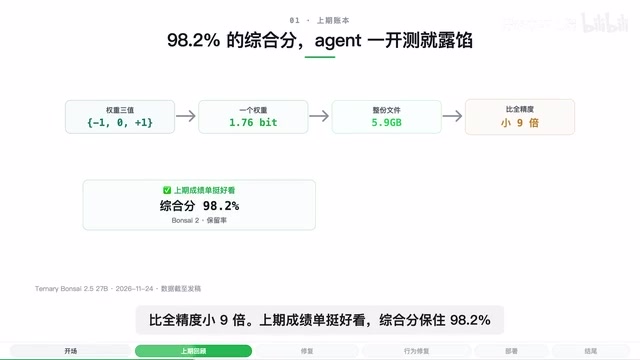
Fitting a 27B Model into 5.9GB: Ternary Bonsai 2.5 Fixes Its Agent Weaknesses
Prism ML releases Ternary Bonsai 2.5: a 27B model in just 5.9GB, with ternary quantization compressing weights to 1.76 bits. The new version focuses on fixing Agent capabilities, raising Tao3Bench Verify to 75.6 and Upworld from 51.2 to 90.5, hitting 291 tokens/s on a single A700, open-sourced under Apache 2.0.

GPT-6-Designed Proteins Validated in Lab; ERNIE 5.5 Preview Open-Sourced
GPT-6 designed proteins using reasoning and code alone, with lab binding evidence across five targets; Baidu open-sourced ERNIE 5.5 Flash Preview under Apache 2.0 with 280B parameters and 1M context.