Engram: The AI Sampler That Turns Hallucinations into Music

Engram turns AI hallucinations into musical material, challenging the mainstream "one-click" AI music generation model.
Music tech startup Thoughtful Things has launched a Kickstarter campaign for Engram, an AI-powered hardware instrument combining a sampler and groovebox. Unlike "one-click" tools such as Suno, Engram deliberately exploits the hallucinations, distortions, and unpredictability of AI audio processing to generate unique timbres — continuing the experimental music tradition of "embracing imperfection" seen in circuit bending and tape saturation. Its hardware form emphasizes tactile interaction and live performance, positioning AI as an instrument to be played rather than a black box that creates on your behalf. Engram poses a pointed question for the industry: in the age of generative AI, preserving creator agency may matter more than automating the final product.
When AI Hallucinations Become Creative Material
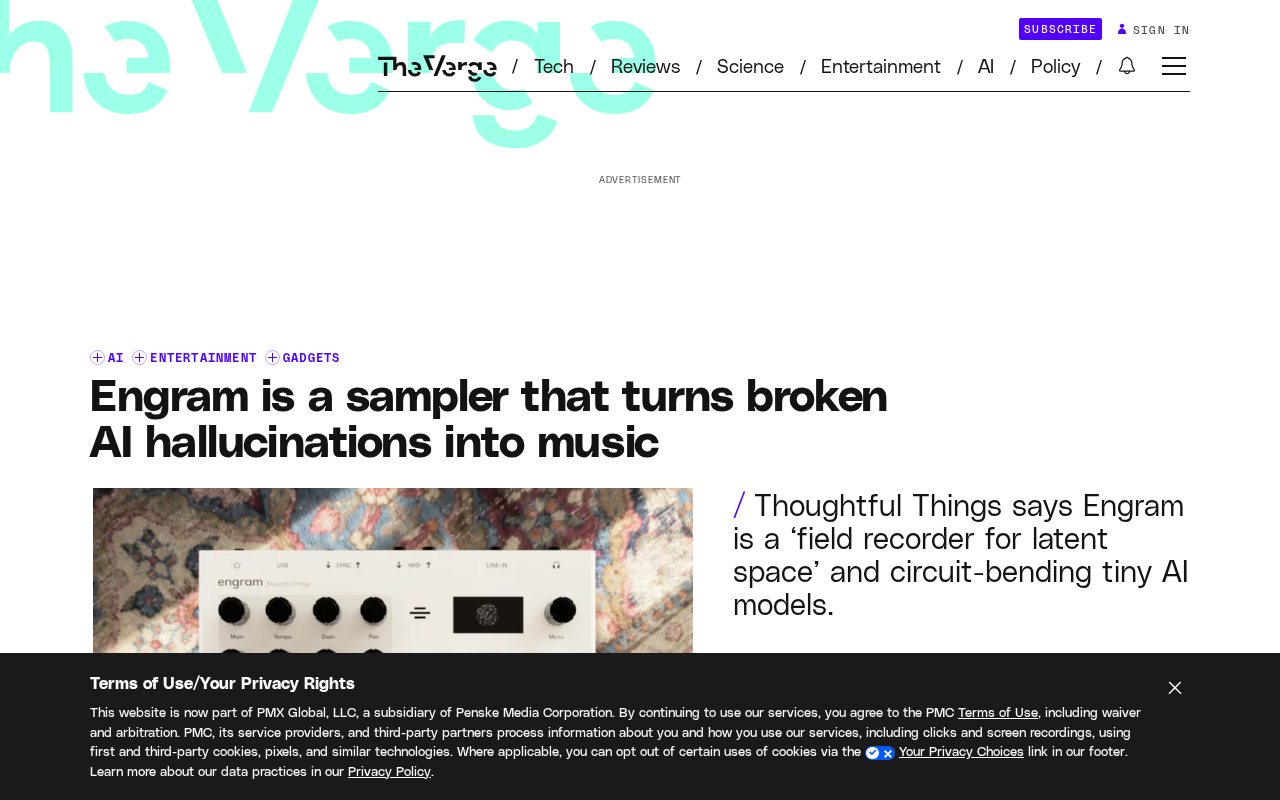
Music tech startup Thoughtful Things recently launched a Kickstarter campaign for Engram, its debut hardware instrument. Engram is a combined sampler and groovebox that uses AI to "corrupt" incoming audio — and even "hallucinate" entirely new sounds from scratch.
For those familiar with generative music tools, the immediate association might be something like Suno. But Engram deliberately positions itself as the opposite — it explicitly states that it's "not a Suno in a box," and not a device that spits out chart-ready tracks at the push of a button.
Hallucination as a Feature, Not a Bug
In most AI applications, "hallucination" is treated as a problem to be eliminated — a sign that the model has produced inaccurate or uncontrollable output. Engram flips this logic entirely: it deliberately exploits the distortions, glitches, and unpredictability that arise when AI processes audio, turning these "artifacts" into distinctive timbres and textures.
This approach is nothing new in electronic and experimental music. From tape saturation and bit-crushing to circuit bending, musicians have long deliberately "misused" technology to coax unexpected sounds from it. Engram carries this "embrace imperfection" aesthetic into the AI era — making the machine's mistakes part of the artistic expression.
Circuit bending originated in the 1960s as an experimental technique that creates unintended sounds by deliberately short-circuiting or rewiring the internal electronics of a device. Practitioners typically disassemble toys, synthesizers, or other consumer electronics and connect circuit nodes that were never meant to touch, triggering noise, distortion, and random tones. The core aesthetic is "controlled loss of control" — the creator sets the conditions, but the resulting sound is determined by physical chance. Reed Ghazala is widely credited as the founding figure of the practice and theorized it in the 1990s. Engram's AI hallucination processing is philosophically aligned with circuit bending: both reject the idea of technology as a transparent means to a predetermined end, and instead actively invite the "accident" into the creative process.
A Clear Departure from the "One-Click Generation" Approach
Engram's insistence that it isn't a "push a button, get a finished product" tool is worth examining closely. Most generative music products on the market today pursue simplicity and output-orientation — users type in a prompt and receive a fully produced song in return.
While this lowers the barrier to creation, it also strips away the creator's sense of control and agency over the sound. Engram takes a different path: treating AI as an instrument to be played, rather than a black box that completes the creative work on your behalf. It's closer to giving musicians a new means of sound processing — AI handles the raw material generation and unexpected timbres, while the creator handles selection, arrangement, and shaping.
A groovebox is a portable, all-in-one device integrating a drum machine, sequencer, and synthesizer. Classic examples include the Roland MC series and Teenage Engineering's Pocket Operator lineup. The core interaction model revolves around real-time button presses, knobs, and step sequencing to build beats and melodies, emphasizing spontaneity and physical engagement. Compared to DAW software, a groovebox workflow is more linear and intuitive — well-suited to live performance and rapid idea capture. By presenting AI audio processing in groovebox form, Engram signals that its intended context is a performer making decisions in the moment, not a producer endlessly tweaking parameters on a screen. This design choice reinforces the positioning of "AI as instrument" rather than "AI as production tool."
Why Hardware Matters
Building AI audio processing into a physical device — rather than another software plugin or cloud service — is itself a statement. Hardware means tactile interaction, immediate feedback, and the possibility of live performance, all of which are often critical to musicians who care deeply about workflow.
The sampler-plus-groovebox combination also signals that Engram wants to cover the full chain from sound capture and AI processing to rhythmic arrangement, rather than serving as a single-purpose effect unit. It aims to become a central node in the creative process, not just an add-on.
A Reflection on AI's Role in Creativity
Engram's product philosophy offers an interesting perspective: what role should AI actually play in creative tools? Should it be an "auto-composer" that replaces human input, or a "new kind of instrument" that expands what humans can do?
Thoughtful Things is clearly betting on the latter. By deliberately amplifying AI's uncertainty and turning hallucinations into musical material, Engram reframes AI from an "efficiency tool" into a "source of inspiration." How the device actually performs in practice — and whether the crowdfunding campaign succeeds — remains to be seen once the product ships. But it at least raises a question worth the entire industry's consideration: in an era where generative AI is sweeping through creative fields, preserving the creator's agency may ultimately be more valuable than chasing the perfect one-click output.
Related articles

Free Unlimited Claude Code Solution: Agnes AI + CC Switch Setup Guide
No paid subscription needed — pair the free AI platform Agnes AI with the open-source tool CC Switch to provide a backend for Claude Code, enabling unlimited free calls to text, image, and video models. This guide covers the full setup, test results, and usage boundaries.

A Complete Zero-Cost Guide to Getting Started with Claude Code for Beginners in China
A beginner's guide to Claude Code for users in China: two installation methods (command line and IDE plugin), full configuration steps for replacing the official API with the free domestic LongCat model, and a hands-on demo of building a small tool with natural language, plus tips.

When the NSA Gets Involved: The AI Supply Chain Crisis Behind Open-Source CVEs and API Key Hijacking
Multiple open-source projects disclosed severe CVEs in one day, PHP flaws alarmed the FBI, and Railway and OpenCode were breached with API keys stolen. This article breaks down the vulnerability window, AI-accelerated exploitation, and the AI supply chain crisis behind the API key black market, with a developer defense checklist.