Enterprise AI Agent Full-Stack Development: A Complete Learning Path to Building Production-Ready Agents from Scratch
A complete learning path from LangChain basics to multi-agent production deployments for developers entering AI.
This course overview covers enterprise-grade AI Agent development across four dimensions: motivation, audience, curriculum, and distinguishing features. Targeting developers with programming experience, it progresses through foundational AI concepts, six chapters of LangChain, a single-Agent customer service project, and advanced multi-agent systems using CrewAI and LangGraph — with 10+ open-source projects and a zero-config online IDE included.
AI Agents have become one of the most talked-about directions in the tech world today. This course introduction from Bilibili covers enterprise-grade AI Agent development, structured around four questions: why learn it, who it's for, what you'll gain, and what makes it stand out. It maps out a complete learning path from foundational knowledge to real-world deployment. Unlike the many tutorials that stop at demo showcases, this course emphasizes hands-on production capability in real enterprise projects — making it a solid reference for engineers looking to transition into AI application development.
Why Learn AI Agent Development
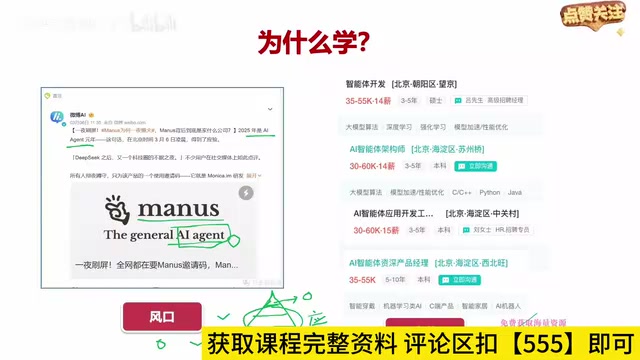
The first reason the course offers is market opportunity. Products like Manus sparked massive industry buzz, with invite codes reportedly reselling for up to 100,000 RMB on secondary markets — a clear sign of market heat. The author argues that AI Agents are reshaping the entire landscape of internet applications, creating enormous opportunity.
A thought-provoking "triangle theory" is introduced here: at the top of the AI industry sits large model training and development, accessible only to a handful of well-resourced companies. The vast majority of practitioners cluster in the middle and lower tiers of application development — and Agent development is the core of that layer, making it the most realistic entry point for everyday developers.
The second reason is more pragmatic — job market demand. The course references job posting screenshots showing competitive salaries and growing demand. As Agents expand beyond pure software into robotics and embedded systems, the talent gap is expected to widen further. Right now is a relatively favorable window to start learning.
Who It's For and What You'll Learn
This course has a clear positioning: it's a development course, not a tool-usage guide, so some programming background is required. The target audience falls into three main groups:
- Junior frontend or backend developers
- Mid-to-senior developers looking to level up
- Technical professionals interested in AI Agent development who want a structured understanding
The course sets out several concrete goals: build a systematic understanding of AI Agent concepts, develop foundational AI applications through hands-on practice, master two mainstream Agent frameworks, and acquire the core competencies needed for AI-era application development. By the end, learners should be able to use Agent frameworks for customized development.
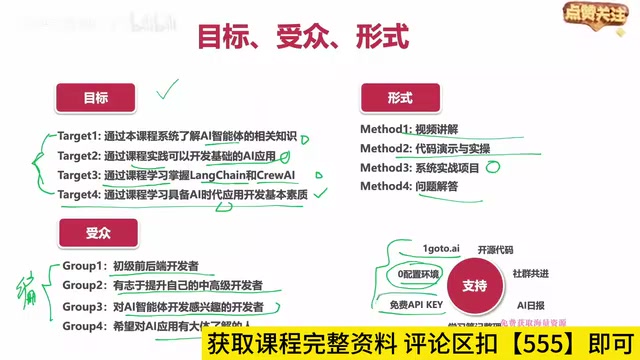
To lower the barrier for beginners, the course also includes several perks: an online IDE with zero configuration required, eliminating the common pain point of environment setup; approximately 150 free API calls bundled with the course, saving the hassle of obtaining API keys; fully open-sourced course code ready to use; and a learning community with shared study notes and an AI daily digest.
Course Structure: Four Progressive Stages
The full course spans roughly 14 to 15 chapters, following a stepped approach that progresses from beginner to advanced.
Foundations (approx. 4 chapters)
This section covers the prerequisite knowledge for AI application development — what AI is, what large language models are, what Agents are, how to use AI coding tools, how to call LLMs via API, and how to work with models like DeepSeek. After this section, learners will have a clear mental model of the entire tech stack and know exactly what preparation is needed going forward.
Framework Learning: LangChain (approx. 6 chapters)
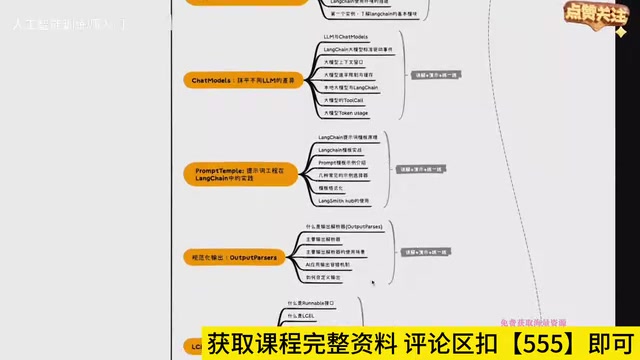
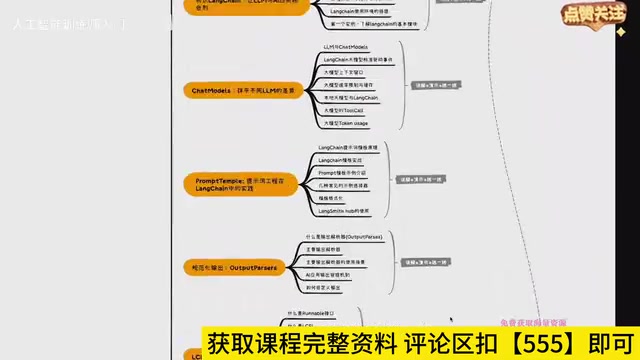
The course uses LangChain as its primary teaching framework. Given LangChain's vast ecosystem, the author has distilled it down to six chapters covering only the most application-relevant content, using a mix of explanation and hands-on exercises. This section forms the foundation for all subsequent projects — learners should be able to independently build applications with the framework upon completion.
LangChain is one of the most popular frameworks for building large model applications. Released by Harrison Chase in late 2022, its core idea is to "chain" together LLMs with external tools, data sources, memory modules, and other components to build applications capable of handling complex tasks. It provides abstractions for conversation chains, tool calling, memory, and retrieval-augmented generation (RAG), so developers don't need to manually handle prompt management, context truncation, and other tedious details. LangGraph is an extension library within the LangChain ecosystem, designed specifically for complex Agent workflows that require loops, conditional branching, and multi-node coordination. It describes agent interaction logic as a directed graph, making it a key piece of infrastructure for building multi-agent systems.
Hands-On Project: Xiao Lang Assistant
The course's centerpiece practical project is an intelligent customer service bot called "Xiao Lang Assistant" — a single-Agent bot with autonomous looping capability. The entire process is fully hands-on, including a complete requirements breakdown and a demonstration of how to evolve it toward a multi-agent architecture. This section is the integrated application of everything covered in the preceding six chapters.
Advanced Topics and Expert Level
The advanced section focuses on Multi-Agent systems, with increased difficulty. It covers agent evolution, performance optimization, deployment, and observability through a mix of explanation, demonstrations, and mini-projects.
The highest-level section introduces CrewAI, a more advanced multi-agent framework. The author openly acknowledges that Agent frameworks are proliferating rapidly, and bringing in CrewAI is meant to open doors rather than be exhaustive — giving learners a comparative understanding of different framework design philosophies so they leave the course comfortable with multiple tools.
CrewAI is an open-source framework designed specifically for multi-agent collaboration. Its core abstraction is the "Crew" — organizing multiple Agents with distinct roles, goals, and tools into a collaborative team, where a Process orchestrates members to complete subtasks sequentially or in parallel, ultimately aggregating into a final output. Compared to LangChain/LangGraph, CrewAI places greater emphasis on declarative role assignment and task orchestration, with a coding style that feels closer to business modeling — making it well-suited for scenarios that simulate real-world team collaboration. The core value of Multi-Agent architecture lies in "divide and conquer": a single Agent faces bottlenecks in context window size, tool count, and reasoning depth. Distributing complex tasks across multiple specialized Agents significantly improves system reliability and scalability, and this is now the dominant direction for production Agent deployments.
Course Highlights and Practical Orientation
Overall, this course has several defining characteristics:
- Mainstream frameworks + frontend/backend friendly: Uses current mainstream AI application frameworks with a development style accessible to both frontend and backend engineers, aligned with the future of AI application development.
- Gentle learning curve: Deliberately lowers the entry bar for developers without machine learning backgrounds, avoiding the deterrent effect of unfamiliar jargon.
- 10+ hands-on projects: All with open-source code, covering three major paradigms — single-agent, multi-agent, and AI workflow — across three frameworks: LangChain, LangGraph, and CrewAI.
- Built-in learning tools: An integrated progress tracker and test Agent that requires learners to pass quizzes before advancing to the next chapter, creating a closed-loop learning experience.
Compared to fragmented tutorials, this course emphasizes system thinking and engineering deployment. The author closes by encouraging learners to seize the current window of opportunity, suggesting that AI Agents could be one of the most important directions for employment or entrepreneurship over the next three to ten years.
Summary
This course introduction clearly maps out a learning arc from zero to production-ready Agents: foundational concepts → framework mastery (LangChain) → single-Agent project → multi-agent advancement → advanced framework exploration. For developers looking to establish a foothold in the AI application layer, building a complete, systematic Agent development skill set is far more valuable than feeling anxious while being bombarded by demos. That said, as a course overview, it paints a broad picture — actual effectiveness will ultimately depend on the specific code and projects covered in the chapters ahead.
Related articles
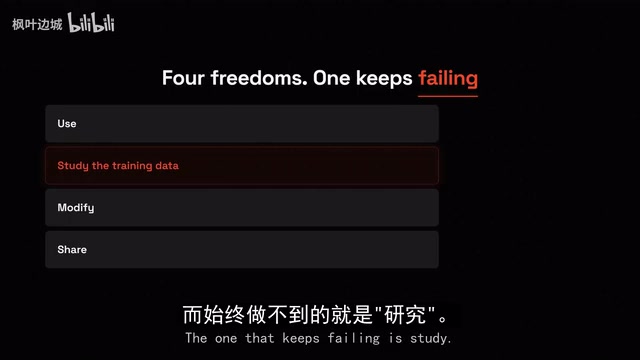
The Truth About Open-Source AI: You Got the Cake, Not the Recipe
Open-source AI exposed: what you download is weights (the cake), not training data or code (the recipe). A deep dive into open weights vs. true open source, Meta/Alibaba/DeepSeek business strategies, and how US/China/EU governments are redrawing the boundaries of openness.
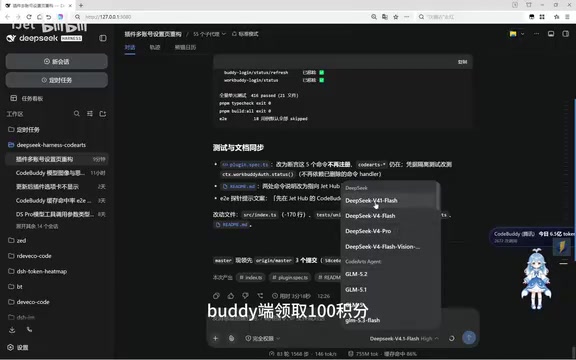
Free DeepSeek V4.1 Flash via DSH: Bulk Point Collection & International WorkBuddy Tested
DSH project update tested: WorkBuddy now offers 100 points per claim, rate limits raised beyond 80M tokens with faster resets, and international WorkBuddy supports free Hunyuan 4 and DeepSeek V4.1 Flash.
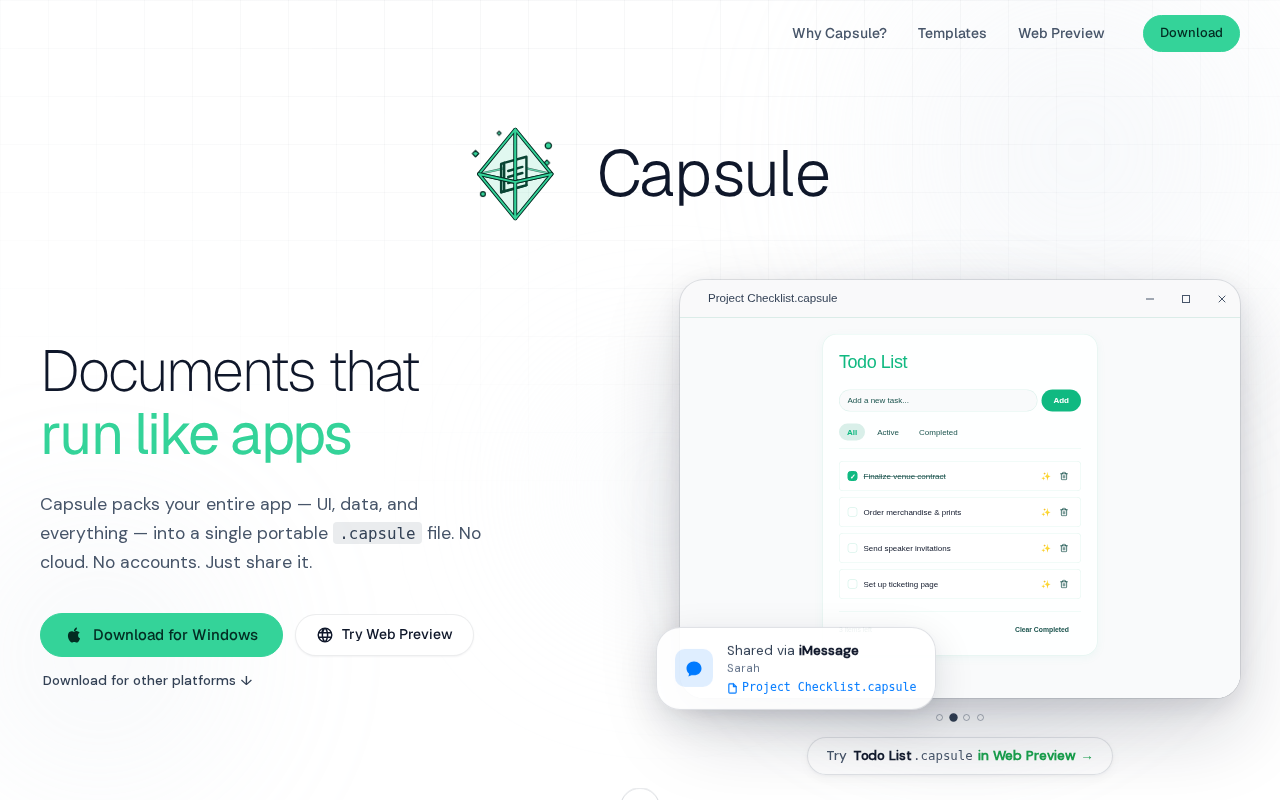
Capsule: Pack Web Apps and Data into a Single SQLite File
Capsule is a Rust/Tauri 2.0 tool that packs HTML web apps and data into a single SQLite file — privacy-first, local storage, portable sharing, with AI support.