Enterprise AI Agent Tech Stack: Four Issues Stalling POCs

Enterprise Agent POC stalls stem from four architectural issues—auditing, sensitive data, escalation, and evaluation—which event sourcing can structurally address.
Based on a conversation between Anthropic's Christopher Lovejoy and Anterior's Saul Howard, the article analyzes why enterprise AI Agent proof-of-concepts (POCs) frequently stall after the demo. The two speakers argue the root cause is not model capability but four architectural questions raised in enterprise review: how to audit Agent decisions and actions, how to handle sensitive data exposure in the inference chain, how to escalate to humans when Agents exceed authority or lack confidence, and how to conduct repeatable evaluation of an open behavior space. The article proposes an event-sourced tech stack as a response: recording every Agent state change as an immutable event, making audits replayable, data boundaries explicit, escalation a built-in mechanism, and evaluation based on real traces. The core argument is that these four issues should be initial design constraints for the tech stack rather than post-POC security hardening, and enterprises should prioritize whether an architecture can answer these four points over model benchmark scores.
When enterprises deploy AI Agents, the proof-of-concept (POC) stage frequently gets stuck. In a conversation between Christopher Lovejoy of Anthropic and Saul Howard of Anterior, the root cause was attributed to four recurring issues: auditing, sensitive data, escalation paths, and evaluation. They also proposed an event-sourced tech stack design approach intended to address these concerns at the architectural level.
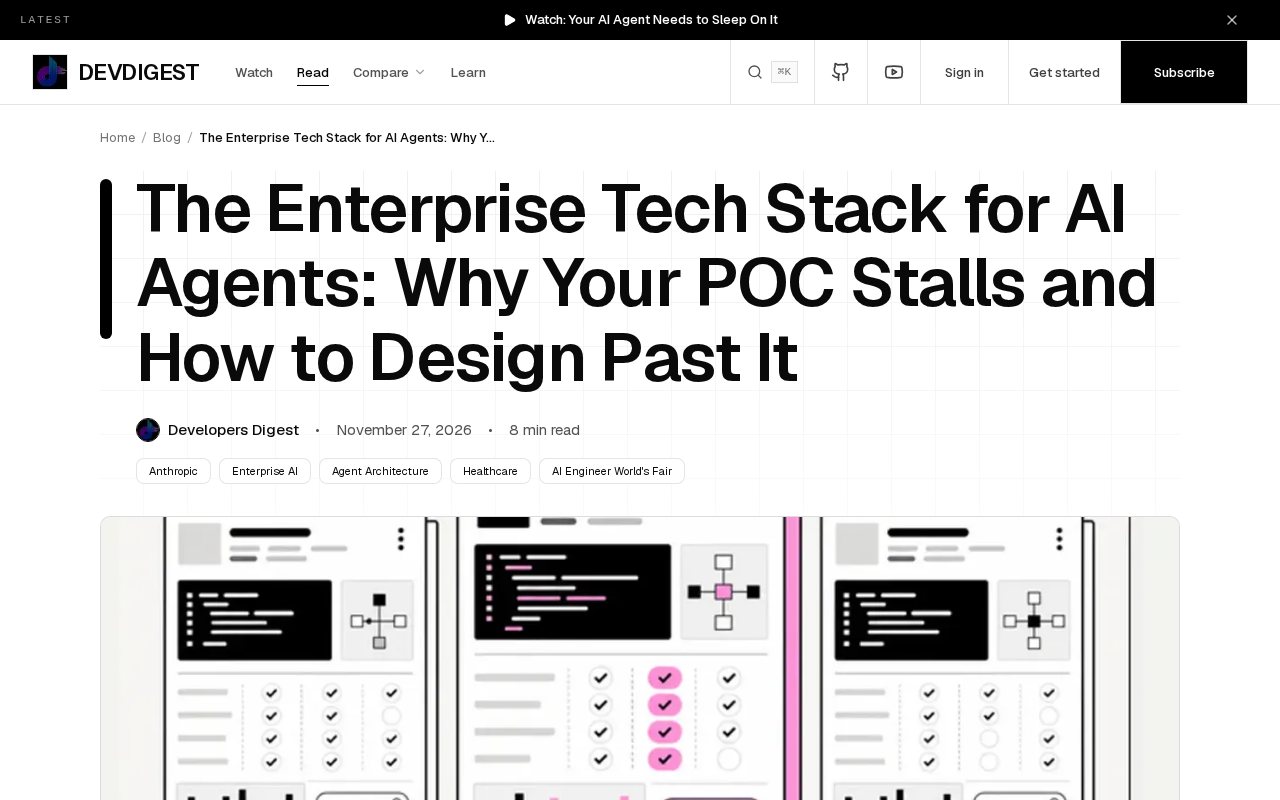
Why Enterprise Agent POCs Always Stall After the Demo
Agent products tend to deliver exciting demos: the model can autonomously call tools, chain together multi-step operations, and complete tasks in open environments. But once they enter enterprise procurement processes, the same systems struggle to pass review by security, compliance, and operations teams. Lovejoy and Howard's observation is that POC stalls are rarely due to insufficient model capability. Rather, enterprises raise a series of architectural questions that cannot be avoided, and most POCs were not designed with answers to these questions in mind from the start.
The two speakers distilled these issues into four: how to audit every decision and action the Agent takes; how to handle the exposure of sensitive data within the inference chain; how to escalate to humans when the Agent encounters uncertainty or exceeds its authority; and how to conduct repeatable evaluations (evals) of Agent behavior. These four issues are interconnected, and patching just one of them is often futile.
The Four Blockers: Auditing, Sensitive Data, Escalation, and Evaluation
Auditing requires more than a statement that "we logged everything"—it demands the ability to reconstruct why the Agent chose a particular tool at a particular moment and what context informed its judgment. Traditional application logs record deterministic code paths, whereas an Agent's decision paths are probabilistic and context-dependent, requiring audit granularity to be redesigned.
The sensitive data problem is that, to complete tasks, Agents often need to access data across multiple systems. Data flows between tool calls, prompt assembly, and model inference, creating a far larger exposure surface than traditional API calls. Drawing on Anterior's practice, Howard emphasizes that data boundaries must be explicitly defined in the architecture rather than relying on post-hoc redaction.
Escalation paths refer to how an Agent hands control back to humans when confidence is insufficient, authority boundaries are reached, or abnormal states arise. Without a clear escalation mechanism, enterprises cannot define the scope of Agent autonomy, and POCs cannot scale to production environments.
The difficulty with evaluation is that an Agent's behavior space is open, and evaluation sets for single-turn Q&A are insufficient to cover the quality of multi-step tool calls. The two speakers argue that evals need to be integrated with the runtime architecture, not tacked on as a separate step after the fact.
Evals in the context of LLMs and Agents refers to systematic methodologies for measuring the quality of model or system behavior. Traditional machine learning evaluation relies on fixed test sets and scalar metrics such as accuracy, but an Agent's behavior space is open: the same task may have multiple valid paths, and tool call order, parameter selection, and failure retry strategies all affect outcomes. Agent evaluation therefore typically requires combining multiple approaches, including offline replay scoring based on real execution traces, LLM-as-judge where a stronger model serves as arbiter, and end-to-end success rate statistics for multi-step tasks. Evaluation sets also need to be continuously updated with real traffic to avoid overfitting to static cases. This is precisely the technical reason the article emphasizes that evals must be integrated with the runtime architecture rather than added afterward.
How Event-Sourced Architecture Addresses These Four Issues
The core design proposed in the conversation is an event-sourced tech stack. The basic idea: every state change of the Agent—receiving input, selecting a tool, calling results, decision branches—is written as an immutable event to an event log, and the current state is derived by replaying the event stream.
This design provides structural answers to each of the four blockers. For auditing, the event log naturally constitutes a complete decision trail that is replayable and traceable. For sensitive data, data access can be recorded and constrained as events, making boundaries explicit at the event level. For escalation, specific patterns in the event stream can trigger human intervention, making escalation a built-in architectural mechanism rather than bolt-on logic. For evaluation, the event stream itself constitutes a reusable evaluation dataset, supporting replay and scoring of real execution traces.
Lovejoy and Howard's argument is that these four issues should not be treated as security hardening items after the POC, but rather as initial design constraints for the Agent tech stack. When selecting solutions, enterprises should first confirm whether a candidate architecture can answer the four questions of auditing, data, escalation, and evaluation, rather than comparing model scores on benchmarks.
Event Sourcing is a persistence pattern contrasted with the traditional approach of "storing only current state." Traditional systems directly overwrite and update records in a database, retaining only the latest snapshot; event sourcing appends every state change as an immutable event to an event log, and the current state is computed by replaying these events in order. This pattern originates from Domain-Driven Design (DDD) and CQRS (Command Query Responsibility Segregation) practices, and is common in scenarios with high traceability requirements such as financial accounting and order systems. For Agents, the value of event sourcing lies in the fact that Agent decisions are probabilistic—saving only the final output cannot explain "why this choice was made"—whereas the event stream naturally preserves intermediate steps such as input context, tool selection, and call return values, making the decision chain reconstructable and replayable. The cost is storage growth and replay performance overhead, typically requiring a snapshot mechanism to periodically compact the event stream.
Implications for Enterprise Technology Selection
The practical value of this framework is that it shifts the discussion from "is the model strong enough" back to "can the system be governed by the enterprise." For teams currently running Agent POCs, an actionable checklist is: can you replay the complete decision chain of any given Agent run; is sensitive data access constrained and auditable at the architectural level; are there explicit human-in-the-loop escalation trigger conditions; and is evaluation based on real execution traces rather than only static datasets.
Whether all four questions have answers is a better predictor of whether an Agent project can move beyond the pilot stage than the quality of the POC demo.
One-line Summary
Enterprise Agent POC stalls stem from four architectural issues—auditing, sensitive data, escalation, and evaluation—which event sourcing can structurally address.
Paragraph Summary
Based on a conversation between Anthropic's Christopher Lovejoy and Anterior's Saul Howard, the article analyzes why enterprise AI Agent proof-of-concepts (POCs) frequently stall after the demo. The two speakers argue the root cause is not model capability but four architectural questions raised in enterprise review: how to audit Agent decisions and actions, how to handle sensitive data exposure in the inference chain, how to escalate to humans when Agents exceed authority or lack confidence, and how to conduct repeatable evaluation of an open behavior space. The article proposes an event-sourced tech stack as a response: recording every Agent state change as an immutable event, making audits replayable, data boundaries explicit, escalation a built-in mechanism, and evaluation based on real traces. The core argument is that these four issues should be initial design constraints for the tech stack rather than post-POC security hardening, and enterprises should prioritize whether an architecture can answer these four points over model benchmark scores.
Related articles

A 19-Year-Old's Rental Horror Story: Ceiling Collapse, Bug Infestation, and the Lessons It Taught Me
At 19, my first off-campus rental brought bug infestations, no heat, a collapsed ceiling, and a ruined laptop with no renter's insurance. Here are the hard-won lessons for first-time student renters.

Veda Nurse's Cranial Nerve Exam: Why ASMR Role-Play Is Going Viral
Bilibili creator Veda's cranial nerve exam ASMR video goes viral, blending humor and sensory triggers through nurse role-play. This article analyzes its unique appeal and the audience psychology behind ASMR role-play.

LG Cinebeam AI Review: 120-Inch Giant Screen + 3000 Lumens, a New Choice for the Living Room Theater
LG Cinebeam AI projector review: 3000 ANSI lumens, 4K, 100 inches from about 8 cm and 120 inches from about 18 cm. Built-in webOS, AI Concierge voice recommendations, AI Sound Pro 11.1.2 virtual surround, and Game Optimizer—positioned for fixed living room installation, complementing the portable Cinebeam S.