Enterprise AI Agent vs. Personal Agent: A Deep Architectural Comparison

Enterprise agents aren't scaled-up personal agents — they require ground-up redesign for multi-user governance and event-driven workflows.
This article examines three fundamental architectural differences between enterprise AI agents ("company OS") and personal AI agents: the many-principals, one-actor structure requiring multiplayer support and memory isolation; a quantum leap in governance needs around observability, auditability, and admin control planes; and a shift from synchronous conversation to event-driven async interaction. Both agent types share foundational capabilities including code execution, browser use, Skills/MCP interfaces, and the core agent loop. The key takeaway is that enterprise agents must be rebuilt from the ground up around collaboration, compliance, and automation — not simply scaled up from consumer products.
From Personal Assistant to Enterprise Operating System
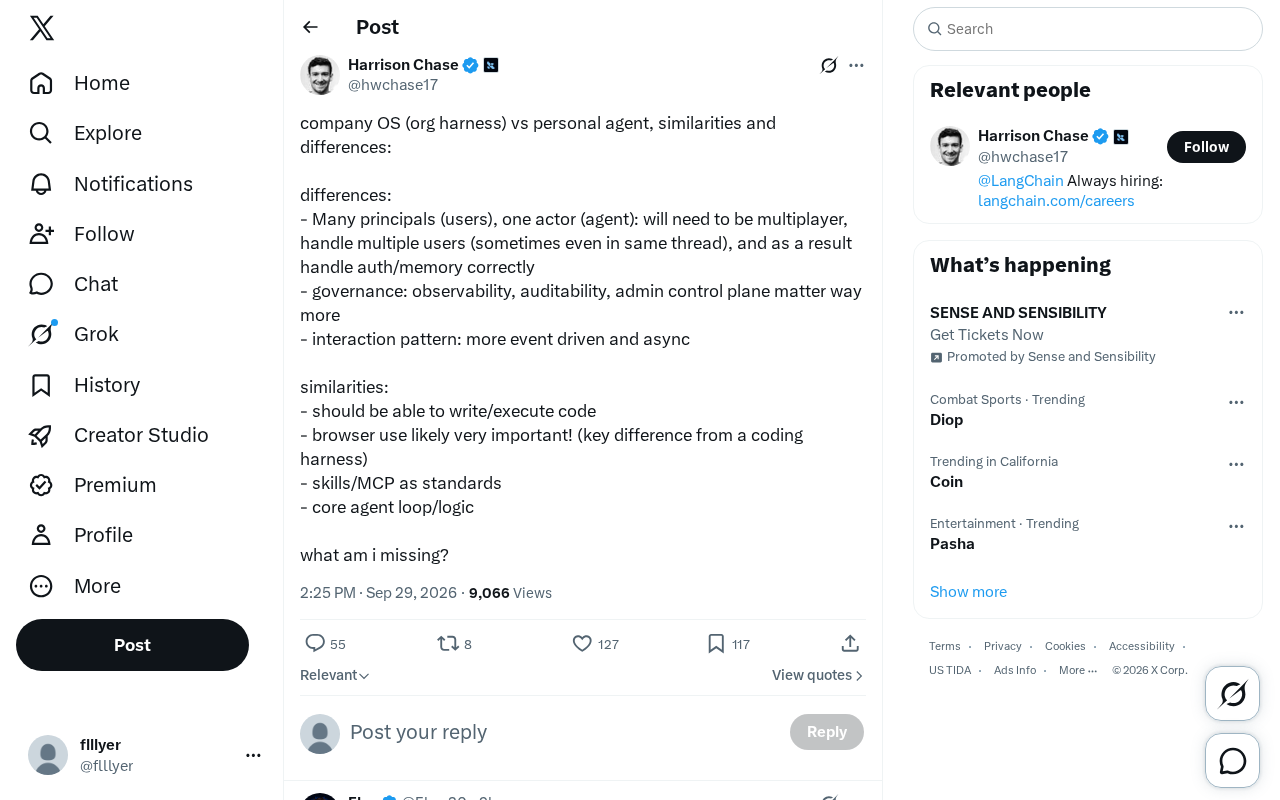
As AI Agent technology moves from experiment to production, a critical architectural question is emerging: what are the fundamental differences between a "company OS" (org harness) built for enterprise organizations and a personal agent serving individual users? A tech practitioner recently shared a remarkably insightful comparison on social media, sparking industry discussion about Agent system design.
The question may sound like a technical detail, but it cuts to the core of AI Agent commercialization. Personal agents and enterprise agents face vastly different user scales, governance requirements, and interaction patterns — and these differences directly shape the underlying architecture.
Three Core Differences
The Many-Principals, One-Actor Mismatch
The first challenge enterprise agents face is the "many principals, one actor" structure. In personal use cases, an agent typically serves a single user, keeping the logic relatively simple. But within an organization, a single agent may need to respond to multiple users simultaneously — sometimes handling instructions from different people within the same conversation thread.
This means enterprise agents inherently require multiplayer capabilities. That brings with it the complexity of auth and memory management: the system must accurately track who is making a request, what resources each person can access, and how to maintain separate memory boundaries within a shared context. These issues barely exist for personal agents, yet they're unavoidable thresholds for enterprise deployment.
The "many principals, one actor" structure is a variant of what security engineering calls the principal-agent problem: when one agent is simultaneously authorized by multiple principals, preventing high-privilege instructions from being forged or hijacked by lower-privileged users becomes a central security threat. In the AI Agent context, this evolves into an enterprise-scale version of prompt injection — a malicious user could craft inputs that trick the agent into executing unauthorized operations under another user's or admin's privileges. This is precisely why enterprise agents need identity-based auth mechanisms at the session layer, rather than relying solely on role declarations within the conversation context. Memory isolation is equally critical: if different users' historical contexts become mixed in a shared memory space, sensitive information can leak unintentionally.
A Quantum Leap in Governance Requirements
The second major difference lies in governance. For enterprise agents, observability, auditability, and an admin control plane matter far more than they do in personal scenarios.
Enterprises need to know clearly what the agent did, why it did it, and who is accountable when something goes wrong. Administrators also need a control plane to configure permissions, set boundaries, and monitor behavior. These capabilities are often nice-to-haves for personal assistants, but in organizational environments they're life-or-death requirements for compliance and security.
Observability is a well-established concept in distributed systems, typically defined as the ability to infer a system's internal state from its external outputs — logs, metrics, and traces. Applying this to agent systems is particularly challenging: unlike the deterministic execution paths of traditional software, LLM-driven agents dynamically generate intermediate steps during reasoning, making it extremely difficult to reconstruct "why the model made this decision" after the fact. The admin control plane is borrowed from networking and cloud infrastructure, referring to a dedicated layer for configuring, monitoring, and managing data plane behavior — in the agent context, it means IT administrators can centrally define which tools are available, which data is accessible, and which operations require human approval, all without modifying the agent's business logic. This "separation of policy and execution" design philosophy is a foundational paradigm in enterprise software compliance architecture.
The Shift to Event-Driven Async Interaction
The third key difference is a transformation in interaction patterns. Personal agents predominantly use synchronous, conversational interaction — the user asks, the agent answers. Enterprise agents, by contrast, lean toward event-driven and async modes.
Workflows within organizations are typically triggered by events: an email arrives, a ticket is created, a data change occurs. Enterprise agents need to respond automatically when these events happen, rather than passively waiting for humans to issue instructions one by one. This shift from "conversation" to "event stream" places significantly higher demands on scheduling, concurrency, and state management.
The Overlooked Commonalities
Despite the clear differences, both types of agents still share a large amount of foundational infrastructure at the base layer.
First is the ability to read, write, and execute code. Whether serving individuals or enterprises, the ability to write and run code is key to modern agents delivering real productivity.
Second, browser use is considered potentially very important — and it's a key differentiator between agent systems and pure coding harnesses. The ability to operate a browser means the agent can access virtually any web service, breaking free from the constraints of closed APIs.
Additionally, Skills and MCP (Model Context Protocol) are increasingly becoming the standard interfaces for extending agent capabilities. And the core agent loop/logic — the basic closed loop of perceive, plan, execute, and reflect — is fundamentally shared across both types of systems.
MCP (Model Context Protocol) is a standardized protocol proposed and open-sourced by Anthropic in late 2024, designed to address the fragmented integration between AI models and external tools and data sources. Before MCP, each agent system typically needed to develop a custom adapter for each external service, generating large amounts of repetitive, hard-to-reuse "glue code." MCP defines a unified server-client communication specification, allowing tool providers to implement the MCP interface once and have it called by any compatible agent framework. This is analogous to the standardization logic of REST APIs in web development — standardization itself doesn't create new capabilities, but it dramatically reduces the friction of ecosystem fragmentation. Major agent frameworks (such as Claude, Cursor, and others) have already begun supporting MCP, and the tool ecosystem around it is expanding rapidly, with strong potential to become the de facto standard interface layer for agent capability extension.
The Business Logic Behind Architectural Choices
The value of this comparison isn't in listing technical checkboxes — it's in revealing a trend: enterprise agents aren't simply a scaled-up version of personal agents, but a system that needs to be redesigned from the ground up.
The three key differences — multi-user support, strong governance, and event-driven interaction — map directly onto the core, longstanding demands of enterprise software: collaboration, compliance, and automation. This also explains why simply "selling" consumer-grade agent products to enterprises so often fails: the underlying assumptions are different, so the architecture naturally requires reconstruction.
For teams building agent products, clearly identifying whether you're targeting individuals or organizations — and then making the right early decisions around multi-user collaboration, permission governance, and interaction patterns — may matter more than chasing the latest model capabilities.
It's worth noting that the author's closing question, "what am I missing?", reminds us that this field is still in rapid exploration. Mature best practices have yet to solidify.
Related articles

Huberman's Rational Supplement Guide: A Five-Layer Health Framework and Scientific Decision-Making
Stanford neurobiology professor Huberman proposes a rational supplement framework: behavior and nutrition are the foundation, basic combination supplements serve as insurance, and sleep/hormonal/cognitive directions should stick to single-ingredient experiments. Omega-3 is the top single-ingredient choice, and melatonin is not recommended.

The Unsung Painter Behind Gilded Age Manhattan Interior Design
HN discussion highlights the painter behind Gilded Age Manhattan interiors: he created murals and decorative paintings but was long overlooked as his work was seen as architectural appendage.

Can AI Agents Be Socially Engineered? Understanding Prompt Injection and Tool Permission Risks
Through Invariant Lab's GitHub Issue injection and Brave's AI browser attack, this article analyzes how Prompt Injection induces AI Agents to perform unauthorized actions, and offers protection advice across three layers: least privilege, tool validation, and operation auditing.