Enterprise AI Security Guide: Why Traditional Firewalls Can't Protect Your AI

Why traditional firewalls fail against AI threats, and how enterprises can build layered defenses with AI Gateways.
Traditional firewalls inspect packets and ports — they're blind to what's happening inside AI conversations. This article breaks down three core enterprise AI risks: Shadow AI data leakage, AI Agent permission abuse, and prompt injection attacks. It cuts through market noise with practical evaluation criteria, introduces the emerging AI Gateway product category, and argues for a layered defense strategy combining technology controls with governance policy.
Why Traditional Firewalls Fail in the Age of AI
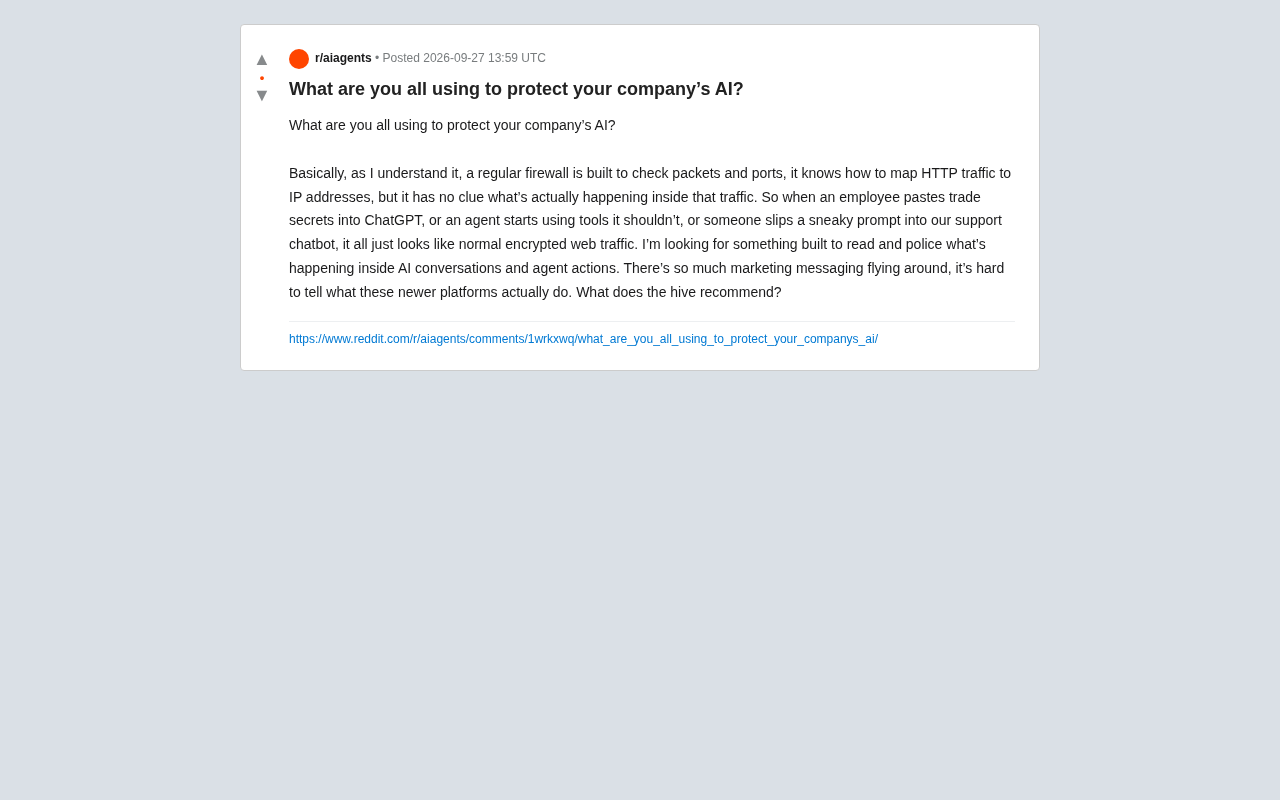
A question that sparked debate on Reddit cut right to the heart of enterprise IT security's blind spot: when an employee pastes confidential business secrets into ChatGPT, when an AI Agent calls a tool it never should have, when someone embeds a subtle prompt injection attack into a customer service chatbot — your traditional firewall doesn't notice a thing.
The original poster nailed the core problem: conventional firewalls are designed to inspect packets and ports. They're good at mapping HTTP traffic to IP addresses, but they have no idea what's actually happening inside that traffic. To a firewall, a conversation leaking trade secrets and a routine web browse look identical — both are just "encrypted web traffic."
This observation exposes the central tension in AI security: the defensive perimeter is shifting from the network layer to the semantic layer. Traditional security tools care about who is communicating with whom. AI security demands answers to what they're saying and what the AI is doing.
Three New Categories of AI Security Risk
From the original post, three distinct risk categories emerge — scenarios that any credible AI security solution must address.
Data Leakage: The Shadow AI Problem
The most pervasive and most easily overlooked risk is employees voluntarily feeding sensitive information to external AI models. Sales reps paste client lists into ChatGPT for summaries. Engineers dump internal source code into an AI assistant to debug it. Legal teams hand contract clauses to a model for polishing. From the employee's perspective, this is a productivity win. From the security team's perspective, it's uncontrolled data exfiltration. AI tools used without formal approval are commonly called "Shadow AI" — and they represent the most immediate data compliance risk enterprises face today.
Shadow AI is the natural evolution of the "Shadow IT" concept into the AI era. Shadow IT refers broadly to software or services employees adopt without IT department approval. Shadow AI specifically refers to AI tools used to process enterprise data without security review — including public ChatGPT, various AI writing assistants, or third-party plugins. The danger isn't just that model providers might use your data for training. It's that the enterprise loses complete visibility into where that data goes, making it impossible to satisfy the audit trail requirements of compliance frameworks like GDPR and HIPAA. Surveys suggest more than 60% of employees use AI tools without informing their employers — meaning most organizations' data exposure is far larger than their IT teams realize.
Agent Misuse: Tool-Calling Permission Abuse
As AI Agents become more widespread, the risk escalates from "saying the wrong thing" to doing the wrong thing. When an Agent is granted the ability to call tools, query databases, and execute actions, a single bad instruction — or a manipulated one — could trigger deleted records, misdirected emails, or unauthorized transactions. What makes this so dangerous is that Agent behavior is dynamically generated. Static permission rules cannot anticipate every scenario in advance.
Prompt Injection: An Entirely New Attack Surface
The third category is what the original poster described as "someone embedding hidden instructions into a customer service chatbot" — prompt injection attacks. By crafting malicious inputs, attackers can manipulate an AI model into ignoring its original instructions, leaking its system prompt, or performing unauthorized actions. OWASP has listed this as the top security threat for LLM applications. Because the attack vector is natural language, traditional WAF rules are almost entirely ineffective.
Prompt injection takes two primary forms. Direct injection occurs when an attacker types malicious instructions directly into the chat interface, attempting to override the system prompt. Indirect injection is more insidious: the attacker embeds malicious instructions inside external content that the AI will read — web pages, uploaded PDFs, database records — so that when an Agent retrieves this content, it unknowingly executes the embedded commands. The latter poses extreme risk to AI Agents equipped with web browsing or file-reading capabilities, since the attack surface expands from user input to everything the AI can access. OWASP ranks it as the number-one risk for LLM applications precisely because natural language simultaneously serves as both the functional medium and the attack vector — impossible to exhaustively defend against with rules alone.
Cutting Through the Market Noise: What Actually Matters
Another pain point from the original post rings very true: "With all the marketing speak flying around, it's hard to tell what these new platforms actually do." This is the current state of the AI security market — concepts lead, vendors slap "AI security" and "AI firewall" labels on everything, and actual capabilities vary wildly.
For enterprises in evaluation mode, the practical approach is to ignore the buzzwords and focus on whether a solution covers these specific capability dimensions:
- Content-level inspection: Can it decrypt and understand the actual content of AI conversations — not just traffic metadata? This is the line between genuine AI security and a rebranded firewall.
- DLP integration: Can it detect sensitive information in conversations (PII, API keys, source code, financial data) and block or redact it?
- Agent behavior monitoring: Can it log and govern the tool-calling chains of AI Agents, with configurable boundaries on what actions are permitted?
- Prompt attack detection: Does it include built-in detection models for prompt injection and jailbreak attempts?
- Observability and audit trails: Can it provide comprehensive AI usage logs that satisfy compliance audit requirements?
A New Product Category Taking Shape: AI Gateway
The industry is coalescing around a new product category to address these needs, commonly called an AI Gateway or LLM Firewall. It functions as a middle-layer proxy for AI traffic: all requests going to and from LLMs pass through it, enabling content inspection, sensitive data filtering, permission enforcement, and behavioral auditing at a single chokepoint.
The architectural value here is centralizing security policy from scattered application-level implementations into a unified control plane. This covers both employees accessing SaaS LLMs and internal AI Agents operating within the enterprise. Compared to building security logic independently into each application, the gateway model is far easier to maintain and govern consistently.
A word of caution: AI security is still evolving rapidly, and no single tool is a silver bullet. The more pragmatic approach is layered defense — use a gateway for traffic control, DLP for data identification, a policy engine to constrain Agent permissions, and employee training to reduce Shadow AI adoption. Technology and governance working together is the only realistic answer at this stage.
At the implementation level, AI Gateways are typically deployed as a reverse proxy sitting between the application and the LLM API, exposing an interface that's compatible with the original API so business code requires no changes to integrate. Core capability modules generally include: real-time content scanning of requests and responses (via dedicated classification models or rule engines), token-level sensitive data detection and substitution, role-based tool-calling permission matrices, and full request-chain logging. Some products also introduce a Guardrails mechanism, allowing enterprises to define policies in natural language (e.g., "never output any competitor product names"), enforced at runtime by the model itself or a separate classifier. This architecture shares the same reverse-proxy philosophy as traditional API gateways like Kong and APISIX — but its fundamental distinction is that the detection layer shifts from rule-based traffic signature analysis to semantic understanding.
Closing Thoughts
This question from a practitioner in the field reflects a deeper shift in security paradigms. As AI evolves from a "tool" into an "autonomous actor," security must evolve from inspecting packets to understanding semantics and monitoring behavior. Traditional firewalls aren't going away — but they need an AI-aware partner. For enterprises, the time to put "AI security" on the formal technology evaluation agenda is now. Not after the first data breach.
Related articles

GPT-Next Leak, Gemini 4 Argon Imminent: AI News Roundup
GPT-Next leak suggests extreme efficiency; OpenAI's 28-day shipping pledge boosts speed 50%; Gemini 4 Argon nears release; Anthropic subscription value report sparks debate.

GPT-Next Leaked, Gemini 4 Argon Speeds Up, Fable 5.5 May Launch Today
OpenAI's GPT-Next model leaks, expected to be extremely low-cost and possibly part of the 28-day release plan; Gemini 4 Argon internal testing accelerates, NanoBanana 2.1 is live; Semi Analysis tests show Claude Max's equivalent API value is about 5 times that of ChatGPT Pro; Fable 5.5 may launch today.

Gemini 4 Argon Launches Globally: Key Highlights from the AI Daily Brief
Google opens Gemini 4 Argon globally across Pro and Ultra subscriptions and the API, and demonstrates robot control. This article rounds up open-source models, Agent infrastructure, cost transparency, and safety governance updates.