EPOCH: Making AI Research Agent Discoveries More Trustworthy Through Evidence Governance

EPOCH governs evidence in AI research agents to produce trustworthy discoveries, not just higher benchmark scores.
A key risk in AI research agents is that systems optimize evaluator feedback without distinguishing between benchmark improvements, numerical validations, and theorem-level conclusions — allowing fragile candidates to pass as reliable discoveries. EPOCH addresses this with an evidence-governed discovery loop featuring five components: task contracts, typed memory, active falsification, admission checks, and independent replay. Experiments show EPOCH achieves an average normalized score of 0.65 on AlgoTune (vs. the best baseline's 0.53), leads on Math14 and AgentHPO, and delivers substantive advances — including algorithm optimizations and counterexample constructions — across ten discovery problems.
Why AI Research Agents Need "Evidence Governance"
AI research agents are increasingly being used to search for programs, mathematical constructions, and proofs. These systems essentially search vast candidate spaces for better algorithms, tighter constructions, or stronger theorems. However, a long-overlooked problem has gradually come to light: existing systems tend to focus on optimizing evaluator feedback without seriously managing how that feedback should be interpreted, challenged, or reused.
The consequences are significant. A seemingly promising but actually fragile candidate may be presented as a "discovery." More critically, three fundamentally different levels of conclusions — benchmark improvements, finite numerical certificates, and theorem-level claims — get conflated without distinction. In other words, the system cannot tell the difference between "I outperformed on a test set" and "I proved a theorem."
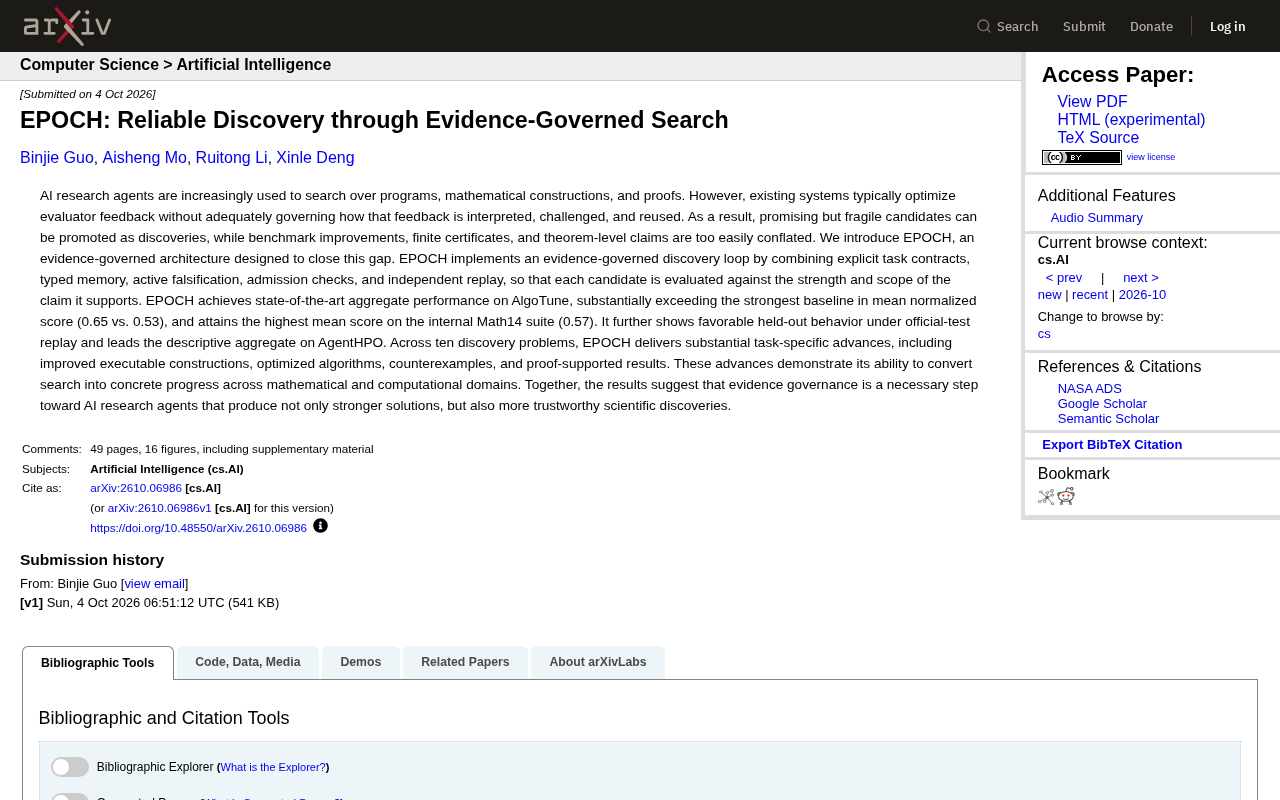
To address this gap, a new arXiv paper introduces EPOCH — an evidence-governed architecture designed to help AI research agents produce not just stronger solutions, but more trustworthy scientific discoveries.
EPOCH's Core Mechanism: A Governed Discovery Loop
EPOCH implements an "evidence-governed discovery loop" that combines multiple components to ensure every candidate is evaluated according to the strength and scope of the claims it supports — rather than applying a one-size-fits-all evaluation score.
Five Key Components
The paper identifies five core elements that together form this governance mechanism:
- Explicit task contracts: Clearly define what conclusion a task requires and what counts as qualifying evidence.
- Typed memory: Structured, type-annotated storage of past candidates and evidence, preventing conclusions of different strength from being conflated or misreused.
- Active falsification: Rather than passively accepting evaluator pass signals, the system actively challenges and attempts to refute fragile candidates.
- Admission checks: Candidates must pass validation thresholds matching their claim strength before being accepted as "discoveries."
- Independent replay: Results are re-validated through an independent process to examine their true performance on held-out scenarios.
The elegance of this design lies in decoupling "search optimization" from "evidence adjudication." Traditional systems are prone to overfitting evaluator feedback, whereas EPOCH specifically combats false-positive discoveries — those that only hold under specific conditions — through active falsification and independent replay.
Typed memory deserves special attention. In traditional AI search systems, memory tends to be flat — candidates, evaluation scores, and intermediate results are all stored in the same pool, available for downstream steps to draw from without distinguishing the reliability of their sources. Typed memory assigns an "evidence type" tag to every stored piece of information, distinguishing levels such as "passed numerical tests," "passed formal verification," or "validated on training set only." This allows the system to know the proof strength of any historical record when reusing it in later reasoning, preventing a conclusion that "ran successfully on a few samples" from being treated as a universally valid result. This mechanism parallels type systems in databases or type checking in programming languages: by carrying metadata at the data level, structurally incorrect reasoning becomes hard to express, rather than relying on manual runtime inspection.
Experimental Results: Leading Performance Across Multiple Benchmarks
EPOCH demonstrates leading overall performance across multiple benchmarks — the strongest evidence distinguishing it from mere verbal promises.
Quantitative Results Across Benchmarks
On the AlgoTune benchmark, EPOCH achieves state-of-the-art overall performance with an average normalized score of 0.65, substantially outperforming the strongest baseline at 0.53. On the internal Math14 test suite, it achieves the highest average score of 0.57.
Perhaps more noteworthy is its strong held-out behavior under official-test replay — meaning its advantage was not obtained through memorization or overfitting, but holds up under unseen conditions. Additionally, EPOCH leads on descriptive synthesis metrics on AgentHPO.
Substantive Progress on Ten Discovery Problems
Beyond abstract scores, the paper highlights that EPOCH delivers substantive, task-specific progress on ten concrete discovery problems, including:
- Improved executable constructions
- Optimized algorithms
- Counterexamples
- Proof-supported results
These achievements span both mathematics and computation, demonstrating EPOCH's ability to translate "search" into concrete advances rather than merely gaming leaderboards.
Why Evidence Governance Is a Necessary Step
The research value of EPOCH lies not only in setting new state-of-the-art scores on several benchmarks, but in advancing a methodological position: evidence governance is a necessary step toward trustworthy AI research agents.
A large number of current AI agent systems treat "evaluator score improvement" as equivalent to "scientific progress" — an equivalence that is dangerous in serious research contexts. A benchmark improvement does not equal a theorem that can withstand peer review; a finite numerical validation does not equal a universally valid conclusion. EPOCH's contracts, admission checks, and independent replay are precisely the mechanisms that establish, at the system level, the ability to distinguish between these different levels of evidentiary strength.
In the long run, as AI agents become increasingly involved in program search, mathematical construction, and theorem proving, ensuring that the "discoveries" they produce are trustworthy will become a more important issue than simply chasing higher scores. EPOCH's answer is to engineer the evidence norms already present in the scientific community — contracts, falsification, replication — directly into the discovery loop. This may be the critical inflection point for AI moving from "able to find solutions" to "able to produce trustworthy scientific conclusions."
This issue carries deep historical lessons from the fields of Automated Theorem Proving (ATP) and Program Synthesis. Early inductive program synthesis systems once claimed to have "found the correct program" after passing validation on a finite set of examples, only to be found systematically failing on edge-case inputs. Similarly, machine learning-assisted mathematical conjecture systems (such as DeepMind's 2021 work on topology and representation theory) were accompanied by independent verification from human mathematicians upon publication — precisely because researchers clearly understood that "patterns" discovered by models need to be strictly distinguished from provable propositions. EPOCH's contribution is to move this distinction from post-hoc manual review to an endogenous constraint in the system architecture — enabling agents to continuously self-challenge during the discovery process, rather than waiting for external scrutiny at publication time.
Summary
EPOCH represents an important conceptual shift in the field of AI research agents: from purely optimizing evaluator feedback, to governing the generation, challenge, and reuse of evidence. Its leading results on benchmarks including AlgoTune, Math14, and AgentHPO, combined with substantive progress on ten discovery problems, support the argument that evidence governance can simultaneously produce stronger and more trustworthy results. For researchers interested in AI-automated scientific discovery, program synthesis, and automated theorem proving, this is work worth close attention.
Related articles

Cursor AI Programming in Practice: Build a Student Management System from Scratch in 30 Minutes
A Bilibili creator demonstrates Cursor AI programming: generating a student management system in 30 minutes with natural language. Details on Agent mode, Claude selection, prompt techniques, and thresholds.

Top 20 AI Coding Tools Ranking: From Rock-Solid to Lackluster, a Scored Matrix
Bilibili creator releases top 20 AI coding tools ranking, tiered T0–T4 from rock-solid to lackluster, with Claude Code and Codex tied at T0. This article details the scoring dimensions (capability, reliability, robustness, durability, cost, domestic availability) and tool performances to help developers choose the right AI coding assistant.

Vibe Coding Systematic Tutorial: Master AI-Assisted Programming from Zero
A three-month Vibe Coding tutorial from a Bilibili creator covering Codex, ClaudeCode, and Cursor, from core logic to commercial project practice for beginners.