ESP32-Bit-Pirate: An ESP32-Based Open-Source Multi-Protocol Hardware Debugging Tool

An ESP32-based open-source multi-protocol hardware debugging tool with a web CLI interface.
ESP32-Bit-Pirate is an open-source hardware hacking tool built on the affordable ESP32 chip, supporting UART, SPI, I2C, and 1-Wire protocols. Its standout feature is a web-based CLI that enables zero-install, cross-platform debugging from any browser. Costing just a few dollars, it offers a powerful alternative to traditional hardware debuggers for security researchers and embedded developers.
A Comprehensive Hardware Debugging Powerhouse
In the fields of hardware security research and embedded development, engineers often need to switch between multiple communication protocols—UART, SPI, I2C, 1-Wire, and more. Traditionally, this meant preparing multiple dedicated tools or adapters, which is cumbersome and costly. While the classic Bus Pirate filled this gap, its hardware price and availability still kept many hobbyists at bay.
Bus Pirate is an open-source hardware debugging tool released around 2008 by the Dangerous Prototypes team, often hailed as the "Swiss Army knife" of hardware hacking. Through a unified serial command-line interface, it allows users to interact with SPI, I2C, UART, 1-Wire, JTAG, and other bus protocols without writing any code. Its core philosophy is "universal bus interface"—one device to handle reading, writing, and sniffing all common low-speed buses. Bus Pirate has had a profound influence on the hardware security research community and is a standard tool for many penetration testers extracting firmware and reverse-engineering communication protocols. However, its hardware is based on a PIC microcontroller with limited processing power, and the official hardware is not easily available in some regions, typically priced in the $30–50 range.
The open-source project ESP32-Bit-Pirate targets precisely this pain point. Built on the affordable and widely available ESP32 chip, it delivers a hardware hacking tool that covers mainstream communication protocols. Since its launch, the project's popularity has surged rapidly, accumulating 4,676 Stars and 383 Forks, with a single-day Star increase as high as 152—a clear testament to the community's strong demand for practical tools like this.
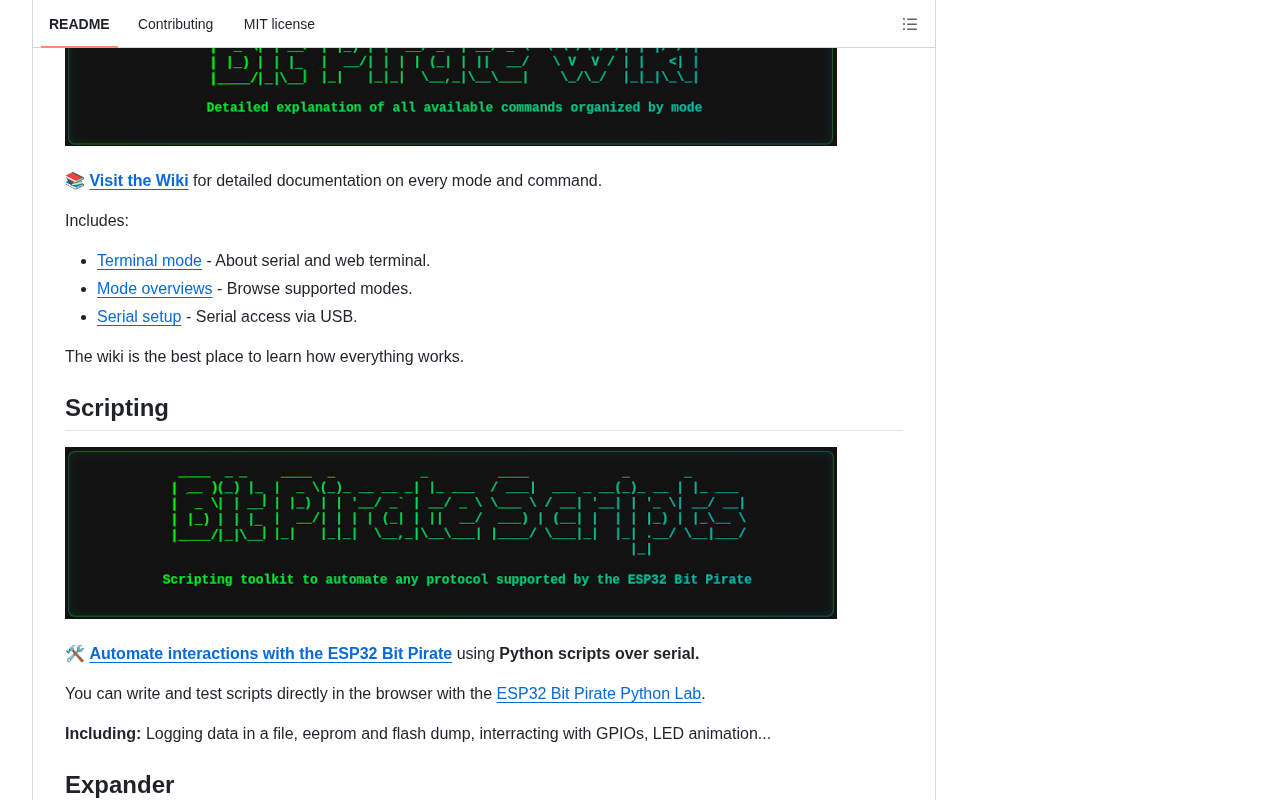
Core Highlight: Web-Based Command-Line Interface
Say Goodbye to Traditional Serial Terminal Operations
Unlike traditional debugging tools that require connection through serial terminals (such as PuTTY or minicom), ESP32-Bit-Pirate's biggest innovation is its web-based CLI (Command-Line Interface). Users simply access the device's webpage through a browser to enter commands, switch protocols, and send/receive data directly.
From a technical implementation perspective, ESP32-Bit-Pirate leverages ESP32's built-in WiFi module to launch a lightweight HTTP/WebSocket server. After booting, the device creates a WiFi hotspot (AP mode) or connects to an existing network (STA mode), and users can load the frontend page by visiting the device's IP address in their browser. The page maintains bidirectional real-time communication with the ESP32 via the WebSocket protocol—commands entered by users are sent to the device as WebSocket frames, and the device pushes results back to the browser in real time after execution. Compared to traditional HTTP polling, WebSocket has extremely low latency and minimal overhead, making it ideal for this interactive command-line scenario. This architecture also means the device is essentially an independent network node that can be accessed by any device on the same LAN, and can even enable remote debugging through port forwarding.
This design brings significant advantages:
- Zero installation barrier: No drivers or terminal software need to be installed on the computer—any device with a browser (including phones and tablets) can operate it.
- Cross-platform consistency: Windows, macOS, Linux, and even mobile devices share a unified experience, avoiding the perennial serial driver compatibility issues.
- Wireless debugging capability: Leveraging ESP32's built-in WiFi enables protocol interaction in remote or wireless scenarios, freeing users from physical cable constraints.
A Modern Upgrade to the Interactive Experience
The Bus Pirate-style interaction logic is preserved—configuring bus mode, clock frequency, pull-up resistors, and other parameters through concise text commands. The web interface adds friendlier visual feedback on top of this, reducing the learning curve for beginners.
Hardware Foundation Supporting Multiple Protocols
The ESP32 chip itself integrates rich peripheral interfaces, providing a natural hardware foundation for multi-protocol support. ESP32 is a cost-effective SoC from Espressif Systems, featuring a Xtensa LX6 dual-core processor (up to 240MHz), 520KB built-in SRAM, and integrated WiFi 802.11 b/g/n and Bluetooth 4.2/BLE. Its peripheral resources are extremely rich: 3 UARTs, 2 I2C interfaces, 4 SPI interfaces, 12-bit ADC, DAC, PWM, and a programmable GPIO Matrix that allows mapping virtually any peripheral function to any pin—this is the key hardware foundation enabling multi-protocol switching. ESP32 development boards (such as ESP32-DevKitC, NodeMCU-32S) sell for just a few dollars on the market, and combined with the mature ESP-IDF and Arduino frameworks, they form a massive developer ecosystem.
ESP32-Bit-Pirate fully utilizes these resources, covering the most common bus types in hardware debugging:
-
UART: Serial communication debugging, a common method for reading device logs and flashing firmware. UART (Universal Asynchronous Receiver/Transmitter) is one of the oldest and most widely used serial communication interfaces, requiring only TX and RX signal lines for full-duplex communication. In hardware security research, UART ports are often the first entry point attackers look for: a large number of IoT devices (routers, cameras, smart speakers) retain unshielded UART debug interfaces on their PCBs, through which one can directly obtain bootloader logs, Linux shells, or even root access. The typical identification process involves using a multimeter to find the 3.3V/GND/TX/RX pads, using a logic analyzer or automatic baud rate detection to determine communication parameters (common baud rates are 9600, 38400, 115200), and then connecting a debug tool to read the output.
-
SPI: Commonly used to connect Flash storage, sensors, and other peripherals—a key protocol for firmware extraction in hardware security research. SPI (Serial Peripheral Interface) is a high-speed synchronous serial bus consisting of MOSI, MISO, SCK, and CS lines, supporting full-duplex communication with clock frequencies reaching tens of MHz. In hardware security, SPI's most important use case is directly reading firmware images from Flash chips. Nearly all embedded devices use SPI NOR Flash (such as the Winbond W25Q series) to store bootloaders and OS images. Security researchers can read the complete firmware directly from the chip via SPI protocol, then use tools like binwalk to unpack and analyze the file system, extract encryption keys, or discover hardcoded credentials.
-
I2C: Widely used for low-speed sensor and EEPROM communication, with convenient address scanning and register read/write capabilities. I2C (Inter-Integrated Circuit) was invented by Philips Semiconductor in 1982 and requires only SDA (data line) and SCL (clock line) to connect up to 127 devices (7-bit address space). I2C uses a master-slave architecture where each slave device has a unique address, and the master selects its communication target by sending an address frame. In debugging and security research, "I2C scanning" is a fundamental operation—iterating through all possible 7-bit addresses to detect which devices are online and responding. This is very effective for identifying unlabeled EEPROMs (which may store configuration data or keys), security chips, sensors, and other components on PCBs.
-
1-Wire: An interaction protocol for single-bus devices such as temperature sensors. 1-Wire is a single-bus communication protocol developed by Dallas Semiconductor (now Maxim/ADI) that requires only one data line (plus ground) to accomplish both power supply and bidirectional data transfer. It encodes 0s and 1s through precise timing pulse widths, and each 1-Wire device has a globally unique 64-bit ROM code burned in at the factory, eliminating the need for external address configuration. The most classic application is the DS18B20 digital temperature sensor, along with iButton access keys and DS28E series cryptographic authentication chips. In hardware security scenarios, 1-Wire authentication chips are often used for device anti-counterfeiting or consumable authentication (such as printer cartridges), and reverse-engineering their communication protocols is a key step in bypassing authentication.
By freely switching between these protocols through a unified interface, engineers don't need to prepare dedicated adapter boards for each scenario—a single ESP32 development board can handle most daily debugging tasks.
Why ESP32-Bit-Pirate Deserves Attention
Extremely Low Hardware Cost
ESP32 development boards typically cost just a few dollars on the market, offering a massive cost advantage compared to dedicated hardware debuggers that often cost tens of dollars. This means that students, independent researchers, and hardware hobbyists alike can own a full-featured debugging toolkit at minimal cost. The project is developed in C++ and runs immediately after firmware flashing, making it very accessible to developers familiar with the ESP32 ecosystem.
Practical Value for Hardware Security Research
In scenarios such as IoT device security auditing, firmware extraction, and protocol reverse engineering, quickly connecting to and sniffing a target device's communication buses is fundamental work. A complete IoT device hardware security audit typically follows this workflow: first, physical layer reconnaissance—disassembling the device, identifying main chip models, locating debug interfaces (UART, JTAG) and storage chips; then obtaining system logs or an interactive shell via UART, or directly extracting firmware from Flash via SPI/I2C; followed by static analysis of the firmware—unpacking the file system, decompiling binaries, searching for hardcoded keys and backdoors; and finally, dynamic debugging (such as GDB remote debugging) to verify discovered vulnerabilities.
ESP32-Bit-Pirate integrates these capabilities into a lightweight, portable, wirelessly operable device, greatly enhancing the flexibility of field operations. Throughout this process, a multi-protocol debugging tool plays the role of a "master key," and such lightweight tools allow security researchers to complete on-site assessments without carrying expensive equipment kits.
The Sustained Driving Force of the Open-Source Community
Judging from the attention the project has accumulated in a short time, the trend toward democratizing hardware debugging tools is accelerating. The open-source model enables the community to continuously contribute new protocol support and fix compatibility issues, creating a virtuous cycle. For developers who want to learn embedded low-level principles, reading the source code itself is an excellent opportunity to deeply understand bus protocol implementations.
Conclusion
ESP32-Bit-Pirate redefines the user experience of entry-level hardware hacking tools using an inexpensive ESP32 development board paired with a modern web CLI interface. It lowers the cost and barrier to multi-protocol debugging while retaining the core capabilities of professional tools. For those engaged in hardware security research, embedded development, or anyone wanting to explore low-level communication principles, this is an open-source project well worth trying. As the community continues to contribute, it has the potential to become an essential debugging tool in the ESP32 ecosystem.
Related articles

The Return of Wind Power: How Cargo Ships Are Embracing Wind Energy to Cut Emissions
Why are cargo ships embracing wind power again? Explore rotor sails, hard wing sails, and other modern wind-assisted technologies driving shipping's emission-cutting comeback.
Scarier Than AI Agents Taking Over the Internet: A CEO Cartel Monopolizing AI
A Hacker News piece argues that a CEO cartel monopolizing AI is scarier than agents taking over the internet. This article examines AI concentration, open source, and governance.
Vercel AI SDK Alibaba Adapter Update: Multi-Turn Conversations Now Preserve Reasoning Chain by Default
Vercel AI SDK's @ai-sdk/alibaba adapter v0.0.28 now preserves reasoning chain by default in multi-turn conversations on supported models, improving coherence.