Essential Math for AI/ML Research: Should Undergrads Choose the Specialist Sequence or the Major Track?

How to choose undergrad math for AI/ML research: specialist sequence or Major track, weighing depth against GPA.
Aiming for AI/ML research means facing a key choice: take the tough specialist math sequence or the regular Major track? This article breaks down the three core pillars—linear algebra, probability & statistics, and optimization—weighs mathematical maturity against GPA risk, and argues that early research involvement and self-study matter more than course numbers.
A Common Yet Critical Dilemma
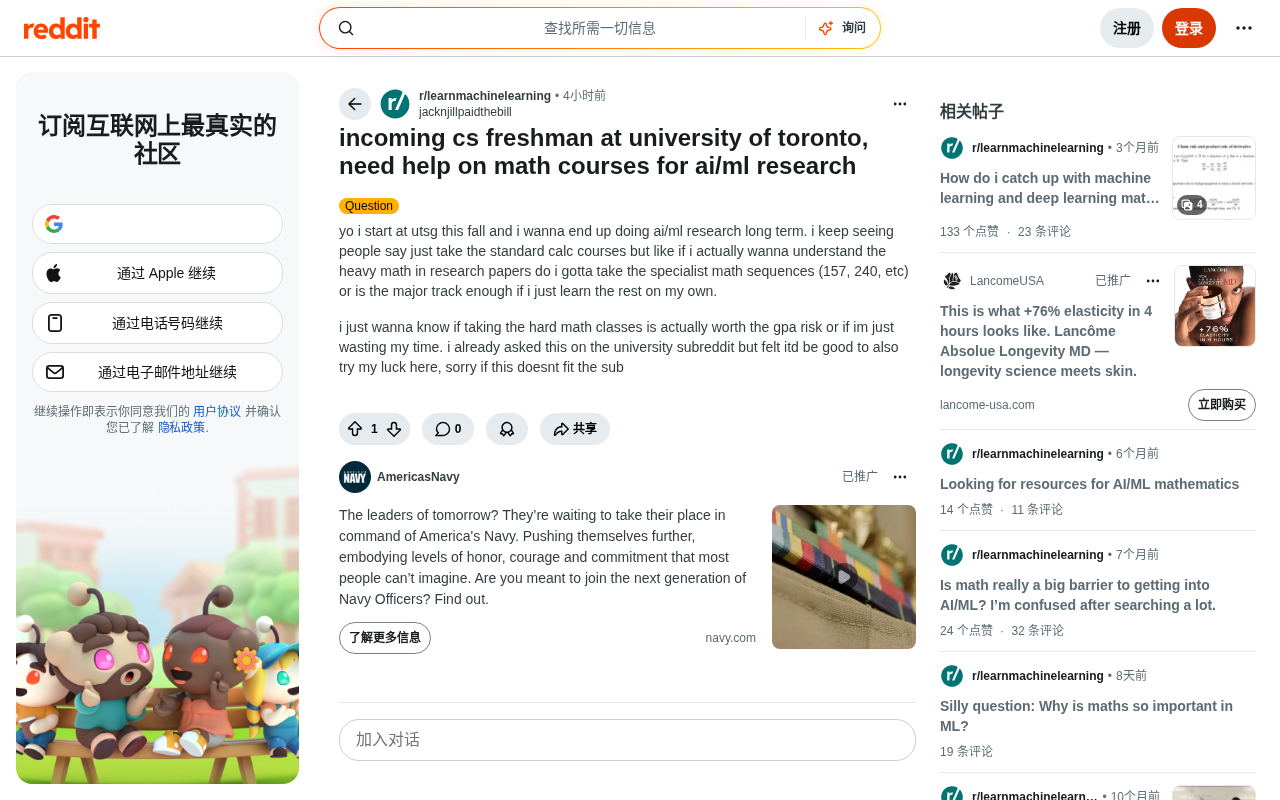
An incoming computer science freshman at the University of Toronto (UTSG) posted a question on Reddit that many aspiring AI/ML researchers will face: to truly understand the "hardcore math" in research papers, do you need to take the notoriously difficult specialist math sequence (such as MAT157, MAT240, etc.), or should you take the regular Major math track and fill in the gaps through self-study?
His central struggle revolves around return on investment and GPA risk: specialist-level math courses are extremely challenging and carry a real risk of dragging down your GPA; but if the Major track doesn't offer enough mathematical depth, you may struggle when facing research papers down the road. This isn't an isolated case—it's a strategic decision that nearly every CS student on a research path must confront.
What Math Does AI/ML Research Actually Require?
To answer the question of "how hard a math course should you take," you first need to understand what mathematical foundations AI/ML research actually depends on.
The Three Core Pillars
Looking at mainstream machine learning and deep learning papers, the three most indispensable mathematical foundations are:
-
Linear Algebra: Matrix operations, eigenvalue decomposition, singular value decomposition (SVD), vector spaces, and so on—these form the bedrock for understanding neural networks, attention mechanisms, and dimensionality reduction methods. Take the self-attention mechanism in Transformers as an example: at its core, it performs scaled dot-product operations on three matrices—Query, Key, and Value—followed by a Softmax-weighted sum. Without intuition for the geometric meaning of matrix multiplication, projections, and subspaces, it's hard to truly grasp what "attention" is doing. SVD, meanwhile, is the mathematical heart of PCA dimensionality reduction, matrix factorization in recommender systems, and the recently popular LoRA (Low-Rank Adaptation) fine-tuning method. Understanding the geometric meaning of left and right singular vectors and singular values lets you get straight to the essence of a method when reading related papers, rather than getting stuck on the surface of formulas.
The Deep Connection Between LoRA and SVD: LoRA (Low-Rank Adaptation) is an efficient fine-tuning method for large models proposed by Microsoft Research in 2021, and its core idea derives directly from the low-rank approximation theory of SVD. SVD decomposes any matrix into the product of three matrices (U·Σ·Vᵀ), where the magnitude of the singular values reflects the "amount of information" in the corresponding directions. LoRA's working assumption is that the change ΔW in large model parameters during fine-tuning is essentially low-rank, and can therefore be approximated by two small matrices B·A, compressing the number of trainable parameters from d×d to d×r + r×d (where r is far smaller than d). This design makes it possible to fine-tune models with billions of parameters under constrained GPU memory. Understanding this method requires not only knowing the computational steps of SVD, but also having a deep intuition for the geometric meaning of "rank"—rank represents the dimensionality of the subspace a matrix transformation can "span," and low rank means the transformation is constrained to a low-dimensional manifold. This is a textbook application of the abstract linear algebra thinking emphasized in specialist math courses.
-
Probability & Statistics: Bayesian inference, expectation, variance, distributions, maximum likelihood estimation, and so on—these are the core language for understanding generative models, variational inference, and reinforcement learning. Take the Variational Autoencoder (VAE) as an example: the derivation of its training objective, the ELBO (Evidence Lower Bound), is built entirely on operations involving KL divergence and expectation. The forward noising and reverse denoising processes of Diffusion Models are, at their core, precise manipulations of conditional probabilities over a Markov chain. The thinking framework of Bayesian statistics—treating model parameters as random variables rather than fixed values—is the foundational epistemology for understanding uncertainty quantification, Bayesian deep learning, and even the calibration problems of large language models. Without this language, much of the cutting-edge literature in generative AI reads like a "symbol game."
The Information-Theoretic Foundations of ELBO and KL Divergence: The ELBO (Evidence Lower Bound) is the core training objective for the variational inference family of models, and understanding it requires mastering both probability theory and information theory. KL divergence (Kullback-Leibler Divergence) measures the "distance" between two probability distributions, but it is asymmetric—the KL divergence of P relative to Q is not equal to the KL divergence of Q relative to P. This asymmetry has real significance in VAEs: minimizing KL(q||p) tends to make the approximate posterior q cover the main mass region of the true posterior p, producing a "mean-field" effect. The derivation of the ELBO reveals an elegant mathematical structure: since computing the true posterior is intractable, we instead maximize a computable lower bound, and the gap between this bound and the true objective is exactly equal to the KL divergence—a classic example of the intersection of information theory and Bayesian statistics. Recent diffusion models (such as DDPM), while appearing on the surface to be stochastic processes, similarly rely on the ELBO framework in their theoretical derivations, simply replacing the variational distribution with conditional Gaussian distributions defined by a Markov chain.
-
Multivariable Calculus & Optimization: Gradients, Jacobian matrices, the chain rule, and convex optimization directly underpin backpropagation and various training algorithms. The essence of the backpropagation algorithm is efficiently computing the partial derivatives of a scalar loss with respect to each parameter over a computational graph using the chain rule. The design logic of adaptive optimizers like Adam and RMSProp comes from estimating the first- and second-order moments of gradients. And the KKT conditions in convex optimization theory are essential tools for understanding the dual problem of Support Vector Machines (SVMs), as well as the constrained optimization design in recent RLHF (Reinforcement Learning from Human Feedback).
Bonus Points for Advanced Research
If your goal leans toward theoretical directions—such as learning theory, optimization theory, or the mathematical analysis of generative models—then Real Analysis, Measure Theory, Functional Analysis, and even Information Theory all come into play.
Real Analysis studies the rigorous foundations of limits, continuity, differentiability, and integration, and is the starting point of all "analysis" mathematics. Its core training is the ε-δ language: characterizing "approaching" and "convergence" with precise logic, without relying on geometric intuition. This rigor manifests in ML theory through: proving the convergence behavior of gradient descent on non-convex loss surfaces, analyzing the generalization error bounds of neural networks, and handling optimization problems in infinite-dimensional function spaces.
The PAC Learning Framework and Generalization Theory: The PAC (Probably Approximately Correct) learning framework is a cornerstone of modern machine learning theory, proposed by computer scientist Leslie Valiant in 1984, for which he was awarded the 2010 Turing Award. The PAC framework attempts to answer a fundamental question: how many training samples does a model need to learn a "good enough" hypothesis with high probability? Its core quantity, Rademacher Complexity, characterizes the upper bound of a model's expressive power by measuring the hypothesis class's ability to fit random noise, thereby providing a theoretical guarantee on generalization error. Understanding such results requires the concentration inequality tools from real analysis (such as Hoeffding's inequality and McDiarmid's inequality), as well as a measure-theoretic understanding of function spaces. Although generalization phenomena in deep learning practice (such as double descent, and the relationship between memorization and generalization) still lie beyond the full explanatory scope of classical PAC theory, this framework remains the common language for serious researchers discussing model behavior, and is the starting point for recent theoretical analysis tools such as the Neural Tangent Kernel (NTK).
Measure Theory builds probability theory on a rigorous set-theoretic foundation and is the "true language" for understanding probability distributions—the theoretical analysis of generative models like diffusion models and Normalizing Flows often requires a clear understanding of change of variables for continuous distributions and the Radon-Nikodym derivative. Specialist math sequences represented by courses like MAT157 (Analysis I) are precisely where this kind of rigorous analytical ability and mathematical maturity is cultivated.
Specialist Sequence vs. Major Track: How to Weigh the Trade-offs
The essence of this choice is a trade-off between mathematical maturity and GPA stability.
The True Value of the Specialist Sequence
Courses like MAT157 aren't valuable because they teach a lot of "directly applicable" formulas, but because they train you in how to construct rigorous proofs and how to think abstractly about problems. There's a specific term for this ability—Mathematical Maturity: it doesn't refer to how many specific theorems you've mastered, but to a kind of metacognitive ability, including being able to read and understand formal proofs, identify logical gaps in arguments, extract mathematical structure from new problems, and not panic when facing unfamiliar symbolic systems. Cultivating mathematical maturity is gradual: understanding others' proofs → filling in the omitted steps in a proof → independently proving similar propositions → transferring proof strategies to new contexts. Specialist math sequences systematically compress this growth cycle through intensive problem sets and rigorous exams. This ability creates an irreplaceable advantage when reading theoretical papers, deriving algorithm convergence yourself, and even designing new methods. Many top ML researchers emphasize that what truly sets people apart is often not proficiency with tools, but a deep intuition for the underlying mathematics.
GPA Risk Cannot Be Ignored
But reality can't be avoided either: graduate school applications and summer research (collaborating with professors or joining a lab) both place a high value on GPA. In applications to top North American CS graduate programs (such as Toronto, MIT, Stanford, CMU, etc.), GPA is usually the first screening threshold—many programs have informal GPA expectations above 3.7/4.0 for international applicants. Even more crucially, there's an interactive relationship between GPA and research experience: a high GPA can help you catch a professor's attention in your second and third years, landing you undergraduate research opportunities like the NSERC USRA or the on-campus ROP (Research Opportunity Program). These early research experiences, in turn, significantly strengthen your graduate application competitiveness, often carrying more weight than course selection alone.
NSERC USRA and ROP: The Institutional Context of Undergraduate Research Opportunities: The NSERC USRA (Natural Sciences and Engineering Research Council of Canada Undergraduate Student Research Awards) is an undergraduate research award funded by Canada's Natural Sciences and Engineering Research Council, providing a 16-week summer research stipend each year to eligible third- and fourth-year students nationwide (the 2024 rate was about CAD 600 per week, with supervisors required to provide matching funds for part of the cost). Competition is fierce, GPA is the primary screening metric—usually requiring above 3.7/4.0—and a professor's recommendation letter and research proposal are also needed. UofT's ROP (Research Opportunity Program), on the other hand, is an on-campus program aimed at second-year students, where students can join a professor's research group within the framework of formal course credits, complete a semester of independent research, and receive a grade—this is the most important early research entry point when you lack USRA competitiveness. What both programs have in common is that they not only provide opportunities to engage with real research, but more importantly, leave a verifiable research contribution on your resume, significantly enhancing your competitiveness in graduate applications. In the eyes of many professors, their signaling value is even higher than course grades themselves.
If you push through the specialist sequence but end up with poor grades, it may actually block your entry into research. A solid Major track + an excellent GPA + active involvement in research is often more competitive than a combination where specialist courses drag down your GPA.
A Practical Middle-Ground Path
A more pragmatic approach is a three-step plan:
- Test the waters first: In the first semester of your first year, try the first course in the specialist sequence to gauge how well you adapt. Most schools allow you to drop the course or switch to the regular track before the drop deadline, so the cost of trial and error is low.
- Know your limits: If you find you enjoy proofs and derivations and can keep up with the pace, continue with the specialist sequence; if you're clearly struggling and it's seriously affecting your other courses, decisively switch to the Major track and fill in the gaps through self-study.
- What matters isn't the course number, but the depth of mastery: No matter which path you take, make sure you solidly master linear algebra, probability and statistics, and numerical optimization—these three—and develop the ability to read and write proofs.
Something More Important Than Course Selection
This freshman's anxiety actually reflects a more widespread misconception: treating "picking the right courses" as the only key to research.
The factors that determine whether someone can enter AI/ML research go far beyond a course schedule:
-
Get involved in real research early: Actively reading papers, reproducing code, and finding professors for undergraduate research (UofT has programs like ROP) often yields more direct returns than taking one more difficult course.
The Epistemological Value of Paper Reproduction as a Learning Method: Paper Reproduction / Reimplementation has gradually developed into a distinct learning culture within the ML community, and dedicated Reproducibility Challenge tracks set up by top conferences like NeurIPS and ICLR have further institutionalized it. From an epistemological perspective, reproduction and reading are two entirely different cognitive modes: when reading a paper, readers tend to "fill in" plausibility at ambiguous points and skip over derivation details; but when reproducing, every mismatched matrix multiplication dimension, every vanishing gradient, and every subtle discrepancy from the paper's results forces you back to the most fundamental mathematical and engineering details. ML research contains a great deal of "tacit knowledge": intuition for learning rate scheduling, the difference in batch normalization behavior between training and inference, the impact of random seeds on result stability—this knowledge is almost impossible to convey through reading and can only be accumulated through repeated debugging. Choosing what to reproduce also involves strategy: Attention Is All You Need (the original Transformer paper) is well-suited for understanding the engineering details of the attention mechanism; DDPM (Denoising Diffusion Probabilistic Models) is good for connecting probability theory knowledge with implementation; and reproducing GPT-2 (such as Andrej Karpathy's minGPT project) is one of the best paths for understanding the full pipeline of language model training.
-
Hands-on implementation skills: Being able to get a method from a paper running in PyTorch is a hard currency for entering research.
-
A habit of continuous self-study: University courses will always lag behind the research frontier; self-study ability is the true source of long-term competitiveness. Self-study resources worth referencing include: Gilbert Strang's linear algebra open course (MIT 18.06), the Deep Learning textbook by Goodfellow et al., and the visualization-focused explanatory articles on cutting-edge methods at distill.pub.
Math courses are a necessary condition, but far from a sufficient one. Rather than agonizing over "157 or the Major," you'd be better off investing the same energy into getting involved in research early and honing your paper-reading and programming implementation skills.
Conclusion
For this UofT CS freshman, and for all students facing similar choices, the answer is perhaps:
If you genuinely love math and can withstand the pressure, the specialist sequence will give you irreplaceable training in thinking; if it would seriously threaten your GPA and research opportunities, a solid Major track combined with active self-study can equally lead to AI/ML research.
What truly matters isn't which course you took, but whether over four years you continuously read, write, calculate, and build—turning mathematics into a tool for understanding the world and creating methods, rather than just a number on a transcript.
Key Takeaways
Key Takeaways
Related articles

GPT-Next Leak, Gemini 4 Argon Imminent: AI News Roundup
GPT-Next leak suggests extreme efficiency; OpenAI's 28-day shipping pledge boosts speed 50%; Gemini 4 Argon nears release; Anthropic subscription value report sparks debate.

GPT-Next Leaked, Gemini 4 Argon Speeds Up, Fable 5.5 May Launch Today
OpenAI's GPT-Next model leaks, expected to be extremely low-cost and possibly part of the 28-day release plan; Gemini 4 Argon internal testing accelerates, NanoBanana 2.1 is live; Semi Analysis tests show Claude Max's equivalent API value is about 5 times that of ChatGPT Pro; Fable 5.5 may launch today.

Gemini 4 Argon Launches Globally: Key Highlights from the AI Daily Brief
Google opens Gemini 4 Argon globally across Pro and Ultra subscriptions and the API, and demonstrates robot control. This article rounds up open-source models, Agent infrastructure, cost transparency, and safety governance updates.