Generate Xianxia Wallpapers with a Single Sentence: A Hands-On Comparison of Three AI Agents with Skill Enhancement

A single plain sentence plus a Skill module produces stunning xianxia wallpapers — tested across three AI Agents.
This article tests how a Skill called "Eastern Xianxia Visual Director" transforms a simple one-sentence prompt into wallpaper-quality xianxia artwork across three AI Agents: Codex, WorkBody, and Grog. Results show the Skill acts as a director — enforcing visual rules like removing railings and locking figure proportions to 3% — while Agents handle execution with varying precision. Only Codex achieved full rule compliance with automatic self-correction.
From Plain Language to Eastern Xianxia Masterpieces
How complex does prompt engineering need to be to create an Eastern xianxia (immortal fantasy) image worthy of a desktop wallpaper? This test delivers a counterintuitive answer: all you need is a single plain-language sentence plus the right "skill pack" (Skill).
Since the explosion of large models in 2022, prompt engineering has evolved from simple keyword stacking into a systematic discipline. Early AI art users needed to master extensive specialized syntax: weight markers, negative prompts, sampler parameters, CFG values — an effective Stable Diffusion prompt could easily run hundreds of tokens. This high barrier spawned prompt marketplaces and dedicated prompt optimization tools. The emergence of Skills represents a new paradigm: encapsulating the complexity of prompt engineering into reusable modules so users can achieve expert-level output without understanding the underlying mechanics.
The core premise of this test is simple — give AI the same sentence and have it draw twice. Once with a Skill called "Eastern Xianxia Visual Director" installed, once without. The difference in results directly determines whether the image is wallpaper-worthy.
This horizontal comparison tested three Agents: Codex, WorkBody, and Grog. Interestingly, the Skill itself doesn't generate images — it acts more like a "director," while the actual drawing capability depends on the Agent's own abilities. To understand the Skill's position in the AI Agent ecosystem: it's essentially a set of predefined rules, constraints, and workflow templates that inject domain-specific knowledge and decision logic during task execution. Unlike traditional system prompts, Skills typically feature stronger structural characteristics — they can include conditional logic, parameter constraints, iteration rules, and other complex logic rather than just descriptive text. This design philosophy draws from the "separation of concerns" principle in software engineering: decoupling domain expertise from general execution capability so both can iterate and combine independently.

Skill Installation Speed: Comparing Three Agents
The first observation point is the Skill's auto-installation capability. The tester simply sent a single sentence without manually typing any commands, and Codex completed the installation on its own in 1 minute 23 seconds.
The same operation across the other platforms:
- WorkBody: 58 seconds
- Grog: 1 minute 48 seconds
- Codex: 1 minute 23 seconds
Purely in terms of installation speed, WorkBody is fastest. But speed is just the entry ticket — the real gap shows up in the execution phase.
An Agent's ability to auto-install Skills involves multiple underlying technical steps: first, intent recognition — the Agent must determine from the user's natural language input which tool the current task requires; second, environment configuration — automatically completing dependency checks, permission requests, and runtime environment setup; finally, verification — running functional tests after installation to ensure the tool works. This process is known as "Zero-Touch Provisioning" in traditional DevOps, and its implementation in the AI Agent domain signals that Agents are evolving from "passive executors" to "autonomous actors."
This also illustrates an important point: an Agent's automation capability (whether it can autonomously assemble tools with zero commands) has become a key maturity indicator, beyond just comparing generation quality.
Codex Image Generation Flow: Plan First, Then Draw
The original prompt was a typical plain-language sentence:
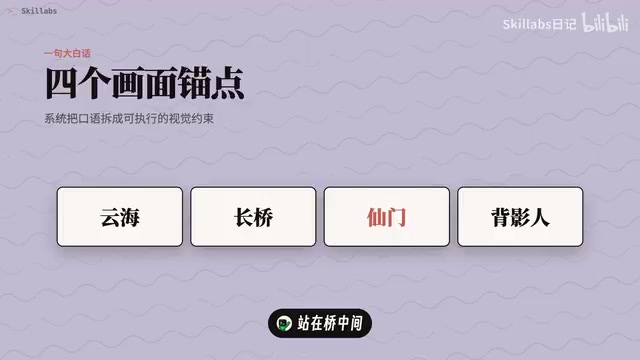
A long bridge above a sea of clouds, a celestial gate at the far end, and a person standing in the middle of the bridge with their back turned.
After receiving the instruction, Codex returned a large block of structured text in 24 seconds rather than jumping straight to image generation. This response contained three parts:
- Complete scene description — a detailed prompt ready to copy and use directly;
- Negative checklist — a separate list of "things that must not appear";
- Three iteration directions — suggestions for subsequent adjustments.
This "plan first, then draw" workflow essentially translates a vague natural language request into an executable, reusable visual specification. It minimizes the luck factor.
The negative checklist plays a crucial role in AI image generation. From a technical standpoint, during the denoising process, diffusion models use the semantic vectors corresponding to negative prompts as reverse guidance signals — at each denoising step, the model not only moves toward the positive description but actively moves away from the negative description. This mechanism is known as the negative conditioning in Classifier-Free Guidance. In practice, negative checklists effectively suppress the model's "default tendencies" — for example, AI art models tend to add excessive decorative details when generating architecture. By explicitly excluding these elements through a negative checklist, you can achieve more restrained, atmospheric compositions.
AI Self-Correction: Automatic Rework Mechanism
What's even more noteworthy is the self-correction during generation. The image appeared at 3 minutes 32 seconds, but Codex "reworked" it once in between.
It detected that the first version had "the figure clearly larger than the locked 3%," so it proactively pulled back the camera, extended the bridge surface, and revised the image. This kind of automatic validation and iteration based on self-imposed rules is something ordinary "one-shot generation" tools simply don't have.
From a technical architecture perspective, this automatic rework is a typical application of "Closed-Loop Feedback" architecture. Under this framework, the system not only executes generation tasks but also has built-in evaluation modules that quantitatively verify the output. In this specific case, after generating an image, the system uses visual analysis (likely object detection or semantic segmentation models) to calculate the figure's proportion in the frame. When it detects deviation from the preset 3% threshold, it automatically triggers regeneration and adjusts composition parameters. This "generate-evaluate-correct" loop is widely used in reinforcement learning and is now being introduced into generative AI toolchains, representing a paradigm upgrade from "single-pass inference" to "iterative optimization."

With Skill vs. Without Skill: Real Results Comparison
This is the most critical and convincing part of the entire test. The tester admitted initial skepticism: "Sure the image looks nice, but anyone can write one sentence — why would installing something make a difference?"
So they turned off the Skill, ran the same sentence again, and placed both images side by side. The difference was immediately obvious.
Difference 1: Visual Breathing Room on Bridge Railings
- Without Skill: Carved stone railings run from end to end on both sides of the bridge, making the image cluttered;
- With Skill: The bridge surface is clean, with nothing but pure cloud sea on both sides.
The reason is that the Visual Director wrote a hard rule — "No railings on the bridge edges." This constraint overrode the model's default tendency, giving the image more negative space and atmosphere.
There's a fascinating technical phenomenon behind this: during training, AI art models learn from massive amounts of "bridge" image data, the vast majority of which feature railings. Thus when generating the concept of "bridge," the model attaches railing elements with high probability. This is known as "data prior bias" — the model tends to generate high-frequency patterns from training data. The Skill forcibly suppresses this statistical tendency through negative constraints, achieving artistic expression that transcends the "average."

Difference 2: Precise Figure Proportion Control
- Without Skill: The figure takes up roughly a quarter of the frame, stealing focus;
- With Skill: The person is just a small dot in the center of the bridge.
The same ruleset explicitly states: lock the figure to "3% of frame height" for this round because "the gate is the protagonist." Even with just a "looks awesome" feedback, the Skill maintains this proportion constraint.
One detail worth noting: among the three Agents, only Codex actually shrunk the figure to that 3% ratio. This confirms the earlier observation: Skills provide rules and intent, but whether they're precisely executed depends on the Agent's own capability ceiling.
Conclusion: Skills Are Directors, Agents Are Artists
This test clearly reveals an evolutionary direction for current AI generation tools — capability decoupling.
A Skill (like "Eastern Xianxia Visual Director") plays the "director" role, responsible for translating vague requests into precise visual specifications, negative constraints, and composition ratios; while Agents (Codex/WorkBody/Grog) play the "artist" role, responsible for understanding and executing these specifications.
Capability decoupling is one of the core trends in AI toolchain evolution, with its philosophy directly borrowed from microservice architecture design. In traditional AI art workflows, model capabilities, prompt strategies, and post-processing logic are often tightly coupled within the same system, meaning any upgrade to one component requires full-pipeline adjustments. The "Skill + Agent" layered architecture completely separates the decision layer (what to do) from the execution layer (how to do it): Skills can be migrated and reused across different Agents, and Agents can load different domain Skills to expand their capability boundaries. This pattern is highly analogous to the "driver + hardware" relationship in operating systems, suggesting that the AI ecosystem may move toward an App Store-like distribution model — in the future, users won't just choose which AI model to use, but which Skills to pair with it to build their own custom creative workflows.
For everyday users, this means a dramatic lowering of the AI art barrier: you don't need to become a prompt engineering expert — just one plain sentence plus the right Skill can consistently produce high-quality work. For developers, building reusable "visual director" style Skills may be a more pragmatic differentiation path than training large models.
If you want to try it yourself — whether it's cloud seas and celestial mountains or palace gate themes — you can start with a single plain sentence.
Related articles

Frontend to AI Agent Development: A Frontline Architect Explains Career Paths and Opportunities
A frontline AI architect explains the industry changes and practical paths for frontend developers transitioning to AI Agent development: why pure frontend jobs are disappearing, why Agent + full-stack has become mainstream in hiring, and three transformation routes—Agent development engineer, FDE, and remote contracting—along with corresponding learning strategies.

How to Choose an AI Agent Development Course: Five Pitfall-Avoidance Guidelines
A mechanical-engineering career changer's two-year pitfall-tested checklist for screening AI Agent development courses: complete delivery pipeline, resume-worthy projects, real development perspective, update frequency, and coaching feedback—with concrete judgment methods and pitfall-avoidance tips.

Coze AI Agent Building for Beginners: A Zero-Code AI Agent Development Guide
Coze, ByteDance's one-stop AI application development platform, supports zero-code drag-and-drop AI agent building. This article outlines Coze's core concepts, three advantages, differences between the domestic and international versions, and the distinction between agents and apps, helping beginners quickly get started with AI Agent development.