eu/jev: The First GDPR-Compliant AI Inference Model Hosted in the EU

eu/jev is the first EU-hosted, GDPR-compliant AI inference model with zero data retention and drop-in Jev API compatibility.
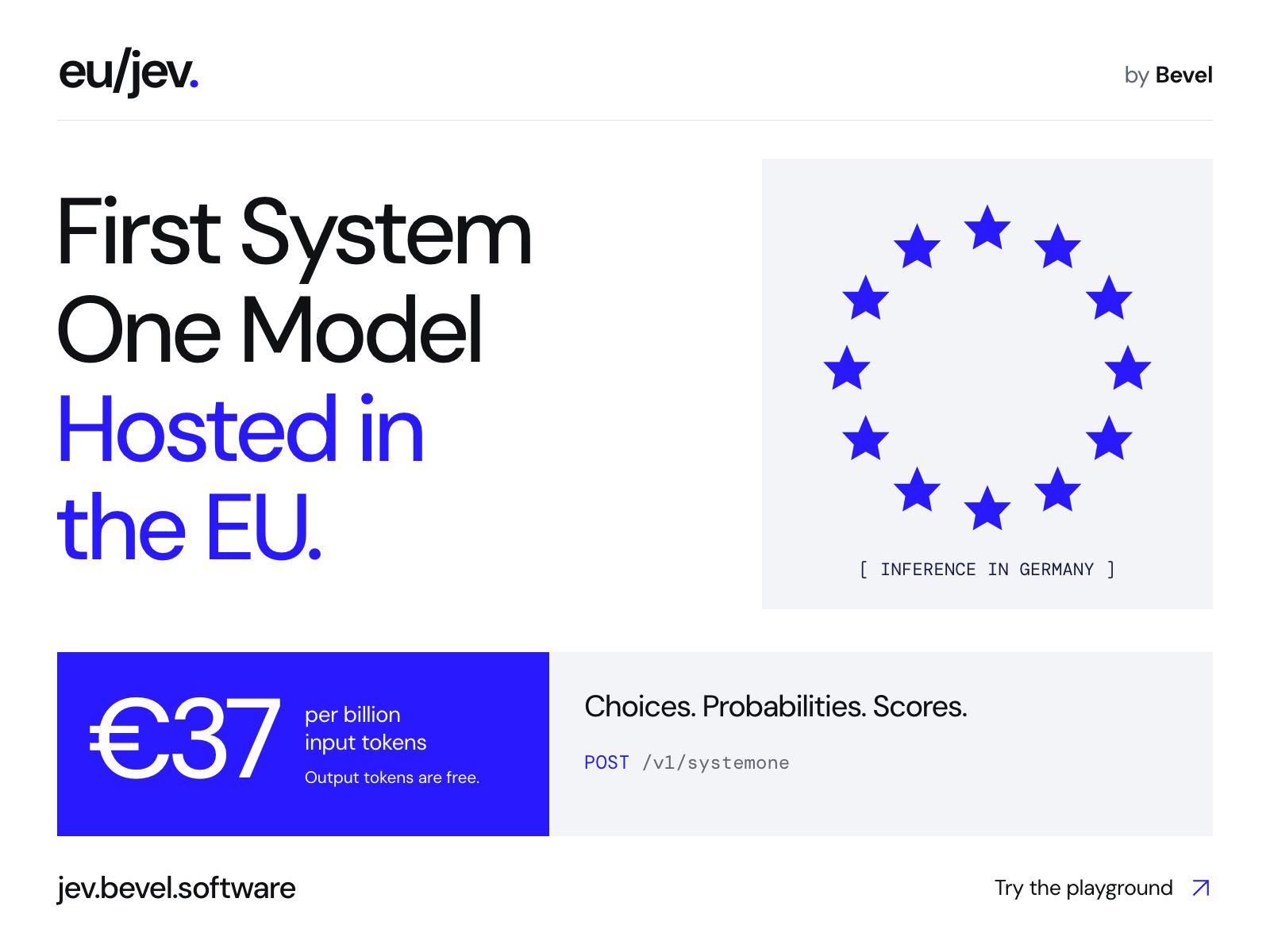
eu/jev addresses GDPR compliance and data sovereignty challenges for European enterprises by deploying its inference model on Hetzner GPUs in Germany, with a commitment to zero prompt or response logging. Its API and pricing are fully compatible with Jev — including free output tokens — so existing applications need only switch endpoints to achieve a compliant upgrade at near-zero migration cost. Built on Winnow, the top-ranked open-source System One model on JevBench, it balances technical transparency with auditability. The product received moderate traction on Product Hunt and targets a clearly defined niche: EU developers and enterprises operating under strict regulatory constraints.
For European businesses and developers looking to use advanced AI inference models in production, data sovereignty and compliance often stand in the way. eu/jev was built specifically to address this pain point — it claims to be the first Jev-class (System One) model fully hosted within the EU and compliant with GDPR requirements.
Why Europe Needs a Locally Hosted Inference Model
Many teams aren't opposed to using high-performance inference models like Jev — they're simply blocked by two practical obstacles: GDPR compliance and data sovereignty. When sensitive business prompts and model responses flow to servers outside the EU, companies face additional legal and audit costs, and in heavily regulated industries like healthcare, finance, and public services, it may be outright prohibited.
eu/jev deploys its model on Hetzner GPUs in Germany, solving the data transfer problem at the infrastructure level. More importantly, it commits to no prompt or answer logging — meaning even the service provider itself retains no record of user inputs or outputs. For privacy-conscious European customers, this is a far more compelling engineering commitment than a simple compliance statement.
GDPR (General Data Protection Regulation), which came into force in 2018, is the EU's mandatory legal framework governing the processing of personal data. Articles 44 through 49 specifically regulate the conditions for transferring data to third countries: if data processing occurs on servers outside the EU/EEA, companies must demonstrate that the destination country offers an "adequate level of protection," or rely on supplementary mechanisms such as Standard Contractual Clauses (SCCs). The situation is particularly complex for the United States — in 2020, the EU Court of Justice struck down the original Privacy Shield agreement in the "Schrems II" ruling, leaving many European companies that rely on US cloud services in a compliance gray zone. In AI inference scenarios, every API call may carry business data containing personal information, making "data residency" a quantifiable compliance asset rather than mere marketing language.
API Compatibility with Near-Zero Migration Cost
Another standout design choice in eu/jev is API compatibility. According to the official description, developers can call eu/jev in exactly the same way they call Jev, with identical pricing — and output tokens are even free.
The intent is clear: lower the barrier to migration. Teams that have already built applications on top of Jev don't need to rewrite their integration logic or redesign their billing model — they simply switch endpoints to get a compliant, localized alternative. For engineering teams, this is essentially a zero-cost "compliance upgrade," bypassing the lengthy process of re-evaluating and re-integrating a new provider.
Under the Hood: Built on the Open-Source Model Winnow
eu/jev wasn't trained from scratch — it's built on top of Winnow, described as the top-ranked open-source System One model on the JevBench benchmark.
This choice is telling: it reflects a typical path emerging from Europe's AI ecosystem under sovereignty pressures — leveraging high-quality open-source models, layered with local hosting and compliance guarantees, to rapidly build a commercially viable service. An open-source foundation brings technical transparency and auditability, which aligns naturally with a privacy-first positioning. Compared to relying on closed-source overseas APIs, this model gives enterprises far greater visibility into where the model runs and what it does.
"System One" is used in this context as a category label, generally referring to large language models with strong reasoning and planning capabilities (analogous to "o-series" or "chain-of-thought reasoning" models in the industry), as distinct from lighter, faster-response "System Zero" class models. The value of an open-source model as a foundation goes beyond cost savings — it also enables auditability: regulators or enterprise security teams can inspect model weights, training data provenance, and inference logic, which is especially critical in heavily regulated sectors like healthcare and finance. The EU AI Act also imposes transparency and explainability requirements on high-risk AI systems, and an open-source foundation makes it substantially easier to produce the evidentiary documentation these compliance frameworks demand.
Market Reception and Positioning
eu/jev received 67 upvotes and 3 comments on Product Hunt, ranking 14th for the day, and was listed under three categories: Privacy, Developer Tools, and Artificial Intelligence.
By the numbers, this was a moderate launch — not a breakout hit, but with a sharply defined target audience: EU developers and enterprises that are subject to GDPR yet eager to adopt cutting-edge inference models. As the topic of data sovereignty continues to gain prominence, products that treat compliance as a core feature rather than an afterthought are well-positioned to steadily attract customers in regulated industries.
Summary
eu/jev's core value proposition comes down to three points: EU-based hosting, zero data retention, and seamless API and pricing compatibility. It doesn't compete on model capability — it differentiates on deployment compliance and migration experience. For European teams blocked by compliance constraints, this kind of pragmatic product thinking often solves real problems more effectively than chasing benchmark performance.
Related articles

Free Unlimited Claude Code Solution: Agnes AI + CC Switch Setup Guide
No paid subscription needed — pair the free AI platform Agnes AI with the open-source tool CC Switch to provide a backend for Claude Code, enabling unlimited free calls to text, image, and video models. This guide covers the full setup, test results, and usage boundaries.

A Complete Zero-Cost Guide to Getting Started with Claude Code for Beginners in China
A beginner's guide to Claude Code for users in China: two installation methods (command line and IDE plugin), full configuration steps for replacing the official API with the free domestic LongCat model, and a hands-on demo of building a small tool with natural language, plus tips.

When the NSA Gets Involved: The AI Supply Chain Crisis Behind Open-Source CVEs and API Key Hijacking
Multiple open-source projects disclosed severe CVEs in one day, PHP flaws alarmed the FBI, and Railway and OpenCode were breached with API keys stolen. This article breaks down the vulnerability window, AI-accelerated exploitation, and the AI supply chain crisis behind the API key black market, with a developer defense checklist.