EU's Right to Repair Rules Meet Cold Reception: Why Are Manufacturers Collectively Non-Compliant?
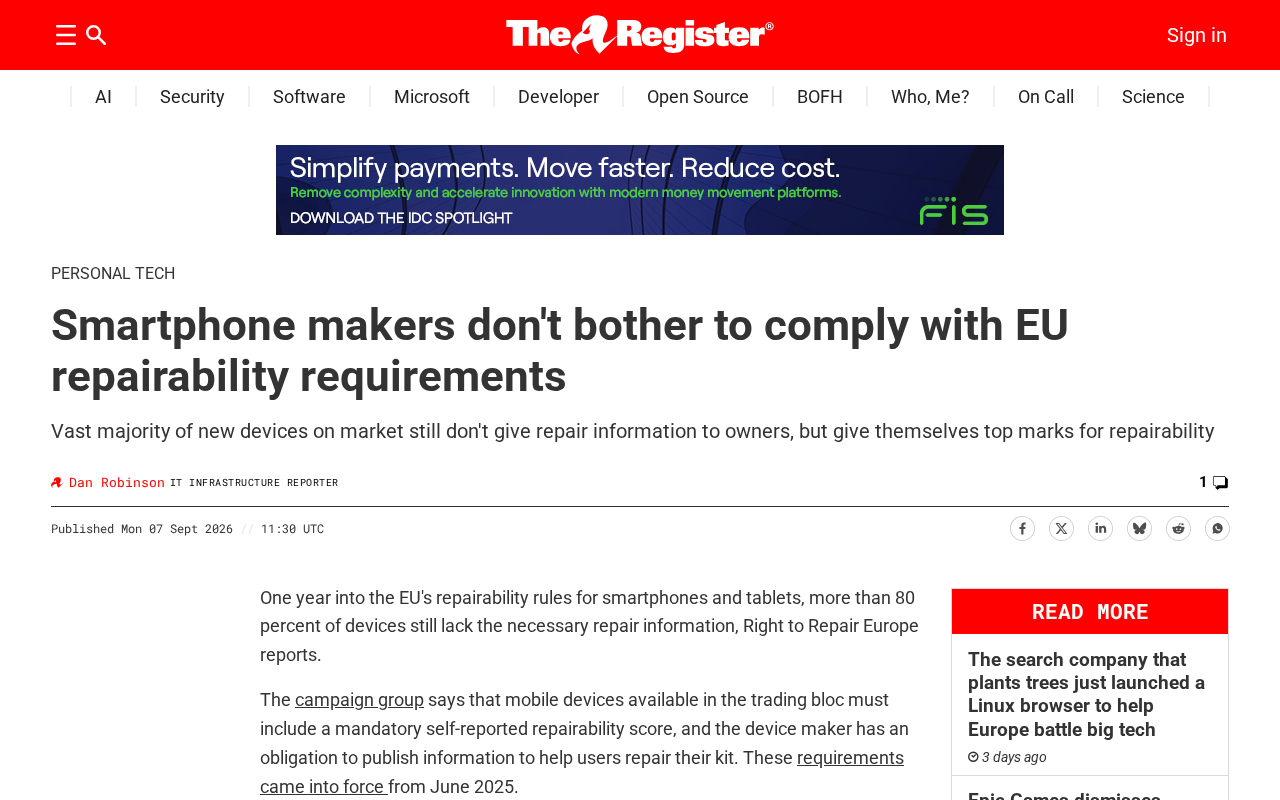
EU repairability rules for smartphones meet industry resistance through minimal compliance and weak enforcement.
Despite ambitious EU regulations requiring smartphone manufacturers to provide spare parts, repairability scores, and software updates, most companies engage in minimal compliance. High spare parts pricing, complex authorization systems, and weak enforcement turn well-intentioned rules into paper constraints, exposing the fundamental conflict between planned obsolescence business models and circular economy principles.
A New Regulation, Minimal Response
The EU has long been a pioneer in global consumer electronics regulation. Since the early 2000s with the RoHS Directive (Restriction of Hazardous Substances) and WEEE Directive (Waste Electrical and Electronic Equipment), the EU has established a regulatory framework centered on environmental protection and consumer rights. This "Brussels Effect"—where EU regulations effectively become global standards due to the bloc's massive market size—is particularly evident in the smartphone industry. From unified charging interfaces to right to repair legislation, Brussels has attempted to use regulations to shift the entire industry's product design logic.
However, a recent report that sparked discussion on Hacker News reveals an awkward reality: many smartphone manufacturers simply haven't seriously attempted to meet EU repairability requirements. As a major discussion platform for Silicon Valley's tech community, Hacker News has a user base primarily composed of software engineers, entrepreneurs, and technology decision-makers. High-engagement discussions on the platform often reflect firsthand observations and deep skepticism from tech professionals regarding policy effectiveness.
This is not an accidental oversight, but an observable industry trend. When compliance costs, business models, and regulatory objectives conflict, manufacturers often choose "minimal compliance" or simply ignore the rules. This reflects a deeper contradiction between the hardware industry's longstanding "planned obsolescence" logic and sustainable development principles.
Planned obsolescence is a key concept from 20th-century industrial design. In the smartphone era, this strategy has evolved more subtly: through non-replaceable batteries, glued casings, proprietary screws, and software update throttling, manufacturers can shorten devices' actual lifespan without obviously reducing initial product quality. The economic basis for this practice lies in the fact that as hardware profit margins continue to decline, maintaining high-frequency device replacement cycles becomes key to ensuring revenue growth. However, this fundamentally contradicts circular economy principles—which emphasize that product design should facilitate repair, upgrades, and material recycling.
What Exactly Do EU Repairability Regulations Require?
From Right to Repair Legislation to Energy Label Systems
The EU has introduced a series of regulations around smartphones in recent years, with core objectives of extending device lifespan and reducing electronic waste. Over 50 million tons of e-waste are generated globally each year, with smartphones accounting for a significant proportion, yet recycling rates remain below 20%. These discarded devices contain rare earth elements, precious metals, and toxic substances, causing both resource waste and environmental pollution.
Specific regulatory requirements include:
- Spare Parts Supply Obligations: Manufacturers must continue providing critical spare parts (such as batteries, screens, charging ports) for a certain period after product discontinuation (typically 5-7 years).
- Repairability Score Labels: Similar to energy labels, visually showing consumers how easy a device is to repair. The EU's energy label system began in the 1990s, initially for household appliances, using simple A to G grading to give consumers clear product performance information. However, applying similar logic to smartphone repairability faces greater challenges: energy efficiency can be measured with objective data, while "repairability" involves multiple dimensions including spare parts availability, repair documentation completeness, and specialized tool requirements—difficult to capture in a single score.
- Software Update Guarantees: Ensuring devices receive system and security updates throughout their hardware lifecycle.
- Battery Replaceability: Promoting removable battery designs to lower barriers for user battery replacement.
The Gap Between Ideal and Reality
These requirements sound extremely consumer-friendly, but implementation proves extremely difficult. The core issue highlighted in the report is that manufacturers are playing word games between the form and substance of compliance. Some manufacturers provide spare parts but price them prohibitively high, making repair economically meaningless; others label repairability scores, but actual disassembly still requires specialized tools and authorized licenses.
Why Are Smartphone Manufacturers 'Unwilling to Comply'?
Fundamental Conflict Between Business Models and Right to Repair
The smartphone industry's profit logic is inherently opposed to "extending device lifespan." Manufacturers want users to replace devices as frequently as possible, and a phone that's easily repairable and long-lasting will obviously slow replacement cycles. When regulations attempt to encourage "repair rather than replace," they directly threaten manufacturers' core revenue sources.
This explains why many manufacturers adopt "passive compliance" strategies—meeting the letter of requirements while effectively discouraging users from repairing through high spare parts prices and complex authorized repair systems. This phenomenon isn't isolated, but consistent with systemic issues revealed by the global right to repair movement.
The Right to Repair Movement originated in agricultural machinery and gradually expanded to automobiles, consumer electronics, and other fields. The movement's core demands include: device owners should have the right to choose any repair service provider, manufacturers should provide reasonably priced spare parts and repair manuals, and software locks shouldn't restrict third-party repairs. These demands challenge manufacturers' long-standing business model of generating ongoing revenue by controlling after-sales service, thus encountering massive industry lobbying resistance.
Lagging Enforcement Leads to Insufficient Compliance Motivation
Another key reason lies in lack of sufficient enforcement power for regulatory implementation. EU regulations often lead in formulation, but member states' market supervision and penalty mechanisms vary widely. Without clear and severe penalties, manufacturers naturally lack motivation for serious compliance. Regulations become "paper constraints" rather than "enforceable mandates."
Industry Insights from the Repairability Dilemma
Regulations Need 'Teeth' to Be Effective
The most direct lesson from this phenomenon is: regulations without strong enforcement equal window dressing. If the EU truly wants to drive repairability transformation, it must provide clear compliance audits, reporting mechanisms, and substantive penalties—otherwise "compliance" will forever remain at the level of corporate PR rhetoric.
The unified charging interface (USB-C) succeeded precisely because it's simple, verifiable, and has high non-compliance costs. The EU's unified charging interface legislation began in 2009, when over 30 different phone charger standards existed in the market. Through sustained efforts, the EU formally legislated in 2022 requiring all smartphones and other devices sold in the EU to adopt USB-C by the end of 2024. This regulation succeeded because: the standard is clear (simply USB-C, no room for interpretation), compliance verification is simple (customs can check), and non-compliance consequences are definite (products cannot be sold in the EU market). Even Apple, which long insisted on the Lightning interface, switched to USB-C with the iPhone 15 series in 2023.
"Repairability," however, involves supply chains, pricing, design, and other dimensions, making verification far more difficult—precisely the space manufacturers exploit. When regulatory objectives cannot be converted into verifiable technical specifications, enforcement costs rise exponentially.
Consumer Rights Negotiation in the Right to Repair Movement
From a more macro perspective, the "right to repair movement" is essentially a power struggle between consumers, independent repair shops, and manufacturers. Manufacturers monopolize design, spare parts, and technical documentation, while consumers often find themselves in a weak position regarding information and bargaining power. In the United States, Massachusetts's 2020 automotive right to repair ballot measure became a milestone; organizations like iFixit provide independent reference standards for consumers by publishing device teardown guides and repairability scores.
EU legislation aims to break this monopoly, but as the report shows, top-down regulations alone cannot shake deeply entrenched business inertia. Real change may require combined forces of regulation, market competition, and consumer awareness. Social enterprises like the Netherlands' Fairphone have proven the viability of sustainable design models, but mainstream manufacturers remain resistant to this transformation due to profit margin considerations.
Conclusion: The Road to Sustainable Hardware Remains Long
Smartphone manufacturers' passive attitude toward EU repairability requirements exposes the chasm between green tech ideals and business reality. Well-intentioned regulations without rigid execution support will ultimately devolve into a "compliance performance."
For those concerned about e-waste, sustainable consumption, and consumer rights, this serves as both a wake-up call and provides clear direction for improvement: the next phase of regulation should perhaps focus not on 'creating more rules' but on 'making existing rules truly effective.' This requires learning from the USB-C unified interface success story: converting regulatory requirements into clear, verifiable technical standards, establishing low-cost, high-efficiency enforcement mechanisms, and providing sufficiently deterrent penalties for violations.
Only when circular economy principles truly integrate into every aspect of product design, when repair convenience becomes a key element of market competition, and when consumers vote with their feet for sustainable products, will repairability move from regulatory documents to market reality.
Note: This article is based on analysis of related reports circulating on Hacker News; specific manufacturer compliance details still require more detailed independent verification.
Key Takeaways
Related articles
TiVo Charging for Ad-Skipping? DVR User Rights and the Digital Ownership Debate Explained
TiVo plans to charge DVR users for ad-skipping, sparking debate over digital ownership and consumer rights. A deep dive into subscription trends and their implications.

Batch Generating Ad Creatives from a Single Product Image: Real Bottlenecks and Solutions for Scaled Workflows
From one product photo to multi-platform ad assets—brand consistency, text rendering, and cross-platform adaptation collapse first. Deep dive into AIGC marketing workflow bottlenecks with template-driven and layered composition solutions.

Scriptly: AI Voice-Following iOS Teleprompter That Eliminates Pace-Chasing
Scriptly is an iOS voice teleprompter using AI real-time voice-following technology to auto-match speaking pace. Supports local storage for privacy, integrates writing, script management & video recording workflow for content creators.