EviDent-CBCT: An Evidence-Bottlenecked Framework for Automated Dental CBCT Report Generation

EviDent-CBCT uses a discrete evidence bottleneck to enable auditable, automated dental CBCT report generation.
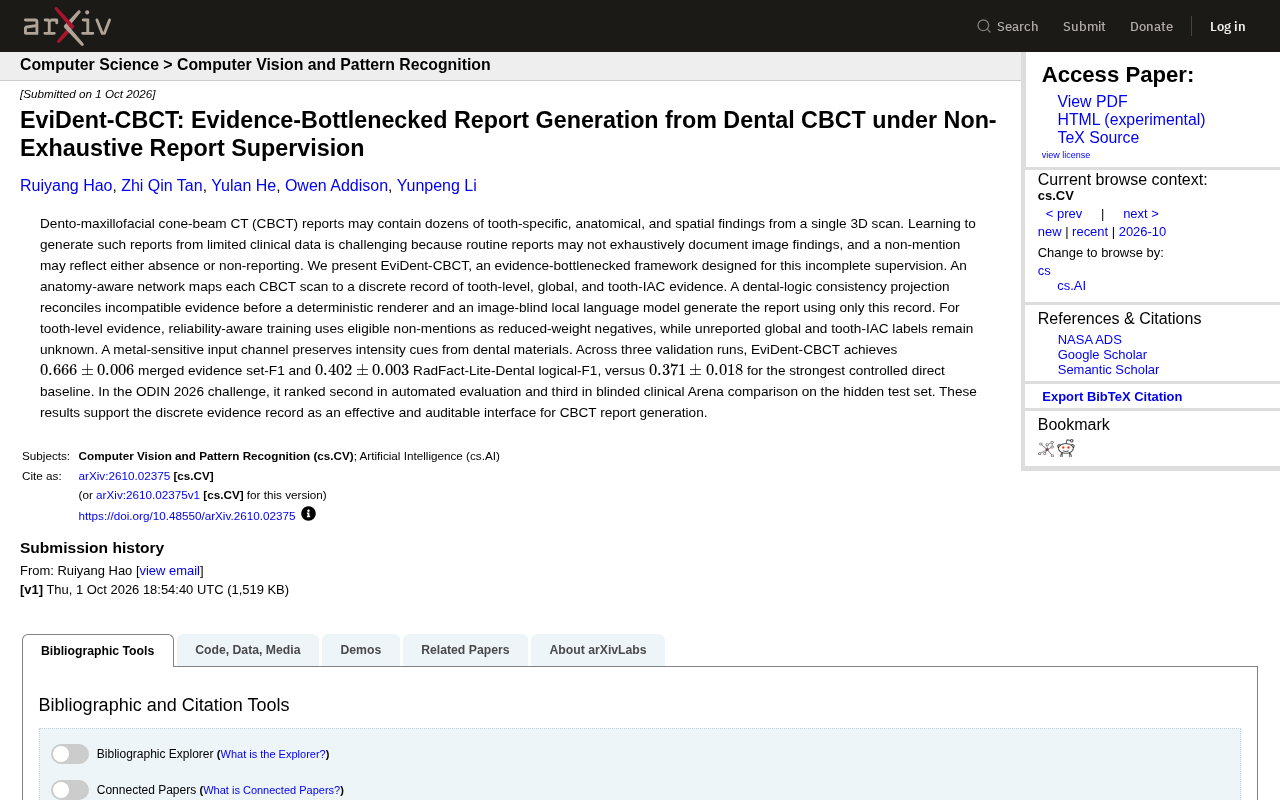
Dental CBCT report generation faces a core challenge: non-exhaustive supervision, where clinicians don't document every finding, making non-mentions ambiguous as either negative evidence or missing labels. EviDent-CBCT addresses this by inserting a discrete evidence record as a bottleneck between image and text: an anatomy-aware network extracts tooth-level, global, and tooth-IAC evidence; dental-logic consistency projection reconciles conflicts; and an image-blind language model generates reports solely from the evidence record, ensuring every conclusion is traceable. Non-mentions are downweighted rather than treated as definitive negatives. In the ODIN 2026 Challenge, the system ranked 2nd in automated evaluation and 3rd in blinded clinical comparison, with a logical F1 of 0.402 versus a baseline of 0.371.
Dental cone-beam CT (CBCT) scans can reveal dozens of findings related to teeth, anatomical structures, and spatial relationships in a single acquisition. Yet training AI to automatically generate clinical reports from these 3D images runs into a stubborn real-world problem: radiologists don't exhaustively document every finding they observe. When something goes unmentioned in a report, it could mean the finding genuinely doesn't exist — or it might simply mean the clinician chose not to write it down. This phenomenon, known as Non-Exhaustive Supervision, makes model training extraordinarily difficult.
A newly published arXiv paper introduces EviDent-CBCT, an "Evidence-Bottlenecked" framework designed specifically for this incomplete-annotation scenario, offering a new auditable and traceable path for automated CBCT report generation.
The Core Challenge: How to Interpret Silence in a Report
Image-to-text mapping is already challenging in medical imaging report generation — and the unique characteristics of dental CBCT amplify the difficulty further. A routine clinical report may only document findings the physician considers significant, leaving a large number of genuinely present observations omitted due to "clinical insignificance" or writing habits.
This means a "non-mention" in training data is an ambiguous signal: it could be negative evidence (the finding doesn't exist) or a missing annotation (it exists but wasn't documented). If a model naively treats all non-mentions as negatives, it learns the wrong distribution and generates reports that either miss findings or hallucinate them. The entire design of EviDent-CBCT centers on handling this uncertainty.
Background: What is Dental CBCT? Dental cone-beam computed tomography is a 3D imaging technology designed for the oral and maxillofacial region. Compared to conventional medical CT, it delivers lower radiation doses, higher spatial resolution, and adjustable fields of view. It is widely used for implant surgery planning, impacted tooth assessment, root canal treatment guidance, and jaw lesion screening. A single CBCT scan produces hundreds of cross-sectional slices that clinicians must interpret across axial, coronal, sagittal, and 3D reconstructed views. This information density makes exhaustive reporting practically impossible — an experienced clinician working under time constraints will focus on findings relevant to the chief complaint and omit many minor or incidental observations. While similar selective documentation exists in chest CT and MRI radiology reports, dental CBCT involves a larger number of discrete anatomical units (individual teeth, alveolar bone segments, nerve canal trajectories, etc.), making selective recording even more prevalent and creating a structural barrier to building complete training labels.
Technical Architecture: Compressing Images into Discrete Evidence Records
The central design insight of EviDent-CBCT is to insert a discrete evidence record as a bottleneck layer between the image and the report text. The full pipeline can be broken down into several stages:
An Anatomy-Aware Network Extracts Three Evidence Types
The framework first uses an anatomy-aware network to map each CBCT scan into three levels of evidence: tooth-level, global-level, and tooth-IAC (tooth to Inferior Alveolar Canal) relationships. This hierarchical design mirrors actual dental diagnostic reasoning — clinicians must evaluate individual teeth, assess the overall picture, and pay close attention to spatial relationships involving critical neural structures.
Dental-Logic Consistency Projection
Extracted evidence items may be mutually contradictory. The paper introduces a dental-logic consistency projection step that reconciles incompatible evidence before report generation. This step explicitly encodes domain knowledge into the model to reduce logical contradictions.
Deterministic Renderer + Image-Blind Language Model
The reconciled evidence record is then handed off to a deterministic renderer and an image-blind local language model that generates the final report. The key insight here is that the language model only has access to the evidence record — it never sees the original images. This structurally guarantees that every statement in the report must be traceable to a specific piece of evidence rather than generated from thin air by the model. This is precisely the value of an "auditable interface."
Training Strategies for Non-Exhaustive Supervision
To address the core pain point of incomplete annotations, the paper adopts differentiated handling strategies.
For tooth-level evidence, reliability-aware training is applied: eligible non-mention samples participate in training as reduced-weight negatives rather than being treated as definitive negatives. This approach exploits the information in non-mentions without over-penalizing the model.
For unreported global evidence and tooth-IAC labels, the framework simply retains an "unknown" status without forcing inference. This honest treatment of uncertainty is one of the key distinctions between this framework and conventional approaches.
Additionally, the paper introduces a metal-sensitive input channel specifically designed to preserve intensity cues from dental materials such as fillings and implants, since these high-density metallic objects in CBCT are simultaneously diagnostic information and common sources of imaging artifacts.
Background: The Inferior Alveolar Canal (IAC) The Inferior Alveolar Canal is a bony channel within the mandible that houses the inferior alveolar nerve and blood vessels, running from the mandibular foramen to the mental foramen and supplying sensation to the posterior mandibular teeth and lower lip. When extracting impacted mandibular wisdom teeth or placing dental implants, the three-dimensional distance between surgical instruments and the IAC is the critical factor for assessing nerve injury risk — inadvertent damage can cause permanent numbness or paresthesia. Dental CBCT is the gold-standard imaging modality for evaluating the tooth root–IAC relationship, but IAC trajectories vary substantially between individuals and frequently appear blurry in regions affected by metal artifacts. EviDent-CBCT designates tooth-IAC relationships as a separate evidence category precisely because of the high clinical stakes of this anatomical relationship and its frequent incomplete documentation in routine reports.
Results: A Second-Place Finish in Automated Evaluation
Across three validation runs, EviDent-CBCT achieved a combined evidence-set F1 of 0.666±0.006 and a RadFact-Lite-Dental logical F1 of 0.402±0.003. For comparison, the strongest controlled direct baseline reached only 0.371±0.018. The improvement on logical consistency — a critical metric — is substantial.
The competition results are even more telling: in the ODIN 2026 Challenge, EviDent-CBCT ranked second in automated evaluation and third in the blinded clinical Arena comparison on the hidden test set. Maintaining strong rankings on unseen data and under real clinical review suggests the method has genuine generalization capability rather than merely overfitting to a particular dataset.
Background: RadFact-Lite-Dental RadFact-Lite-Dental is a logical consistency evaluation metric designed for dental radiology reports. Its design draws from natural language inference (NLI): both the generated and reference reports are decomposed into sets of atomic factual propositions, and the entailment relationships between the two proposition sets are evaluated — rather than simply measuring lexical overlap. Compared to traditional metrics like BLEU and ROUGE, RadFact-style metrics focus on whether generated content is clinically self-consistent and aligned with the reference at the factual level, and are better at penalizing logical contradictions and hallucinations. In high-stakes medical report generation tasks, logical F1 more accurately reflects practical usability than surface-level fluency, which is why EviDent-CBCT's significant improvement on this metric over the baseline carries direct clinical significance.
Significance and Outlook: Auditability Is a Must-Have for Medical AI
The significance of EviDent-CBCT extends beyond benchmark scores. By using a discrete evidence record as an intermediate layer, it provides an effective and auditable interface for CBCT report generation. In clinical settings, whether each conclusion in a report can be traced and verified often matters far more than how fluently the text reads.
Decoupling image understanding (evidence extraction) from text generation (rendering) means clinicians can directly inspect and correct the intermediate evidence record, rather than confronting a black-box end-to-end model. This design philosophy has broader applicability to other high-risk medical AI applications.
Of course, as a freshly published preprint, these results await validation at larger clinical scale, and whether the evidence record's coverage can extend to more complex cases remains worth watching. But the paper at least demonstrates that in medical domains where annotation is inherently incomplete, the path forward lies not in brute-force end-to-end scaling, but in honestly handling uncertainty and building interpretable intermediate representations.
Related articles

Free Unlimited Claude Code Solution: Agnes AI + CC Switch Setup Guide
No paid subscription needed — pair the free AI platform Agnes AI with the open-source tool CC Switch to provide a backend for Claude Code, enabling unlimited free calls to text, image, and video models. This guide covers the full setup, test results, and usage boundaries.

A Complete Zero-Cost Guide to Getting Started with Claude Code for Beginners in China
A beginner's guide to Claude Code for users in China: two installation methods (command line and IDE plugin), full configuration steps for replacing the official API with the free domestic LongCat model, and a hands-on demo of building a small tool with natural language, plus tips.

When the NSA Gets Involved: The AI Supply Chain Crisis Behind Open-Source CVEs and API Key Hijacking
Multiple open-source projects disclosed severe CVEs in one day, PHP flaws alarmed the FBI, and Railway and OpenCode were breached with API keys stolen. This article breaks down the vulnerability window, AI-accelerated exploitation, and the AI supply chain crisis behind the API key black market, with a developer defense checklist.