Evolution Is Not Random: Akarsh Kumar on Artificial Life and an Alternative Intelligence Paradigm

Evolution plus foundation models is redefining how we search for artificial life and the nature of intelligence.
Researcher Akarsh Kumar argues in his paper ASAL that evolution is far from random — its selection mechanism transforms exponential search into linear search, making it one of the most powerful algorithms for discrete combinatorial problems. Using simulators like Conway's Game of Life, Lenia, and Particle Life, he shows how minimal rules give rise to stunning complexity, and frames the research agenda around "life as it can be." He distinguishes "statistical intelligence" (current LLMs) from "regularity-based intelligence" shaped by curriculum learning, arguing the latter bakes symmetries directly into neural circuits. ASAL uses vision-language models as judges to search parameterized simulation spaces, surfacing emergent phenomena; a Core War experiment further shows that LLMs in an evolutionary loop with a verifier can defeat 96% of human-written programs.
When We Call Evolution "Random," We're Wrong
There's a persistent misconception in AI: that evolution is a clumsy, primitive algorithm — a fallback for when gradient descent isn't an option. Researcher Akarsh Kumar directly refutes this view in a recent interview: "I just want to clarify one thing — evolution is absolutely not random."
In his view, evolution is actually one of the most powerful algorithms we know for solving discrete combinatorial problems. The key lies in its deeply underrated selection mechanism: if you solve a small piece of a puzzle and keep it, then search for the rest, you transform an exponential search problem into a linear one. This ability to "lock in progress and build on it" is precisely what random search cannot do.
This conversation centers on Kumar's paper ASAL (Automating the Search for Artificial Life with Foundation Models), covering artificial life, emergent phenomena, and an intelligence paradigm fundamentally different from mainstream deep learning.
Artificial Life: Studying "Life as It Can Be," Not Just Life as We Know It
Kumar opens with a line from his paper — artificial life studies not just "life as we know it," but "life as it can be."
His reasoning is clear: if you only want to understand life on Earth, study biology; if you only want to understand intelligence, study neuroscience. But we build AI to gain a more mechanistic, fundamental understanding. Borrowing from Jeff Clune: to truly claim you understand intelligence or life, you can't just describe one particular form — you must understand the entire space of possible intelligences, the entire space of possible life forms.
"You can't look at one car and say all cars are like this," Kumar offers by analogy. "You can't look at GPT-5 and say all intelligence is like this, or look at the human brain and say all intelligence is like this. There's a space, and we need to study the whole space."
Artificial life has an interesting subfield called "artificial chemistry" — changing the interaction rules for elements like hydrogen and helium to see what emerges. This gives researchers the ability to run counterfactual analyses in "other universes": in which worlds does open-ended complexity arise, and in which does only random noise appear? Why does one set of "physical laws" produce stunning phenomena while another produces nothing? This is the core research agenda Kumar wants to build around.

From Conway's Game of Life to Particle Life: A Tour of Simulators
To make these abstract concepts concrete, it helps to start with specific simulators.
Conway's Game of Life
The most classic and simplest example is Conway's Game of Life: a two-dimensional grid where each cell is either "alive" or "dead," governed by extremely simple rules — for instance, a dead cell with exactly three living neighbors comes back to life. This is perhaps the simplest possible world, yet after running for many steps, it gives rise to staggering complexity.
Kumar mentions that dedicated Discord communities continuously share newly discovered patterns — such as "spaceships" that repeat every 64 steps and travel at some defined speed. These enthusiasts even define a "causal speed" within the system: since information can only propagate one cell per step, they call it "the speed of light c," and will say a glider moves at "c/16" — just like real physics. This is genuinely an artificial universe.
Other Simulators
The paper uses several more complex systems:
- Lenia (created by Bert Chan): A continuous generalization of the Game of Life, using continuous differential equations for update rules, extendable to RGB three-channel color.
- Neural Cellular Automata (Mordvintsev, 2020's "Growing Neural Cellular Automata"): Replaces the local update rule of each cell with a small neural network, trained so that local rules self-organize to "grow" an image of a gecko — and even if part of it is deleted, the system continuously rebuilds itself.
- Boids: The classic algorithm simulating flocking behavior of birds and fish, where each individual makes left-or-right decisions based only on nearby neighbors, yet coherent group behavior emerges at the macro level.
- Particle Life (inspired by Tom Mohr): Particles of various types are placed in Euclidean space, with a 6×6 matrix defining attraction, repulsion, or neutral relationships between types. Change this "physics matrix" and some configurations are utterly unremarkable, while others form persistent, cell-like structures.
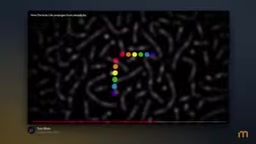
These "cell-like objects" are fascinating: they exploit the physics rules to create persistent structures within this world. As Kumar puts it, the essence of life may be "persistence" — these organisms are simply trying to survive to the next frame, and they leverage the laws of physics to do so.
"Emergence" is the most central concept underlying these simulators: the system as a whole exhibits properties that cannot be directly predicted or derived from the rules governing individual components. No rule in Conway's Game of Life specifies "there shall be moving structures," yet gliders appear. This phenomenon is called "strong emergence" in complex systems science, as distinct from "weak emergence" — macro-level properties that are in principle derivable from lower-level rules, but at prohibitively high computational cost. The distinction matters enormously: if life and intelligence are strongly emergent, inspecting low-level rules one by one will never yield understanding — we must study them at a higher level. If weakly emergent, a reductive explanation path theoretically exists. One of the central debates in artificial life is which category the complexity observed in these simulations belongs to. Wolfram's concept of "computational irreducibility" is closely related — he argues that the evolution of certain systems is itself the shortest computational path, with no shortcut available; you can only know the outcome by simulating it step by step.
Statistical Intelligence vs. Regularity-Based Intelligence
The most valuable part of this interview is Kumar's distinction between two paradigms of intelligence.
He describes current large language models as "statistical intelligence" — they are nearly perfect in a statistical sense; you can train them on anything, even teaching calculus directly without arithmetic as a prerequisite. "It's a very weird, very alien way of training."
In contrast, he proposes "regularity-based intelligence." Human and animal learning follows a natural curriculum: learn this first, then that, step by step, with no alternative. Kumar argues that this sequential, path-dependent mode of learning — in both humans and evolution — is precisely what creates beautiful, structured representations, and is the root of robustness, adaptability, and generalization.
This connects to prior work on Fractured Entangled Representations (FER). The interview cites Kenneth Stanley's view: what matters is not only where you end up, but how you got there. "Right now we tend to only care about outcomes — benchmark scores, whether it passed the math olympiad. But what if how you get there is what actually matters?"

Kumar likes to frame all of this in terms of regularization. Data is one form of regularization; weight decay (L2) is another; and curriculum learning — which respects the symmetries acquired along the way — is an "extremely, extremely powerful" form. He further views the FER approach as an "automatic symmetry-learning algorithm": you can't write down inductive biases like "illumination invariance" in a mathematical formula, but data-driven evolution can bake that regularity directly into the neural circuitry.
"Fractured Entangled Representation" (FER) is key context for understanding this discussion. The concept comes from research by Kenneth Stanley and others, describing the internal representational state that large neural networks form after training: features for different concepts become highly entangled in the network's parameters, making clean separation impossible, while representations of the same concept are fragmented across the network rather than existing in a localized, modular form. This representational structure performs well on benchmarks, yet is brittle when it comes to out-of-distribution generalization, compositional reasoning, and continual learning — change a small detail of training data and the model's internal representations may undergo catastrophic drift. The ideal alternative is a "disentangled representation": different concepts correspond to independent internal dimensions, and modifying one dimension doesn't affect others, giving the model stronger compositional generalization. Kumar argues that path-dependent learning following a natural curriculum is the key mechanism by which models spontaneously form disentangled representations rather than FER.
Searching for Artificial Life with Foundation Models: Three Uses of ASAL
The core idea of ASAL is: rather than hard-coding a single simulation, parameterize a space of simulations, then use a foundation model (a vision-language model) as a "judge" to search through it.
This approach offers two benefits. First, it becomes easier to specify what you want — you don't need an exact target image with pixel-level supervision; you just say "I want a cat," and any cat will do. This drastically simplifies the search problem. Second, it naturally accommodates "computational irreducibility" (from Stephen Wolfram): since you can't predict what a given physics rule will produce, you simply simulate it, let it unfold, and then hand the result to a foundation model for evaluation.
Experiments in the paper yield several findings. In supervised-target experiments, goals like multicellular organisms, neural networks, viruses, and fungal colonies all found corresponding emergent phenomena in Lenia, Boids, and Particle Life. Open-ended search discovered simulations more open-ended than Conway's Game of Life. Most interestingly, after mapping all 260,000 rules — embedding the results through CLIP and visualizing in 2D, colored by open-endedness — a clear structure emerged: one large "island" of non-open-ended configurations, and a small island where all the most interesting simulations clustered.

One intriguing point: foundation models are themselves "fractured entangled representations," and they often produce "imposters." But that's precisely sufficient — because you're only using them as a judge to bootstrap a properly structured, disentangled representation. For tasks that only care about output behavior, not internal representations, foundation models perform nearly perfectly.
The Core War Experiment: The Power of Evolution + LLM
To demonstrate the power of evolution, Kumar's team ran an experiment based on Core War. Core War is a programming game from the 1980s: players write programs in an assembly language called Red Code, drop them into random locations in a virtual machine's memory, and compete to crash each other's threads by injecting illegal operations — the last program still running wins.
They used an LLM as a mutation operator within an evolutionary loop to optimize programs against a baseline, employing MAP-Elites to handle the highly deceptive, non-local search landscape. The results were impressive:
- Warriors produced in just the first training round could defeat 96% of opponents in a dataset of human-written warriors (roughly 300 human programs).
- As adversarial evolution rounds increased, warriors became increasingly general — more likely to defeat human warriors they had never seen — and behavioral variance decreased, converging toward a "generalist" warrior.
The key insight: LLMs are terrible at writing Red Code zero-shot, and best-of-N sampling is also poor — but once placed inside an evolutionary loop with a verifier, they become extremely powerful. This mirrors the lesson from AlphaEvolve.
Kumar's explanation cuts to the heart of evolution: evolution only needs your mutations to be good 1% of the time. Before LLMs, random mutation in program synthesis (as in AutoML-Zero) was nearly futile, since the probability that any random mutation produces useful code is close to zero. LLMs can't guarantee 100% success, but they can far exceed 1%. And every time they succeed, you lock in that progress and build on it — this is the fundamental reason why "evolution + LLM" vastly outperforms LLMs alone. "It's not even close."
MAP-Elites is a "Quality-Diversity" (QD) optimization algorithm introduced by Mouret and Clune in 2015. Unlike traditional evolutionary algorithms that pursue a single optimal solution, MAP-Elites maintains an archive partitioned by "behavioral descriptors," with each cell holding the best-performing individual for that behavioral niche. This actively maintains population diversity, avoiding premature convergence to local optima, and is especially effective on highly deceptive fitness landscapes — where local optima are separated from global optima by large low-scoring regions, making greedy search prone to getting stuck. The Core War setting is inherently deceptive: a program that dominates against one type of opponent may be completely ineffective against another. MAP-Elites, by covering warriors with diverse behavioral profiles, gives the population the ability to counter many different strategies, ultimately evolving more robustly generalizing programs. This also explains why behavioral variance decreases as adversarial evolution rounds accumulate — the archive gradually fills with truly robust strategies.
A Long-Term Bet on Intelligence
Kumar is candid: artificial life is "a long-term bet on intelligence." He's not advocating for simulating every low-level particle to bootstrap intelligence from the bottom up — rather, he wants to distill the right "abstraction" from natural evolution and these simulations: one efficient enough to run in a decade and capable of producing general intelligence in the right way.
This is a natural extension of deep learning's logic: we don't want to learn what a gecko looks like; we want to learn the process by which a gecko rebuilds itself from components. We don't want to learn intelligence itself; we want to learn the process by which intelligence grows. At a moment when statistical intelligence has achieved enormous success, Kumar's reminder is worth taking seriously — we should keep walking this path, but we shouldn't put all our eggs in one basket.
Related articles

Free Unlimited Claude Code Solution: Agnes AI + CC Switch Setup Guide
No paid subscription needed — pair the free AI platform Agnes AI with the open-source tool CC Switch to provide a backend for Claude Code, enabling unlimited free calls to text, image, and video models. This guide covers the full setup, test results, and usage boundaries.

A Complete Zero-Cost Guide to Getting Started with Claude Code for Beginners in China
A beginner's guide to Claude Code for users in China: two installation methods (command line and IDE plugin), full configuration steps for replacing the official API with the free domestic LongCat model, and a hands-on demo of building a small tool with natural language, plus tips.

When the NSA Gets Involved: The AI Supply Chain Crisis Behind Open-Source CVEs and API Key Hijacking
Multiple open-source projects disclosed severe CVEs in one day, PHP flaws alarmed the FBI, and Railway and OpenCode were breached with API keys stolen. This article breaks down the vulnerability window, AI-accelerated exploitation, and the AI supply chain crisis behind the API key black market, with a developer defense checklist.