Exact Tail Laws for SGD with Infinite-Variance Gradients

The paper establishes exact tail laws for nonlinear SGD with infinite-variance gradients, revealing that large gradient shocks dominate the last-iterate convergence behavior.
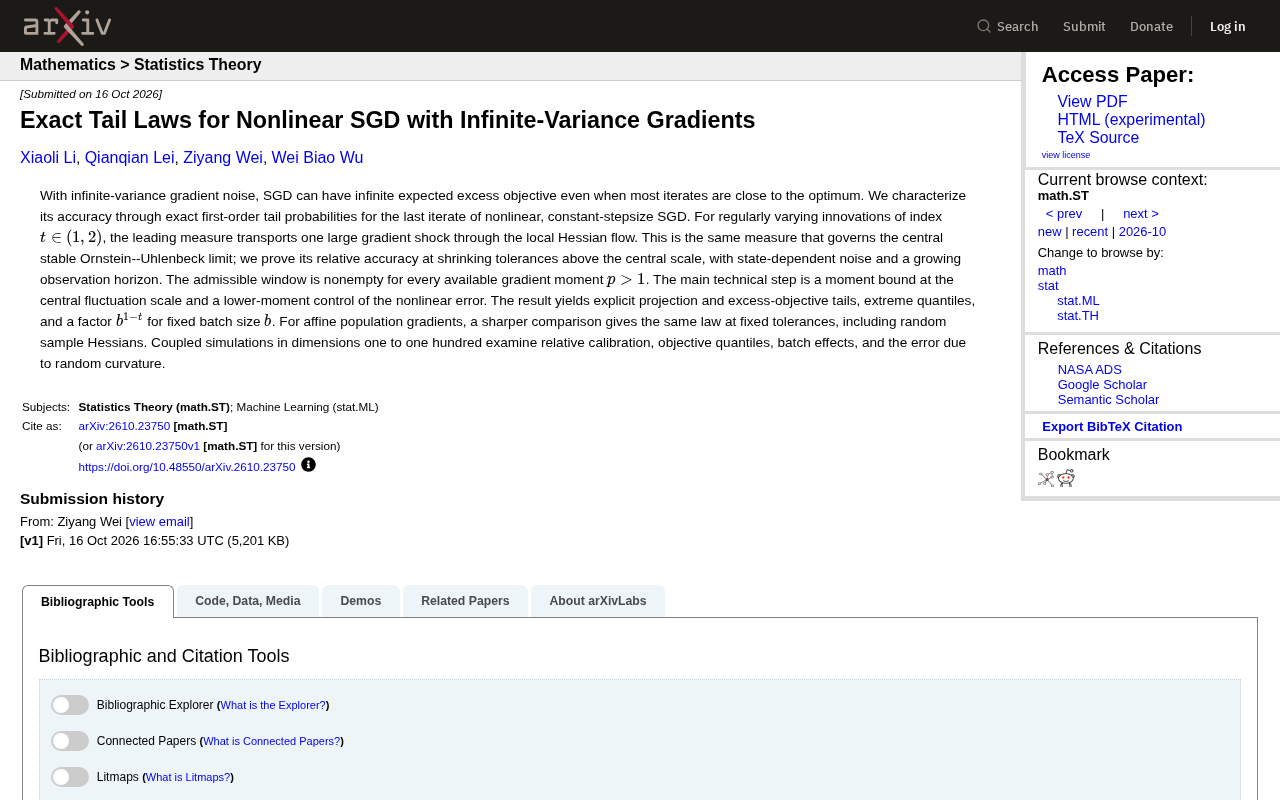
This article interprets the paper "Exact Tail Laws for Nonlinear SGD with Infinite-Variance Gradients," which establishes exact first-order tail probabilities for the last iterate of nonlinear constant-stepsize SGD with infinite-variance gradient noise (regularly varying tail index t∈(1,2)). The core result shows that tail events are dominated by a single large gradient shock transported through the local Hessian flow, consistent with the central stable Ornstein-Uhlenbeck limit. The paper proves relative accuracy under contraction tolerances above the central scale, applies to state-dependent noise and growing horizons, and gives explicit tail expressions, extreme quantiles, and the batch size factor b^{1-t}. Simulations validate the theory, showing that larger batches mitigate heavy-tail effects. This work fills the gap in tail behavior analysis of SGD under infinite variance and provides tools for robust algorithm design and risk assessment.
Title
Exact Tail Laws for SGD with Infinite-Variance Gradients
Meta Description
This article interprets the paper "Exact Tail Laws for Nonlinear SGD with Infinite-Variance Gradients," analyzing exact tail probabilities of SGD under infinite-variance gradients, core theoretical results, and experimental validation, and exploring the impact of heavy-tailed noise on optimization algorithms and practical implications.
Article Content
Stochastic gradient descent (SGD) is a cornerstone of machine learning optimization, but its behavior becomes exceptionally complex when gradient noise has infinite variance. Traditional analysis shows that even if most iterations are close to the optimal solution, the expected excess objective may diverge. A recent paper, "Exact Tail Laws for Nonlinear SGD with Infinite-Variance Gradients," delves into this problem, establishing exact first-order tail probabilities for the last iterate of nonlinear, constant-stepsize SGD, and revealing the fine-grained convergence behavior of SGD under infinite-variance gradients.
Problem Background: The Challenge of Infinite-Variance Gradients
In stochastic optimization, the variance of gradient noise is usually assumed to be finite to obtain good convergence guarantees. However, in real-world scenarios such as heavy-tailed data or certain reinforcement learning tasks, gradient noise may have infinite variance. In this case, the expected excess risk of SGD may be infinite, even if most iterates are close to the optimal solution. This poses a fundamental difficulty for theoretical analysis: traditional moment analysis fails, and new tools are needed to characterize the accuracy of the algorithm.
The paper focuses on nonlinear SGD, where the objective function is non-quadratic and the gradient noise has a regularly varying tail index (t \in (1,2)). Under this setting, the tail probability of gradient shocks decays as a power law, leading to rare but huge gradient updates that may push iterates away from the optimal region. The authors characterize the accuracy of the last iterate through exact first-order tail probabilities rather than relying on expected values.
Regularly varying tail is a core concept in extreme value theory used to characterize heavy-tailed distributions. If the tail probability of a random variable $X$ satisfies $\bar{F}(x) = P(X > x) = x^{-t} L(x)$, where $L(x)$ is a slowly varying function (i.e., for any $c>0$, $L(cx)/L(x) \to 1$), then its tail index is said to be $t$. When $t \in (1,2)$, the variance is infinite but the mean is finite, and the generalized central limit theorem shows that the normalized sum converges to a $t$-stable distribution rather than a normal distribution. This property directly causes rare but huge gradient shocks in SGD to dominate the tail behavior, and is the cornerstone of the paper's theoretical framework.
Stable Ornstein-Uhlenbeck (OU) limit is a generalization of the classical OU process under infinite-variance noise. The classical OU process is driven by Brownian motion, corresponding to the finite-variance case; when the driving force is a $t$-stable Lévy process, the resulting stable OU process has jump-type sample paths, and its stationary distribution is a stable distribution. In SGD analysis, the iterate process at the central fluctuation scale converges to a stable OU process, which provides a limiting tool for characterizing tail probabilities—the paper establishes exact tail laws precisely by proving that the large-shock transport measure coincides with this stable OU limit measure.
Core Results: Exact Characterization of Tail Probabilities
The main contribution of the paper is proving that for regularly varying innovations (index (t \in (1,2))), the tail probability of the last iterate is dominated by a single large gradient shock transported through the local Hessian flow. This measure is the same as that governed by the central stable Ornstein-Uhlenbeck limit, but the paper further proves the relative accuracy of this measure under contraction tolerances above the central scale. This result applies to state-dependent noise and growing observation horizons, and for any available gradient moment (p>1), the admissible window is non-empty.
Key technical steps include moment bounds at the central fluctuation scale and low-order moment control of the nonlinear error. These tools enable the authors to derive explicit projection and excess objective tails, extreme quantiles, and the factor (b^{1-t}) for fixed batch size (b). For affine population gradients, a finer comparison yields the same law under fixed tolerance, including the case of random sample Hessians.
Hessian flow refers to the mechanism of linearly transporting the local Hessian matrix along the SGD iterate trajectory. When a large gradient shock occurs, the iterate is pushed away from the current region, and subsequent updates under the local quadratic approximation are equivalent to transforming the shock vector through the inverse of the Hessian matrix (or a related linear operator). The paper proves that the distribution of a single large shock after transport through this linear flow dominates the tail probability of the last iterate, and that this transport measure agrees with the central stable limit. The validity of this linearized approximation depends on high-order moment control of the nonlinear error, and is the key bridge connecting extreme events and local curvature.
Methodological Innovation: From Central Limit to Tail Laws
Traditional SGD analysis mostly focuses on fluctuations at the central limit theorem scale, i.e., the asymptotic normality of iterates around the optimal solution. However, when the gradient variance is infinite, the central limit theorem no longer applies, and tail events become dominant. The innovation of the paper lies in linking tail probabilities to the central stable limit and proving the consistency of the transport measure of large shocks with the central limit measure. This connection allows the use of theoretical tools for stable distributions to analyze the tail behavior of SGD.
Specifically, the authors consider the last iterate of constant-stepsize SGD and study the probability that its distance to the optimal solution exceeds a certain threshold. For gradient noise with regularly varying tails, large deviations are dominated by a single large gradient shock, which propagates through the linearized flow of the local Hessian matrix. The paper proves that within a certain range of scales, the relative error of this single-shock approximation tends to zero, thereby yielding exact tail laws.
Central fluctuation scale refers to the relative scale of stepsize and number of iterations that makes the normalized fluctuations of SGD iterates converge to a non-degenerate limit. In the finite-variance case, this scale is given by $\sqrt{\eta}$ ($\eta$ is the stepsize), and the limit is Gaussian; in the infinite-variance case $t \in (1,2)$, the central scale becomes of order $\eta^{1/t}$, and the limit is a $t$-stable distribution. The paper establishes moment bounds at the central scale and proves that within a contraction tolerance window slightly larger than this scale, the relative error of the tail probability tends to zero, thereby precisely linking the tail law to the central limit.
Experimental Validation: Simulation and Calibration
The paper validates the theoretical results through coupled simulations from one to one hundred dimensions. The simulations examine relative calibration, target quantiles, batch effects, and errors caused by random curvature. The results show that the theoretically predicted tail probabilities agree well with actual simulations, especially in the tail region. The factor (b^{1-t}) for batch size is also validated, indicating that increasing batch size can mitigate the impact of heavy-tailed gradients.
These experiments not only confirm the theory but also reveal finite-dimensional effects and the influence of random Hessians. For example, in higher dimensions, the randomness of the local Hessian may cause deviations in tail probabilities, but the theory still provides reasonable approximations.
Practical Significance and Implications
This research has several implications for practitioners. First, it shows that under infinite-variance gradients, the last iterate of SGD can still approach the optimal solution, but the convergence rate is determined by the tail index (t), rather than the traditional (1/\sqrt{n}) rate. Second, the choice of batch size (b) affects tail risk, and larger batches can reduce the probability of extreme events. Finally, the explicit tail expressions in the paper can be used to design more robust optimization algorithms, such as adaptive stepsizes or gradient clipping strategies.
For theoretical researchers, this work opens a new direction combining extreme value theory with stochastic optimization. Future work can extend to momentum methods, adaptive optimizers, and more general noise structures.
In summary, this paper provides precise theoretical tools for understanding SGD under heavy-tailed noise and fills the gap in tail behavior analysis under infinite-variance scenarios. Its results not only have theoretical depth but also provide guidance for algorithm tuning and risk assessment in practice.
One-line Summary
The paper establishes exact tail laws for nonlinear SGD with infinite-variance gradients, revealing that large gradient shocks dominate the convergence behavior of the last iterate.
Paragraph Summary
This article interprets the paper "Exact Tail Laws for Nonlinear SGD with Infinite-Variance Gradients," which establishes exact first-order tail probabilities for the last iterate of nonlinear constant-stepsize SGD with infinite-variance gradient noise (regularly varying tail index t∈(1,2)). The core result shows that tail events are dominated by a single large gradient shock transported through the local Hessian flow, and that this transport measure agrees with the central stable Ornstein-Uhlenbeck limit. The paper proves the relative accuracy of this approximation under contraction tolerances above the central scale, applies to state-dependent noise and growing horizons, and provides explicit tail expressions, extreme quantiles, and the batch size factor b^{1-t}. Simulation experiments validate the theoretical predictions, showing that larger batches can mitigate heavy-tail effects. This work fills the gap in tail behavior analysis of SGD under infinite-variance scenarios and provides theoretical tools for robust algorithm design and risk assessment.
Related articles

Free Unlimited Claude Code Solution: Agnes AI + CC Switch Setup Guide
No paid subscription needed — pair the free AI platform Agnes AI with the open-source tool CC Switch to provide a backend for Claude Code, enabling unlimited free calls to text, image, and video models. This guide covers the full setup, test results, and usage boundaries.

A Complete Zero-Cost Guide to Getting Started with Claude Code for Beginners in China
A beginner's guide to Claude Code for users in China: two installation methods (command line and IDE plugin), full configuration steps for replacing the official API with the free domestic LongCat model, and a hands-on demo of building a small tool with natural language, plus tips.

When the NSA Gets Involved: The AI Supply Chain Crisis Behind Open-Source CVEs and API Key Hijacking
Multiple open-source projects disclosed severe CVEs in one day, PHP flaws alarmed the FBI, and Railway and OpenCode were breached with API keys stolen. This article breaks down the vulnerability window, AI-accelerated exploitation, and the AI supply chain crisis behind the API key black market, with a developer defense checklist.