Exploring the Dust Project: Pretraining Transformers Without Backpropagation

Dust explores backpropagation-free Transformer pretraining, challenging a core deep learning paradigm — but remains in early stages.
Dust is an early-stage research project attempting to pretrain Transformers without backpropagation, which recently surfaced on Hacker News. While backpropagation is the foundation of modern deep learning, its heavy caching of intermediate activations creates significant memory pressure, and its global gradient propagation makes parallel training complex. Dust aligns with the broader "local learning" research direction — including Hinton's Forward-Forward Algorithm and Target Propagation — and could potentially reduce peak training memory and improve parallelism. However, the project lacks large-scale benchmark validation and community discussion, and whether it can compete with mature backpropagation approaches in real pretraining scenarios remains an open question.
A Challenge to the Dominant Paradigm
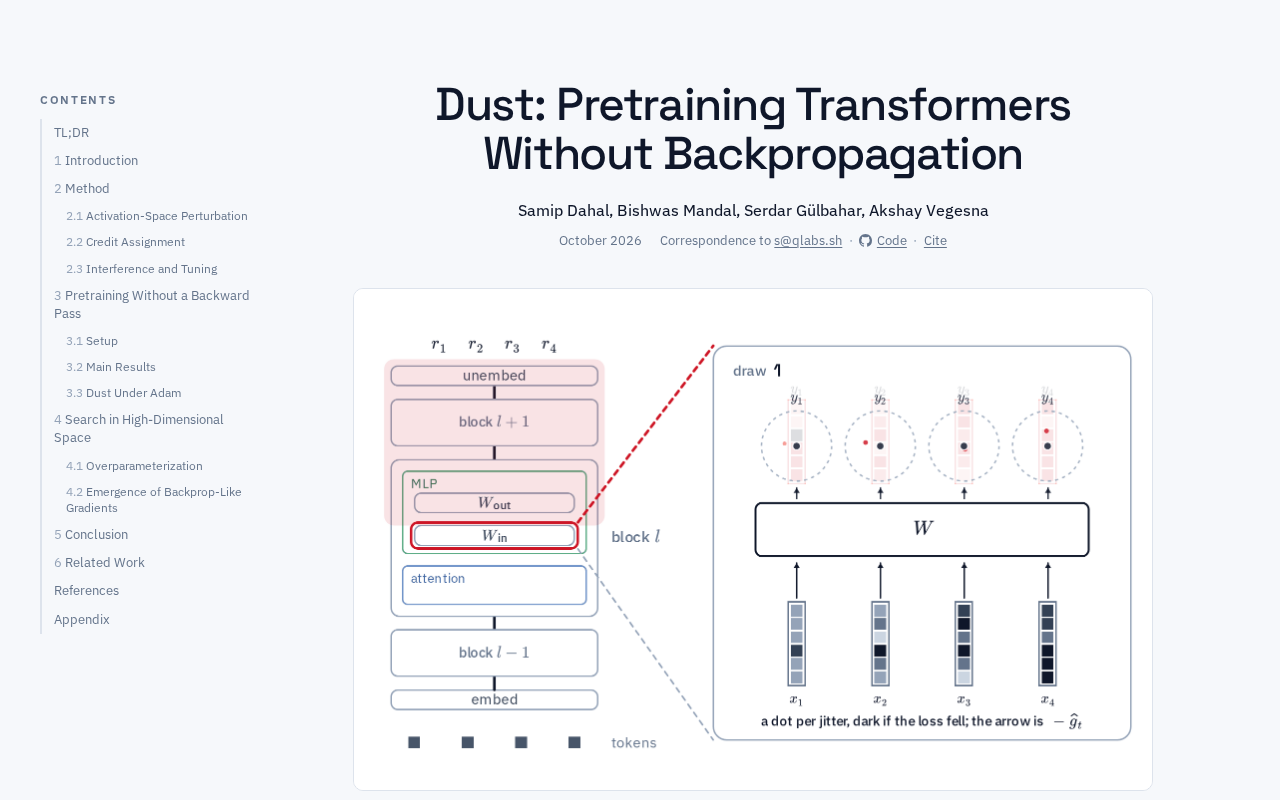
A project called Dust has recently attracted attention on Hacker News with a provocative claim: pretraining a Transformer without using backpropagation. For a deep learning field that has long relied on gradient descent and backpropagation, this is a direction worth examining closely.
Since backpropagation was introduced to neural network training decades ago, it has been the cornerstone of modern deep learning. Whether it's the GPT family of large language models or various vision Transformers, parameter updates almost universally depend on backpropagation to compute gradients. The Dust project takes direct aim at this default assumption and attempts to find an alternative path.
Why Bypass Backpropagation?
As powerful as backpropagation is, it doesn't come without costs. It requires saving large amounts of intermediate activations during the forward pass so that gradients can be computed during the backward pass — this leads to significant GPU memory consumption. When training extremely large models, this often becomes one of the key hardware bottlenecks.
In addition, backpropagation requires global gradient propagation, creating strong coupling between layers and making parallelization and distributed training more complex in practice. The research community has been actively exploring "backpropagation-free" or "local learning" methods in recent years — such as the Forward-Forward Algorithm and Target Propagation — attempting to train networks in ways that are either closer to biological neural mechanisms or more resource-efficient.
Dust can be understood within this broader research context: it represents the community's continued exploration of diverse training paradigms, rather than a simple rejection of existing methods.
The Forward-Forward Algorithm, proposed by Geoffrey Hinton in 2022, replaces one forward pass plus one backward pass with two forward passes: the first runs on "positive" data, increasing each layer's "goodness" metric; the second runs on "negative" data, decreasing it. Each layer updates its weights using only local signals, with no need to propagate gradients back from the output layer to the input layer. Target Propagation, on the other hand, assigns a local "target activation" to each layer, allowing each layer to independently minimize the gap between its output and its target — again avoiding global chain-rule differentiation. Both approaches are considered more biologically plausible than standard backpropagation, since the brain does not appear to transmit precise backward gradient signals, attracting cross-disciplinary interest from both neuroscience and machine learning.
Potential Technical Value
If a backpropagation-free pretraining method can work effectively on Transformers, its significance could manifest in several ways.
Memory and Compute Efficiency
Freeing the process from dependency on a full computation graph and intermediate activations could substantially reduce peak GPU memory usage during training — making larger models feasible on limited hardware, or reducing the training cost of models at equivalent scale.
The reason backpropagation consumes so much memory lies in the fundamental trade-off between activation checkpointing and intermediate tensor caching: standard training requires saving the output activations of every layer during the forward pass for use in gradient computation during the backward pass. For a model with tens of billions of parameters, these intermediate activations can consume as much GPU memory as the model weights themselves — or more. Local learning rules only need to retain activations until the current layer finishes its update, theoretically reducing memory usage from O(number of layers) to approximately O(1) per layer. This has practical implications for training large models on consumer-grade GPUs or edge devices.
Training Parallelism
Local learning rules generally don't need to wait for global gradient backpropagation, allowing layers to update their parameters more independently. This opens up new possibilities for pipeline parallelism and asynchronous training.
Theory and Interpretability
Exploring non-gradient training signals also helps researchers understand what neural networks actually "learn" and which mechanisms truly matter during the learning process.
Reasons for Caution
It must be noted that projects of this kind are still in early exploratory stages. The Hacker News discussion generated limited engagement (15 points, no comments at the time of writing), and the work has yet to receive substantial community validation or peer discussion.
A core challenge that backpropagation-free methods have long faced is that their final performance on large-scale tasks often falls short of mature backpropagation-based training. Whether such approaches can remain competitive in real-world pretraining settings is the critical benchmark for evaluating their value. Until rigorous benchmarks and reproducible results are available, it would be premature to draw conclusions about their effectiveness.
Conclusion
The Dust project is worth paying attention to — not because it's ready to replace backpropagation, but because it continues and advances an important open question: does deep learning have a more efficient and more fundamental way to train? For developers and researchers interested in the underlying mechanics of model training, projects like this offer a window into frontier exploration. Readers who are curious are encouraged to dig into the project's source code and related papers to form their own informed opinions.
Related articles

Bilibili's Hit Dify Tutorial: A Practical Guide to Building 20+ AI Apps from Scratch
A distilled guide to Bilibili's top-rated Dify tutorial: Windows + Docker deployment, MySQL connection, five app types, model integration strategy, and publishing.

Agent Skills Beginner's Guide: From Concepts to Multi-Agent Collaboration in Practice
A comprehensive guide to Agent Skills: core concepts, components, the importance of Description, standardization, beginner learning paths, and multi-agent collaboration.

One Neuron Detects Both Cats and Cars? We Reproduced It and Found a New Explanation
The cat-car neuron reinterpreted: researcher Cammarata argues it distinguishes pointy from round, not cats from cars. We reproduced the experiment and found the new explanation holds on most inputs—but cars are the exception. The interpretability debate continues on language models.