Expo Launches AI Agent Skills Library to Simplify React Native Development

Expo open-sources an AI agent skills library for Expo/EAS, letting AI directly execute mobile development workflows.
The Expo team has open-sourced expo/skills on GitHub, a collection of AI Agent Skills designed for the Expo framework and EAS cloud services, which quickly gained over 3,300 stars. Through predefined instructions and knowledge packages, the skills give AI assistants like Claude and GPT Expo domain awareness, enabling them to recognize project types and directly invoke Expo CLI and EAS CLI commands rather than generic suggestions. Covering project initialization, build deployment, and troubleshooting, the project is implemented with Shell scripts and skill definition files and can be integrated into AI tools supporting agent protocols. The article argues its value lies in solidifying Expo best practices into reusable skills, turning AI from a chat assistant into an executable operations agent and providing a practical reference case for AI-assisted mobile development.
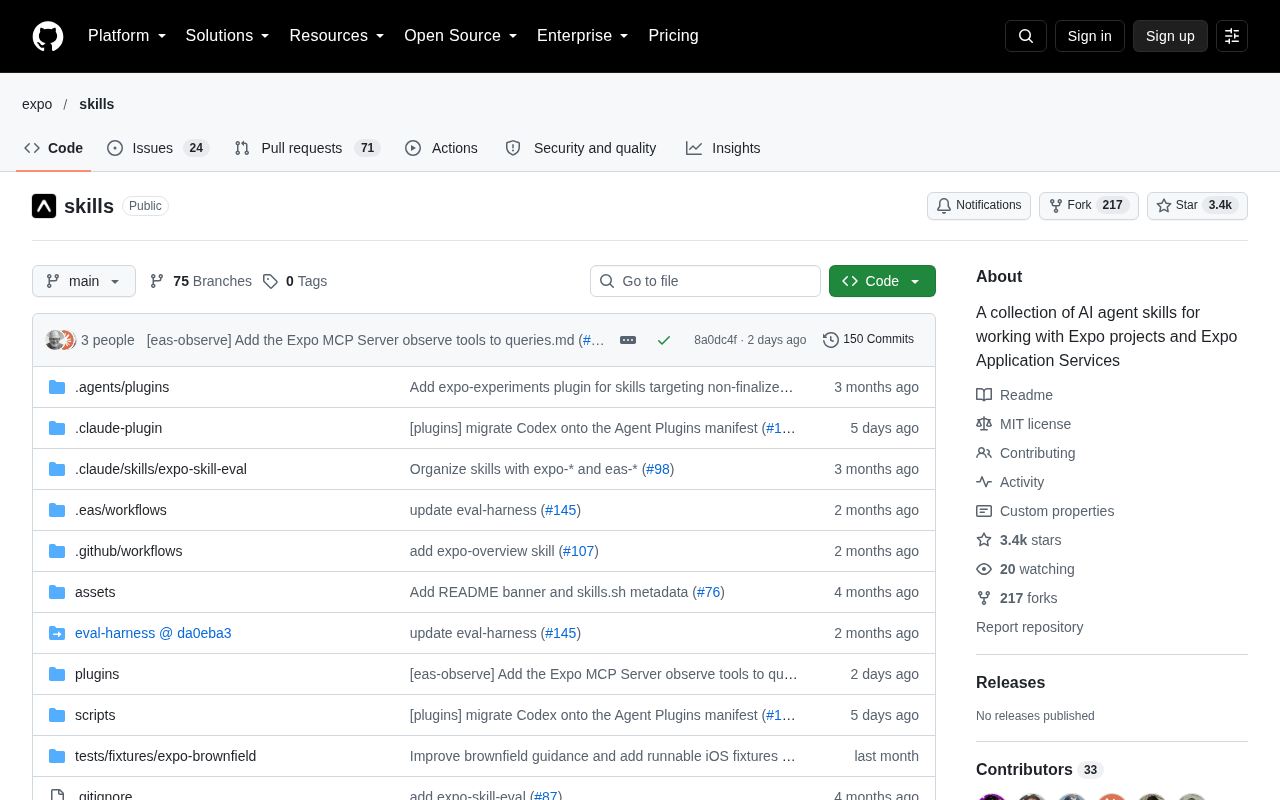
The Expo team has open-sourced the expo/skills project on GitHub, a collection of AI Agent Skills designed specifically for Expo projects and Expo Application Services (EAS). The project quickly garnered over 3,300 stars shortly after launch, with 212 new stars in a single day, reflecting developers' strong interest in AI-assisted mobile development tools.
What Are AI Agent Skills?
AI Agent Skills are a set of predefined instructions, tools, and knowledge packages that enable AI assistants (such as Claude, GPT, and others) to understand tasks in a specific domain and execute operations. expo/skills focuses these skills on the Expo ecosystem, covering common workflows such as project initialization, build configuration, and app store submission.
Unlike generic code completion, the skills library gives agents "domain awareness"—it can recognize that the current project is an Expo project and invoke the corresponding Expo CLI or EAS CLI commands, rather than offering generic suggestions.
Agent Protocol is a standardized convention that enables AI assistants to interact with external tools and environments. It defines how AI discovers available tools, how it constructs invocation requests (such as function names and parameters), and how it receives execution results and continues reasoning. Common implementations include Anthropic's Model Context Protocol (MCP) and OpenAI's Function Calling. The skill definition files in expo/skills are essentially "toolkits" described according to such protocols; once AI tools read them, they know which CLI commands can be invoked in an Expo project, what parameters are required, and how to interpret the results. Without a unified protocol, each AI tool would need to be adapted separately; with a protocol, the same set of skills can be reused across multiple platforms, which is why the project emphasizes "tools that support agent protocols."
Core Content and Usage
The repository is primarily composed of Shell scripts, providing skill definition files and installation scripts. Developers can integrate these skills into AI tools that support agent protocols, enabling AI assistants to directly operate Expo projects.
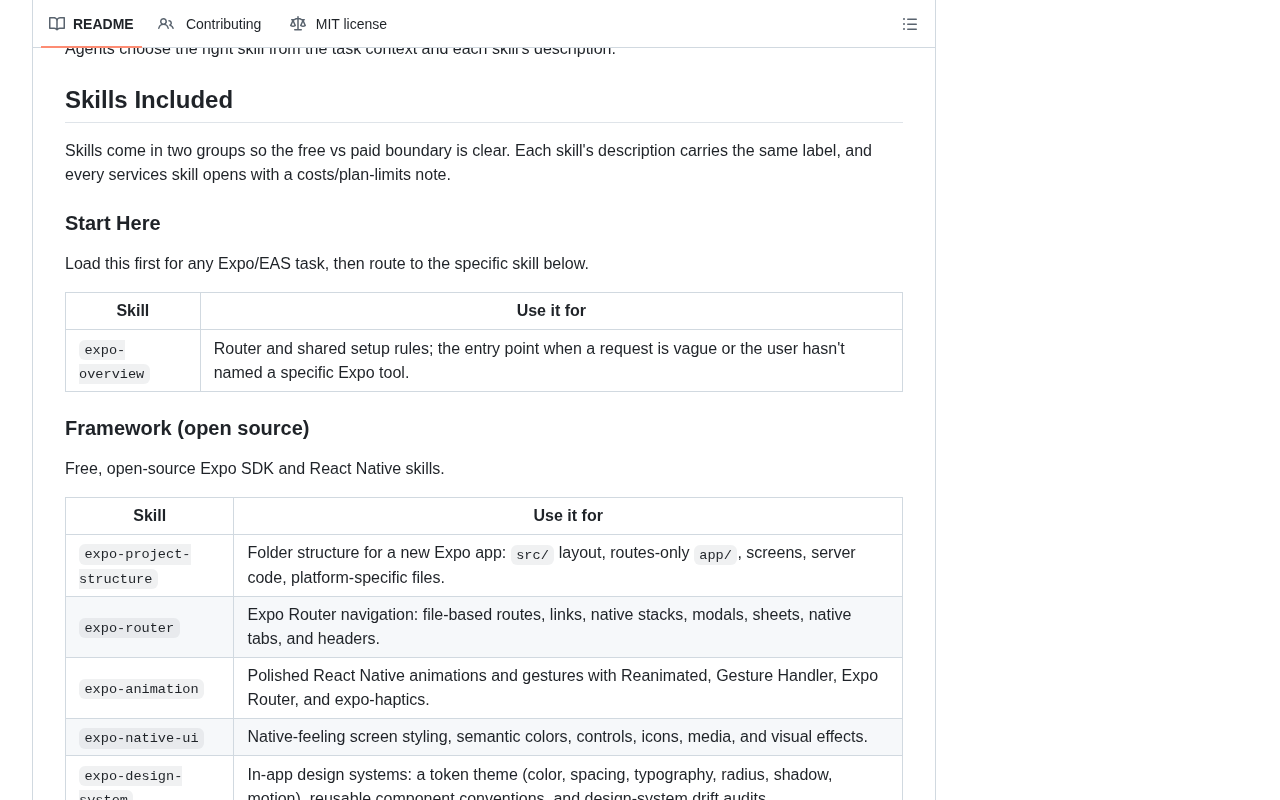
Typical use cases include:
- Project initialization: Create a new Expo app via natural language instructions; the agent automatically runs
npx create-expo-appand configures the template. - Build and deployment: Have the agent help configure EAS Build and EAS Submit, reducing time spent manually consulting documentation.
- Troubleshooting: For common build errors, the agent can provide fix steps based on the knowledge in the skills library.
This model transforms AI from a "chat assistant" into an "executable operations agent," lowering the barrier to entry for React Native developers.
Expo Application Services (EAS) is a suite of cloud build and release services provided by Expo, primarily including EAS Build (generating iOS/Android native installation packages in the cloud, eliminating the need for local Xcode and Android SDK configuration), EAS Submit (automatically submitting build artifacts to App Store Connect and Google Play), and EAS Update (pushing JS-layer hot updates to published apps). These services are driven through the eas-cli command-line tool, with configuration centralized in eas.json. The skills library encapsulates multi-step processes such as "logging into EAS, selecting a build profile, triggering a build, querying build status, and submitting for review" into instruction sequences that agents can execute, which is why AI assistants can replace developers in completing operations that previously required repeatedly consulting documentation.
Why Is It Worth Attention?
Mobile development involves a large number of CLI commands and platform-specific configurations, and beginners can easily get stuck during environment setup and build processes. expo/skills solidifies Expo's best practices through skill encapsulation, enabling AI assistants to accurately execute multi-step tasks.
In addition, the project adopts an open-source model, allowing the community to contribute new skills or adapt to different AI platforms. For teams exploring AI coding assistants, this is a directly referenceable implementation case.
The core value of Agent Skills as a design approach lies in the combination of "knowledge solidification" and "execution closed loop." In traditional prompt engineering, developers need to stuff domain knowledge into the conversation context, which is both verbose and prone to omissions; the skills library instead writes knowledge into independent, version-controllable files, and AI only loads the corresponding skill when needed, thereby saving context window space and improving accuracy. At the same time, skills usually include validation steps and error-handling branches, enabling agents to self-correct during multi-step tasks rather than giving one-shot suggestions that may fail. This "skills-as-code" model is becoming a common practice in the AI programming tool ecosystem, and expo/skills is one of the earlier public practices in the mobile development domain.
Quick Start Guide
- Clone the repository:
git clone https://github.com/expo/skills.git - Check the skill definitions under the
skills/directory to understand what each skill does. - Follow the instructions in the README to install the skills into your AI tool (one that supports agent protocols).
- In your Expo project directory, invoke the AI assistant and try using natural language to have the agent execute build or configuration tasks.
Note that the skills library is still in its early stages, and some skills may depend on specific versions of Expo CLI or EAS CLI. It is recommended to read the documentation for the corresponding skill before use and to keep an eye on repository updates.
Conclusion
expo/skills offers a pragmatic direction for AI-assisted mobile development: rather than having AI replace developers, it makes AI an operations assistant familiar with Expo workflows. As agent protocols become more widespread, domain-specific skills libraries like this are expected to become a standard component of development toolchains.
One-line Summary
Expo open-sources an AI agent skills library for Expo/EAS, enabling AI to directly execute mobile development workflows.
Paragraph Summary
The Expo team has open-sourced the expo/skills project on GitHub, a collection of AI Agent Skills designed specifically for the Expo framework and EAS cloud services, which quickly gained over 3,300 stars after launch. In the form of predefined instructions and knowledge packages, the skills give AI assistants like Claude and GPT Expo domain awareness, enabling them to recognize project types and directly invoke Expo CLI and EAS CLI commands rather than offering generic suggestions. The project covers common scenarios such as project initialization, build deployment, and troubleshooting, implemented with Shell scripts and skill definition files, and can be integrated into AI tools that support agent protocols. The article argues that the project's value lies in solidifying Expo best practices into reusable skills, transforming AI from a chat assistant into an executable operations agent, and providing a practical reference case for AI-assisted mobile development.
Related articles

74M-Parameter Open-Source Model Partially Outperforms Jev AI in Testing
Fastino AI's Glider 2.5 models, with just 74M–300M parameters, reportedly outperform Jev AI in some guardrail benchmarks per YouTube testing, run on consumer hardware, and even play Doom. We analyze small models' competitiveness and deployment value on specific tasks.

Gemini 4 Argon Hands-On: Aggressive Pricing, 3D Capabilities Need Coaching
Gemini 4 Argon hands-on: limited-time $2/$10 pricing, million-token output, strong 3D and reverse-engineering work, but weak front-end aesthetics and zero-shot ability need coaching.

Build Your Own ChatGPT with Flutter and Gemini API: Streaming Chat in 200 Lines of Code
Learn to build a ChatGPT-like AI chat app with Flutter and the Gemini API: secure API keys via Firebase AI Logic, stream replies with sendMessageStream, maintain memory with chat sessions—all in under 200 lines of code.