External State Engine: An Architectural Vision for Turning AI Agents from "Pets" into "Cattle"

Externalize Agent state, memory, and orchestration to a dedicated database, turning Agents into stateless, disposable execution units.
A Reddit thread argues that current AI Agents carry too many responsibilities — task ingestion, planning, context compaction, and more — making them fragile and hard to maintain. The poster envisions a "JIRA board for Agents" where personas, tasks, and results are decomposed into database records, Agents retrieve their manifest on startup, and all reasoning output is written to external storage. A purpose-built database engine handles background compaction, semantic embedding retrieval, auto-indexing, and deduplication. The result mirrors cloud-native "Cattle, not Pets": Agents become lightweight, stateless execution units while all complex state management sinks into a dedicated infrastructure layer.
A Architecture Question from Reddit
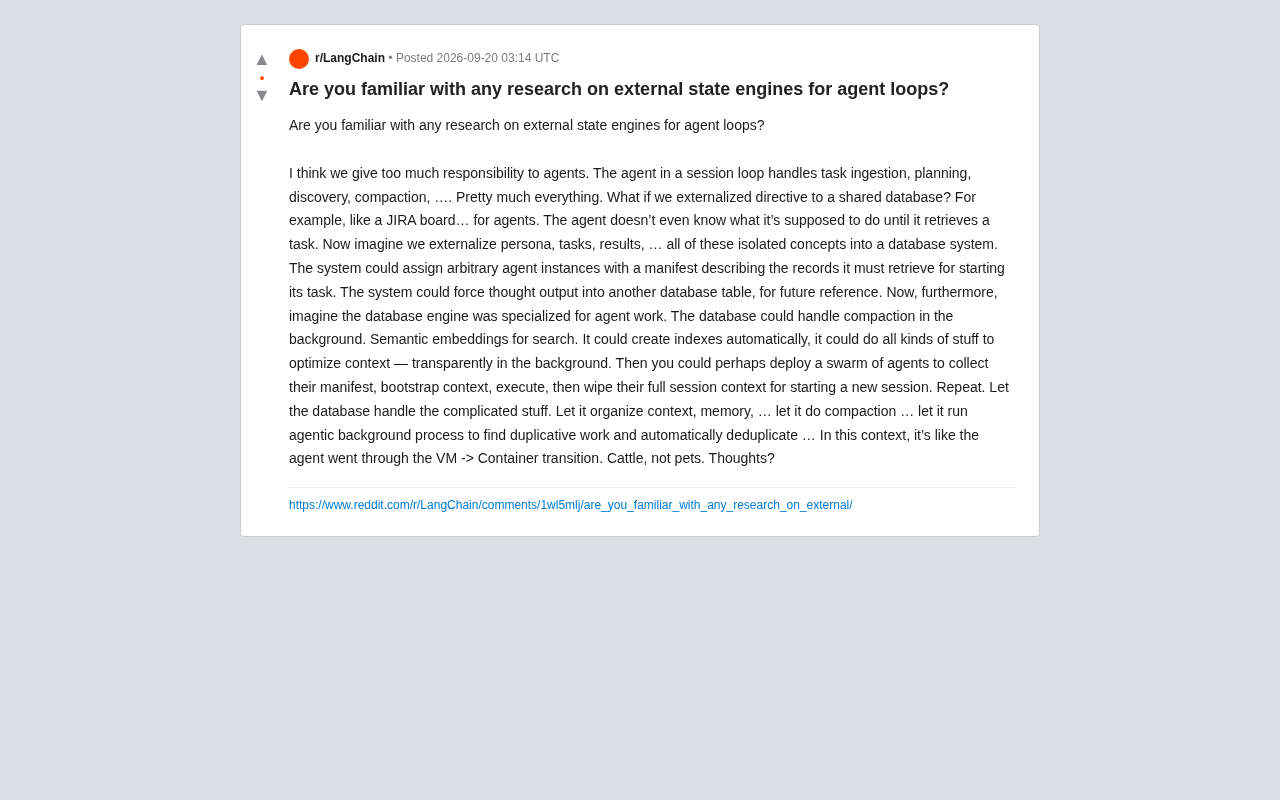
A recent Reddit thread raised a thought-provoking question: are we giving AI Agents too many responsibilities? The poster observed that in a typical Agent session loop, a single Agent handles almost everything — task ingestion, planning, discovery, context compaction, and more, all from start to finish.
This "all-in-one" design may seem flexible, but it piles all the complexity onto the Agent itself — an inherently unstable reasoning entity. The alternative the poster proposed is imaginative: externalize these responsibilities from inside the Agent into a shared database, letting the Agent return to its core role as a pure executor.
A "JIRA Board" Designed for Agents
The poster used a vivid analogy: imagine a JIRA board built specifically for Agents. In this vision, an Agent doesn't even know what it needs to do when it starts up — it must first retrieve its tasks from the system before it can act.
The mechanism works like this: concepts that are currently mixed into the Agent's context — persona, tasks, results, and more — are decomposed into isolated records in a database. The system assigns any Agent instance a "manifest" that describes which records to retrieve when bootstrapping a task. The Agent's reasoning output is no longer ephemeral session content, but is instead force-written into a separate data table for future reference.
This is fundamentally a separation of concerns: the Agent is responsible only for reasoning and execution, while state, memory, and task orchestration are managed by an external system. The immediate benefit is that Agent instances become stateless and interchangeable, and orchestration logic is liberated from the model's "black box" to become observable and auditable.
Separation of Concerns is a classic software engineering principle that divides a system's different functional responsibilities into mutually independent modules, so each module focuses on a single problem domain. In traditional web applications, this manifests as the MVC architecture separating views, business logic, and data access into distinct layers. Applying this principle to Agent design means the model only needs to handle reasoning and generation, while state persistence, task scheduling, and memory retrieval are handled by external infrastructure. Current mainstream Agent frameworks (such as LangChain and AutoGen) do provide tool-calling and memory modules, but these mechanisms are mostly still encapsulated within the Agent's context window management logic — they haven't truly achieved "externalization." When the context window approaches its limit, the Agent often has to decide on its own which information to compress. This design, which mixes state management into the reasoning process, is precisely the core problem the poster wants to fully decouple.
A Specialized Database That "Understands" Agents
The most interesting part of this vision is its redefinition of the database itself. What the poster envisions is not an ordinary storage layer, but a database engine specifically optimized for Agent workloads — one that transparently handles a lot of the heavy lifting in the background:
- Automatic compaction: organizes and distills context in the background, rather than forcing the Agent to scramble through it mid-session
- Semantic embedding retrieval: generates embeddings for records to support semantic search rather than simple keyword matching
- Automatic indexing: automatically creates indexes based on access patterns to optimize context retrieval performance
- Intelligent context optimization: transparently handles various context organization tasks in the background
Taking it further, this database could also run "agentic" background processes — for example, proactively discovering duplicate work items and automatically deduplicating them. In other words, the database is no longer a passive store, but an intelligent layer that actively participates in the governance of Agent collaboration.
Context Compaction is one of the core challenges in modern LLM engineering. Because LLM context windows are finite (even models supporting millions of tokens face cost and attention degradation issues), long-running Agents must periodically "compress" historical information into more concise summaries before continuing to reason. The current approach typically has the model itself perform this compression, which means the timing, granularity, and information trade-offs all depend on the model's real-time judgment — consuming inference resources and making auditing difficult. The "background automatic compaction" envisioned here transfers this responsibility to the database engine, running it as an independent asynchronous process that doesn't consume the Agent's inference context. Embedding-based Retrieval converts text into high-dimensional vectors, allowing the system to retrieve relevant records by semantic similarity rather than exact keyword matching. This is the core technology behind RAG (Retrieval-Augmented Generation) architectures; building it natively into an Agent-specific database can significantly reduce engineering complexity at the retrieval stage.
"Cattle, not Pets": The Containerization Moment for Agents
The poster closes with a classic cloud-native analogy: this architecture gives Agents the equivalent transformation from virtual machines to containers — "Cattle, not Pets."
In traditional operations, "pets" are servers that are carefully tended, unique, and frantically nursed back to health when something goes wrong. "Cattle" are standardized instances that can be destroyed and rebuilt at any time. Applying this concept to Agents: you can deploy an entire fleet of Agents, have each instance pick up its own manifest, bootstrap its context, execute its task, then completely wipe the entire session context and start a new session — repeating this cycle indefinitely.
All the complex stuff is handed off to the database — it organizes context, manages memory, performs compaction, and deduplicates. The Agent itself degrades into a lightweight, stateless, disposable execution unit.
The Value and Open Questions of This Direction
This vision touches on a genuine pain point in current Agent engineering: context management and long-term memory are the most fragile parts of most Agent frameworks today. Externalizing state to a dedicated engine theoretically enables better scalability, reliability, and cost control (stateless instances are much easier to scale horizontally and reclaim).
That said, it also leaves plenty of open questions: does pushing "intelligence" down into the database layer simply move complexity from one place to another? How can background automatic deduplication and compaction guarantee no critical information is lost? How should consistency and race conditions between Agents and the external state engine be handled?
The poster themselves is seeking related research ("Are you familiar with any research..."), suggesting this is more of a thought-provoking architectural hypothesis than a mature solution. But it clearly points toward a trend — as Agent systems scale up, decoupling orchestration, state, and memory from the model and handing them to a dedicated infrastructure layer may well be an inevitable step in the evolution of Agent engineering.
The "Cattle, not Pets" analogy originated in the cloud computing operations community around 2012, first systematically articulated by Randy Bias at an OpenStack summit. Its core idea: traditional physical servers are treated like pets — named, carefully maintained, and urgently rescued when they fail — while modern cloud infrastructure should be managed like cattle, with individual instances simply destroyed and rebuilt when they break rather than repaired. This philosophy drove the adoption of Immutable Infrastructure and containerization (e.g., Docker/Kubernetes) — application state is fully separated from compute instances, state is stored in external databases or object storage, and compute nodes remain stateless. Applying this logic to Agents has the same technical prerequisite as containerization: you must first have a reliable external state layer (i.e., the specialized database envisioned here) before Agent instances can truly become disposable. This also explains why the design requirements for the database engine in this vision are so demanding — the role it plays is essentially that of Kubernetes etcd plus a persistent storage layer for the Agent world.
Conclusion
The core insight of this discussion is: rather than burdening a single Agent with all responsibilities, build a state engine specifically designed for Agents that externalizes and automates complex work like task orchestration, context compaction, memory management, and deduplication. When Agents become "cattle" that can be created and destroyed at any time, the overall elasticity and maintainability of the system could see a qualitative improvement. Whether there is mature research and implementation corresponding to this vision remains a question worth continued exploration by the community.
Related articles

Free Unlimited Claude Code Solution: Agnes AI + CC Switch Setup Guide
No paid subscription needed — pair the free AI platform Agnes AI with the open-source tool CC Switch to provide a backend for Claude Code, enabling unlimited free calls to text, image, and video models. This guide covers the full setup, test results, and usage boundaries.

A Complete Zero-Cost Guide to Getting Started with Claude Code for Beginners in China
A beginner's guide to Claude Code for users in China: two installation methods (command line and IDE plugin), full configuration steps for replacing the official API with the free domestic LongCat model, and a hands-on demo of building a small tool with natural language, plus tips.

When the NSA Gets Involved: The AI Supply Chain Crisis Behind Open-Source CVEs and API Key Hijacking
Multiple open-source projects disclosed severe CVEs in one day, PHP flaws alarmed the FBI, and Railway and OpenCode were breached with API keys stolen. This article breaks down the vulnerability window, AI-accelerated exploitation, and the AI supply chain crisis behind the API key black market, with a developer defense checklist.