Extrovert: Let an AI Agent Take Over Your LinkedIn Outreach

Extrovert uses an AI agent to automate LinkedIn prospecting, engagement recommendations, and voice-matched drafting.
Extrovert is an AI agent tool designed for LinkedIn social selling. It automatically finds prospects, recommends daily engagement priorities, and drafts comments and DMs in the user's own voice. It offers two modes: a 20-minute human review workflow and full automation powered by Anthropic's Claude. Unlike traditional bulk-messaging plugins, its key differentiator is tonal authenticity. It launched on Product Hunt with 95 upvotes and ranked 6th for the day.
At a time when social selling has become a standard B2B lead generation strategy, LinkedIn is no longer just a job-hunting platform — it's the primary battleground where salespeople, founders, and marketers build relationships and prospect for clients. But high-quality LinkedIn activity demands a sustained time investment: finding the right people, commenting, sending DMs, following up — every step takes effort. Extrovert, a new product that recently launched on Product Hunt, aims to solve this age-old problem with an AI agent.
What Problem Does Extrovert Solve?
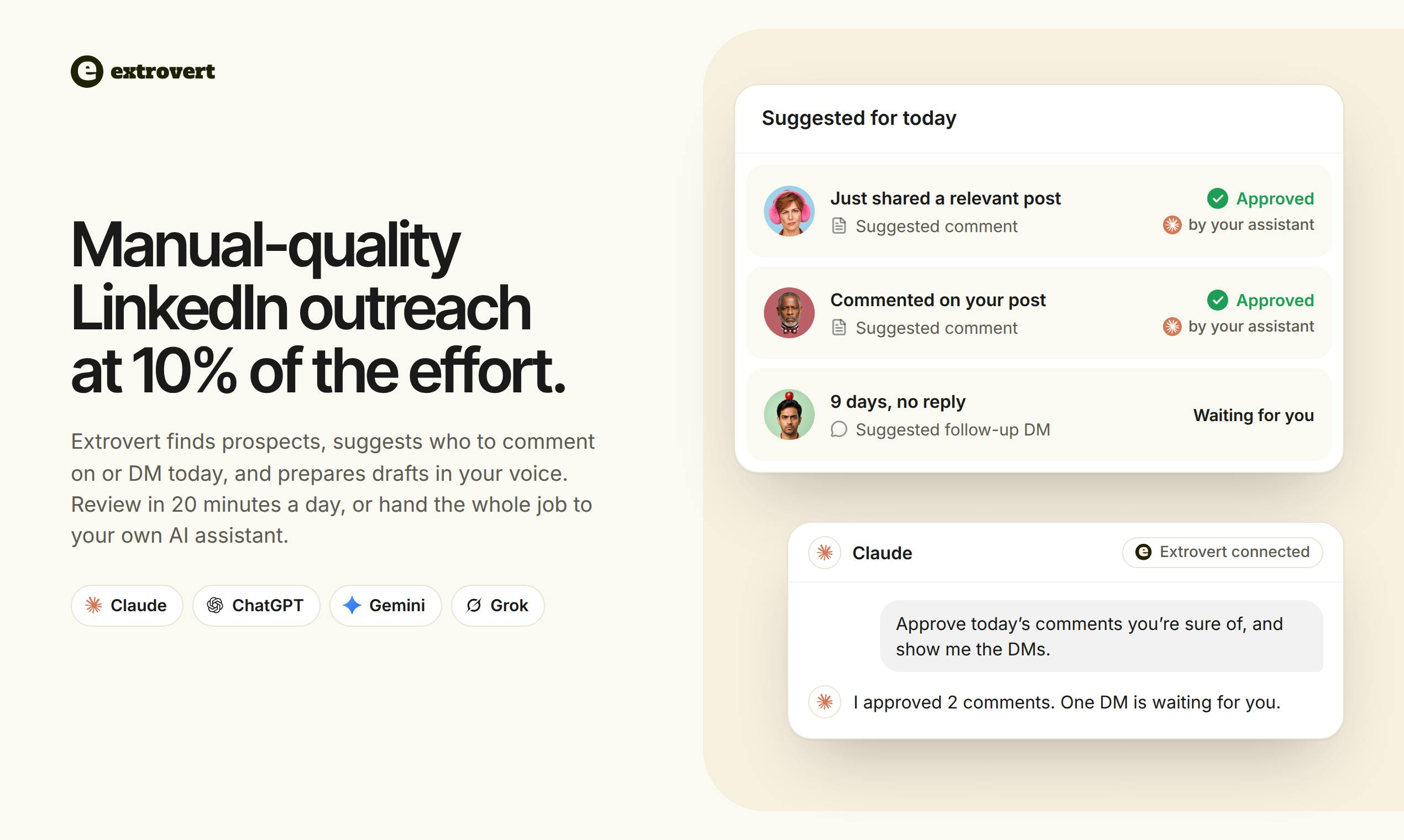
Extrovert's core positioning is "let your AI agent run your LinkedIn outreach for you." According to its official description, it does three main things: find prospects, recommend who you should comment on or message today, and prepare draft content written in your own voice and style.
This workflow targets the most time-consuming and often abandoned parts of social selling. Many people understand the value of LinkedIn engagement but struggle to consistently research target prospects' activity and craft personalized comments and opening messages every day. Extrovert hands off the two heaviest tasks — decision-making and drafting — to AI, leaving users to handle only the final review.
Two Usage Modes: Light Involvement or Full Automation
Extrovert offers flexible levels of user involvement, which is one of its standout design choices.
20-Minute Daily Review Mode
For users who want to stay in control, Extrovert compresses the workload down to roughly 20 minutes a day. You simply open its curated task list, review the recommended contacts and pre-written drafts, then approve or tweak before sending. This mode suits founders and salespeople who care about personal brand authenticity and aren't ready to fully let go.
Full Automation via Claude
The more aggressive option is to hand the entire job over to AI. The product explicitly mentions the ability to "hand the whole job to your Claude" — meaning it integrates with Anthropic's Claude model, allowing the agent to autonomously handle everything from screening to engagement. This signals that Extrovert isn't a closed black-box tool; it's built on top of leading large language model capabilities, embracing an agent-first approach.
Claude is Anthropic's family of large language models, known for instruction-following, long-context handling, and "trustworthiness." It's widely adopted by developers building agentic workflows. Anthropic offers robust API access and Tool Use capabilities, enabling Claude to autonomously plan multi-step tasks, call external services, and iterate based on feedback — the core traits that distinguish an AI agent from a simple chatbot. Extrovert's choice to build on Claude rather than develop its own model or use GPT reflects a broader trend in AI application development: directly leveraging the best foundation model for the target task rather than reinventing the wheel. For users, this means that as Claude itself improves, Extrovert's agent capabilities should theoretically improve in tandem.
"In Your Voice" Is the Key Differentiator
Automated LinkedIn tools are nothing new — the market is flooded with plugins for bulk messaging and auto-liking. But these tools often underperform because their content is templated and robotic, and they risk triggering platform restrictions.
Extrovert repeatedly emphasizes "in your voice" as its answer to this problem. The comment and DM drafts it generates are meant to mimic the user's own communication style rather than rely on generic, one-size-fits-all copy. At a time when real people can increasingly spot AI-generated content at a glance, personalization and tonal authenticity are the deciding factors in whether these tools actually drive replies.
The technical path to achieving voice authenticity typically involves having users provide samples of their past posts, comments, or messages, then using few-shot learning or fine-tuning to internalize individual expression habits — including word choice, sentence length, preferred openers, and even punctuation style. This capability is relatively mature technically, but the engineering challenge lies in striking the right balance between "sounds like you" and "sounds natural." Over-fitting makes the output feel forced and imitative; under-fitting collapses it back into generic templates. LinkedIn readers are especially sensitive to a "sales pitch feel," so the quality of this differentiation directly determines whether the product can evolve from an automation tool into a genuinely effective outreach assistant.
Market Reception and Positioning
Based on Product Hunt data, Extrovert received 95 upvotes, 9 comments, and ranked 6th for the day, categorized under Sales, Marketing, and LinkedIn. These numbers suggest it resonates with a real need among sales and marketing professionals, though the traction is solidly mid-tier rather than breakout.
One of the two co-founders, Dmitry Bergelson, is publicly credited. The product has a clear positioning — targeting individual outreach scenarios that need to scale without sacrificing quality.
A Few Questions Worth Considering
Extrovert represents a textbook example of the "AI agent + vertical use case" product paradigm: instead of building a broad general-purpose assistant, it goes deep on one high-value, high-repetition workflow.
That said, this type of product faces real-world challenges. LinkedIn has always been sensitive to automated behavior, and heavy reliance on autonomous agent interactions could trigger the platform's anti-abuse mechanisms. In fully automated mode, if the AI sends content on your behalf with an off-tone message or a factual error, it can actually damage your personal brand. For this reason, the "20-minute daily review" mode is likely the more prudent approach in practice, while "full automation" reads more like a technical capability showcase than a recommended use pattern.
For salespeople and founders, Extrovert's value isn't about completely replacing human effort — it's about automating the repetitive research and drafting work so people can focus their energy on final judgment calls and genuine relationship-building. That's also the most pragmatic direction for AI tools right now.
LinkedIn's enforcement of automation primarily works by detecting anomalous activity frequency, IP patterns, and account behavior fingerprints. The platform has historically suspended or restricted accounts using automation tools like Dux-Soup and Phantombuster. Its core logic is protecting user experience from spam interactions, which makes bulk liking and templated DMs high-risk operations. By contrast, the "AI-assisted drafting, human-reviewed sending" model is relatively compliant — the behavior is fundamentally still a human action; AI is just involved in the creation process. Extrovert's review mode carries a genuine compliance advantage on this dimension, not merely a conservative product strategy.
Related articles

Bilibili's Hit Dify Tutorial: A Practical Guide to Building 20+ AI Apps from Scratch
A distilled guide to Bilibili's top-rated Dify tutorial: Windows + Docker deployment, MySQL connection, five app types, model integration strategy, and publishing.

Agent Skills Beginner's Guide: From Concepts to Multi-Agent Collaboration in Practice
A comprehensive guide to Agent Skills: core concepts, components, the importance of Description, standardization, beginner learning paths, and multi-agent collaboration.

One Neuron Detects Both Cats and Cars? We Reproduced It and Found a New Explanation
The cat-car neuron reinterpreted: researcher Cammarata argues it distinguishes pointy from round, not cats from cars. We reproduced the experiment and found the new explanation holds on most inputs—but cars are the exception. The interpretability debate continues on language models.