FAA Nationwide Ground Stop: Behind the Full Halt of U.S. Flights

FAA orders nationwide ground stop at all U.S. airports; airborne flights may land.
The FAA issued a nationwide ground stop on Friday, suspending departures at all U.S. airports citing special circumstances and safety. Airborne flights were allowed to land. The cause was not disclosed and the announcement was truncated on social media. The rare measure causes widespread delays and cancellations; lifting depends on FAA safety assessments.
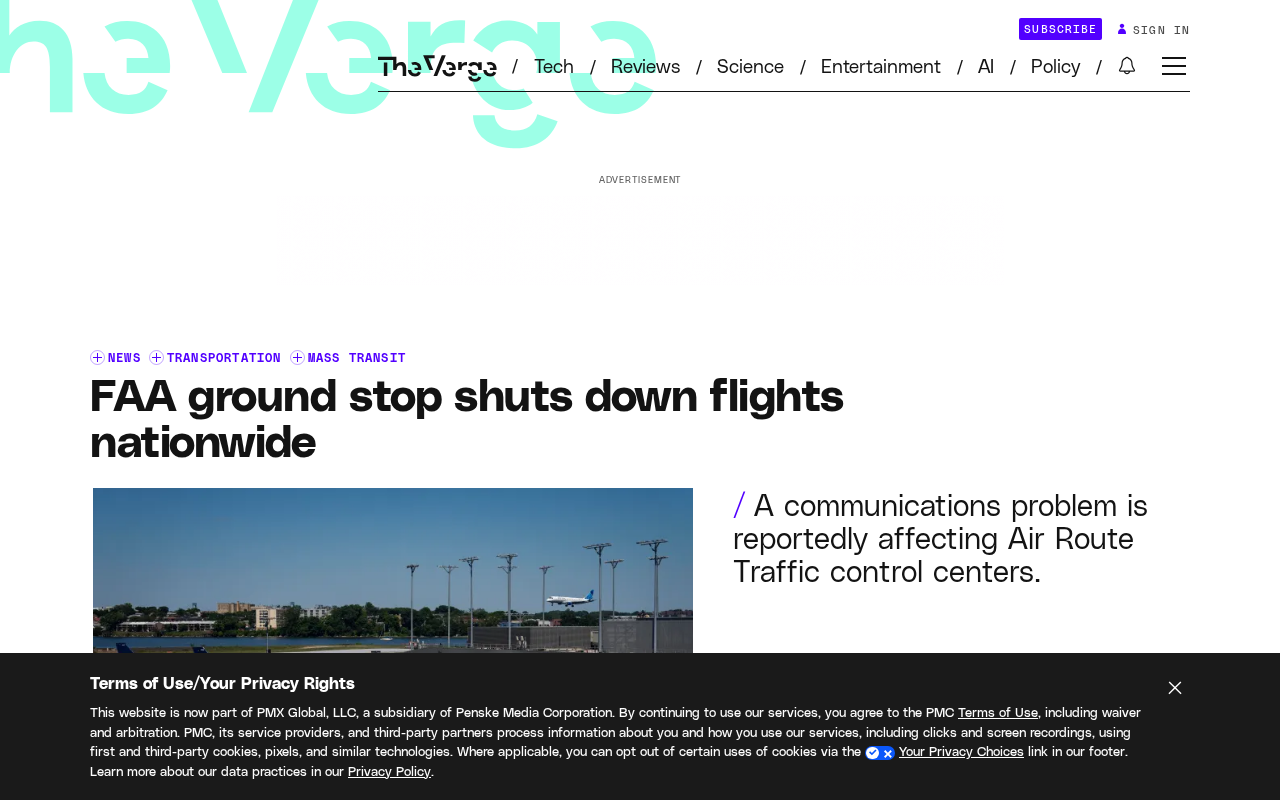
The U.S. Federal Aviation Administration (FAA) issued a nationwide ground stop on Friday, ordering all U.S. airports to suspend departures, citing "special circumstances and safety considerations." Flights already airborne were permitted to continue and land. The news was announced by U.S. Secretary of Transportation Sean Duffy on social media and quickly drew widespread attention.
Core Details of the Ground Stop
According to the FAA's statement, the nationwide ground stop covers all airports within the United States, with all flights barred from departing. The statement used the phrases "special circumstances" and "safety reasons," but the original information did not disclose the specific triggering factors. Aircraft already in flight were unaffected and could land normally.
Secretary of Transportation Sean Duffy announced the news via Twitter, but the tweet content was truncated in the source material, showing only "FAA issued a nationwide ground stop for all U.S. airports following a [...]" with the remaining details not fully presented.
This measure falls within the FAA's standard authority during emergencies. Nationwide ground stops are uncommon and are typically invoked only when systemic safety risks are involved.
Ground Stop is a specific traffic management tool within the FAA's air traffic control system, with subtle differences from what the public commonly calls a "grounding." It typically refers to requiring flights at specific airports or across the country to suspend departures due to weather, equipment failure, safety incidents, or insufficient air traffic capacity, while flights already airborne are unaffected. The FAA issues such orders through the ATC System Command Center and classifies them by severity level. Historically, nationwide ground stops have been extremely rare; common scenarios include the closure of U.S. airspace after the 9/11 attacks and the nationwide grounding in January 2023 caused by a NOTAM system failure. Understanding this term helps distinguish "suspension of departures" from a "full flight ban": the former preserves air traffic control operations, while the latter involves airspace closure.
Impact on Air Travel
The immediate consequence of a nationwide ground stop is widespread flight delays and cancellations. With all airports simultaneously suspending departures, passengers' travel plans are disrupted and airlines must reschedule capacity. That airborne flights were permitted to land means the air traffic control system remained operational, but the ground departure process was completely frozen.
From an operational standpoint, the timing of the ground stop's lifting depends on the FAA's assessment of safety conditions. Without a specific explanation of the cause, both airlines and passengers find it difficult to estimate recovery time. This uncertainty further amplifies the impact on the travel experience.
Information Transparency and Public Communication
In this incident, official information was primarily released through social media, and the FAA's full statement and subsequent updates were not adequately reflected in the source material. For major safety decisions affecting the national aviation system, the public has a high demand for information on the specific cause, scope of impact, and estimated recovery time.
The truncation of Sean Duffy's tweet also illustrates that on fast-spreading social platforms, key information may be lost during retransmission. For travelers relying on official channels for travel information, monitoring the FAA's formal announcements is more reliable than fragmented social media messages.
The Safety-First Decision Logic
The FAA placed "safety" first in its statement. Although the nationwide ground stop caused widespread travel disruption, from an aviation safety management perspective it is a precautionary measure. Suspending departures when the cause is unknown can prevent potential risks from spreading in the air.
The cost of such decisions is obvious—the aviation system is highly dependent on continuity, and any nationwide disruption produces chain reactions. But historical experience in aviation safety shows that precautionary groundings are often a necessary means of responding to systemic risks.
Precautionary grounding corresponds to the principle of "front-loading risk controls" in aviation safety management, with its theoretical basis in the Swiss Cheese Model—accidents are often the result of multiple layers of defense failing simultaneously, so proactively interrupting operations when information is incomplete can prevent potential risks from compounding. The FAA has the statutory authority to issue such orders under the provisions of the Federal Aviation Regulations (14 CFR) concerning air traffic control and flight safety. From a cost-benefit perspective, the direct economic costs of a grounding include flight cancellations, crew overtime, passenger stranding, and subsequent capacity scheduling costs, but compared with the loss of life and property from a potential safety incident, regulators typically prefer to "stop rather than risk." However, precautionary measures also face "false positive" criticism—that is, excessive disruption caused by misjudgment—which is why the FAA needs to quickly assess and restore operations when lifting a ground stop.
What to Watch Next
The conditions and timeline for lifting the ground stop are the most critical unknowns going forward. Passengers should closely follow the FAA's official channels and notifications from their airlines, and airlines will need to quickly restore operational order once the ground stop is lifted.
The original source material did not provide the specific cause or expected duration of the ground stop. These information gaps mean that assessing the full impact of the event still requires further official disclosure.
One-line Summary
<p>A nationwide ground stop issued by the FAA on Friday suspended departures at all U.S. airports, while flights already airborne were allowed to land normally.</p>Paragraph Summary
<p>The U.S. Federal Aviation Administration (FAA) issued a nationwide ground stop on Friday, requiring all U.S. airports to suspend departures, citing "special circumstances and safety considerations," while flights already airborne were permitted to continue and land. Secretary of Transportation Sean Duffy announced the news via social media, but the tweet was truncated in the source material and the specific trigger was not disclosed. A nationwide ground stop is a rare measure typically invoked only when systemic safety risks are involved; its immediate consequences are widespread flight delays and cancellations, requiring airlines to reschedule capacity. The timing of lifting the ground stop depends on the FAA's assessment of safety conditions, and without a specific explanation of the cause, recovery time is difficult to estimate. The article notes that the public should follow the FAA's formal announcements rather than fragmented social media messages, and emphasizes that precautionary groundings are a necessary means of responding to systemic risks in aviation safety management.</p>Related articles

Zed Editor Releases v1.29.2: Observations on a Routine Version Iteration
Zed editor releases patch v1.29.2, version bump by @JosephTLyons, commit verified via GitHub signature. This article covers the release's basic info, what a patch version means, and practical upgrade advice for users.

Anthropic IPO Questioned: Hacker News Debates Timing of Going Public
A Hacker News post titled "Just say no to Anthropic's IPO" sparks debate on the timing of Anthropic's public listing and AI capitalization, touching on valuation bubbles and mission independence.

Hands-On with the Genie 4 World Model: Directing Worlds in Real Time Like a Puppeteer
Google DeepMind's Genie 4 world model in depth: Special Guest X's hands-on demo of real-time scene direction via prompts, custom interactive apps in Project Genie, and prompts-as-seeds reproducibility.