Fable 5.1 Hands-On: AI One-Click 3D Game Scene Generation Crushes GPT and Grok
Fable 5.1 leads AI 3D game scene generation in detail, speed, and optimization over GPT and Grok.
A hands-on benchmark pits Fable 5.1 against GPT-5.6 Sol, Grok 4.6, and Kimi K3 across 3D game scene generation tasks including Neo-Gothic architecture, Sekiro and The Last of Us main menus, cathedral interiors, and voxel dioramas. Fable 5.1 dominates in detail fidelity, rendering optimization, and generation speed (70 min vs. GPT's 139 min), while GPT-5.6 excels at replicating interaction logic and Grok 4.6 surprises as a cost-effective contender.
AI Game Development Enters a New Phase: Fable 5.1 Arrives
When we talk about generative AI, images and text are no longer novel. But when AI starts directly outputting runnable 3D game scenes, shaders, and complete menu interfaces, the paradigm of game development is being quietly rewritten. Shaders are small programs that run on the GPU, responsible for determining the final color, lighting, and visual effects of every pixel. Shaders in modern game engines generally fall into three categories: vertex shaders (handling geometric transformations), fragment/pixel shaders (handling surface materials and lighting), and compute shaders (handling particles, physics simulations, and other general-purpose computations). When an AI model "outputs a shader," it's actually generating GLSL or HLSL code that needs to be compiled and executed in real time on the GPU — whether it can produce syntactically correct, performance-optimized shader code with acceptable visual quality is one of the core metrics for evaluating AI game generation capabilities.
The recently released Fable 5.1 has attracted significant industry attention — this model from the Anthropic camp was pitted against GPT-5.6 Sol, Grok 4.6, Kimi K3, and other cutting-edge models in a series of 3D shader and Blender benchmarks.
Note: This article is based on hands-on test videos from a Bilibili creator. The model version numbers mentioned (e.g., Fable 5.1, GPT-5.6 Sol, Kimi K3) are as stated in the original source material. Some may be conceptual future-facing designations, and readers can interpret them as a preview of next-generation AI generation model capabilities.
This article breaks down each test to see just how far AI has come on the track of "one-click game scene generation."
Neo-Gothic and Sekiro: Fable's Detail Fidelity Crushes the Competition
The first test was Neo-Gothic architecture. Neo-Gothic is an architectural revival movement that emerged in the 19th century, characterized by pointed arches, flying buttresses, rose windows, and intricate stone carvings. In 3D rendering, Gothic architecture has always been a rigorous test for generative models because its surfaces are packed with high-frequency details — from openwork tracery to layered ornamental moldings — any texture blurring or geometric simplification is instantly noticeable.
In this round, Fable 5.1 delivered "the richest architectural detail ever seen" — texture fidelity was impressive, and the Gothic aesthetic was well-preserved. Texture Fidelity refers to how closely generated textures match real-world surfaces in terms of resolution, normal map precision, and PBR material parameters, directly affecting players' perception of scene "believability." However, the water effects showed no significant breakthrough, remaining on par with the previous Fable 5 or Opus 5.
A note on pricing strategy: Anthropic kept input/output token pricing for the new model consistent with Fable 5, while significantly reducing cached token costs — but this efficiency dividend is currently only available to enterprise users, with consumer subscriptions left out for now. In the commercial ecosystem of large language models, a token is the smallest billing unit, with one English word typically corresponding to 1-2 tokens. Cached Tokens refer to previously processed context fragments that the model stores in high-speed cache during multi-turn conversations or repeated requests, eliminating the need for recomputation on subsequent calls, thereby significantly reducing latency and computational costs. Lowering cached token prices is enormously valuable for enterprise users because in scenarios like batch game asset generation and automated testing, a large volume of requests share similar system prompts and context, resulting in extremely high cache hit rates and cost savings of over 50%. This also explains why this discount is prioritized for API enterprise users, reflecting the consistent approach of frontier labs: "serve enterprises first, benefit individuals later."
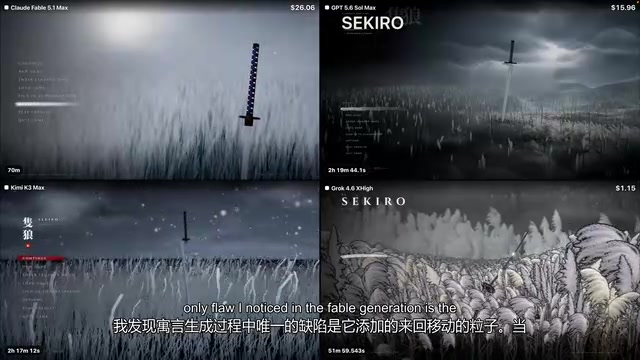
In the Sekiro main menu test, Fable's performance was even more stunning: from the grass and katana to the depth of field on menu options, everything was best-in-class output. It even generated quality presets ranging from Low to Ultra, motion blur and depth of field controls, and included a Credits scene — the level of detail was jaw-dropping.
The only blemish was the oscillating particles it added — nearly imperceptible with depth of field enabled, but once depth of field was turned off, these back-and-forth moving particles became the scene's only obvious flaw.
Massive Speed Gap: 70 Minutes vs. 139 Minutes
The efficiency comparison is even more telling: GPT-5.6 Sol Max took 2 hours and 19 minutes to complete the same test, while Fable 5.1 needed only 70 minutes. Although GPT-5.6 Sol created a decent scene atmosphere, overly tall grass and a "sword that doesn't look like a katana" dragged down the overall result. The dual advantage in speed and quality is Fable 5.1's most direct competitive edge.
The Last of Us Main Menu Test: Grok 4.6 Surprises
In The Last of Us main menu test, Fable's output was nearly a mirror replica of the original menu (if you ignore Z-fighting issues). Z-fighting is a classic visual artifact in 3D rendering: when two polygon faces nearly completely overlap in 3D space, the GPU's depth buffer (Z-buffer) — limited by floating-point precision — cannot accurately determine which face is in front and which is behind, causing pixels from both faces to flicker alternately, producing striped flickering artifacts. In manual modeling, this can be resolved by slightly adjusting face positions or using Polygon Offset, but for AI-generated scenes, the model lacks explicit understanding of depth buffer precision, making Z-fighting a common quality issue in AI-generated 3D content.
More surprisingly, Grok 4.6 placed second, with output quality superior to both GPT-5.6 and Kimi K3 — the latter two both produced low-poly results. Low Poly is a 3D modeling style that uses fewer polygon faces to construct models. It can be an intentional artistic choice (like Monument Valley) or a sign of insufficient generation capability — an inability to produce sufficiently complex geometric structures. Grok 4.6 also completed the task at a lower price point, leaving cost headroom for iteration.

However, side-by-side comparison reveals key differences: even though Grok 4.6 and Fable 5.1 achieved comparable graphical fidelity, Fable had higher frame rates and more optimized builds, while Grok's builds were unoptimized. Frame Rate directly reflects rendering pipeline efficiency: under identical hardware conditions, higher frame rates indicate more efficient GPU resource utilization, with better-balanced draw call counts, polygon counts, and texture sampling operations. Fable 5.1's frame rate advantage means it not only "renders well" but also "renders fast" — its generated code exhibits a degree of performance awareness. Additionally, during the QA phase, Grok failed to even identify lighting issues in its own main menu — exposing a shortcoming in its self-checking capabilities.
The tester even predicted: by the end of this year, AI might be able to generate main menus in a single pass that independent reviewers can't distinguish from the real thing. Current results haven't reached that level, but they already represent "an impressive baseline."
Cathedral and Oasis: AI Begins Understanding Design Intent
In the Cathedral test, Fable not only maintained high detail on exterior Gothic architecture but also brought that level of refinement indoors — walls, columns, floors, and ceilings were all handled with unprecedented quality.
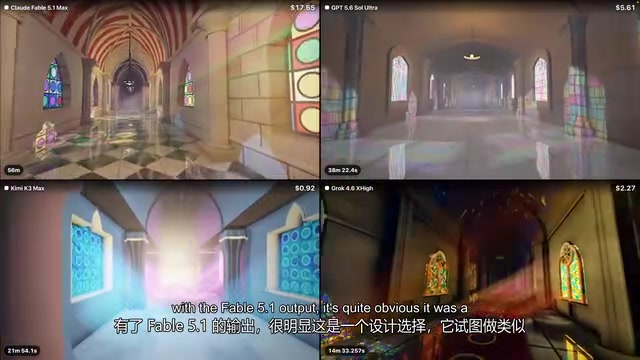
An interesting observation: Grok 4.6 output a multicolored ceiling. Initially, the tester assumed this was an error, since cathedral ceilings are typically plain-colored. But after comparing with Fable 5.1's output, it became clear — this was a design choice. Grok was clearly attempting to achieve an effect similar to Fable's, just lacking the capability to polish it in a single generation pass. This suggests different models are "converging" toward similar design sensibilities, differing only in execution quality.
In the Oasis voxel diorama test, Fable's most notable improvement was in decorative props: banners between buildings curved naturally, rather than appearing as rigid straight lines like Grok 4.6's output. Fable also generated human figures and camels, clearly focusing more on micro-level details than macro-level structure.
Voxels are cubic units in three-dimensional space, analogous to 2D pixels extended into 3D, and serve as the core visual language of games like Minecraft. A voxel diorama applies the voxel style to miniature landscape models, emphasizing viewing a detailed small world from isometric or perspective viewpoints. In AI benchmarks, voxel scenes test both the model's ability to arrange regular geometric shapes and its understanding of decorative details. The natural curvature of banners involves cloth physics simulation — or at least an implicit understanding of draping mechanics — marking a step forward from simple geometric stacking toward physical plausibility.
This leads to a thought-provoking trend: as model capabilities improve, the competitive focus in voxel diorama benchmarks may shift from macro-level composition to the richness of micro-level detail.
Echo Game Main Menu: The Ultimate Test of Ground-Up Recreation
The final Echo Game main menu test was the most difficult: models received only three reference images of the original main menu and had to recreate it from scratch. The result — no model could replicate the original in a single generation pass.
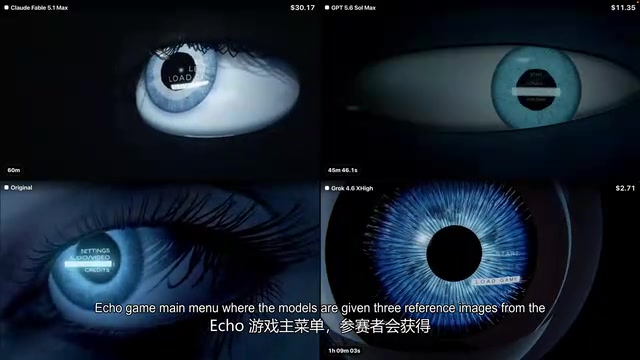
Although Fable's visual output was passable, it missed the original's core interaction mechanic: the original uses eye-tracking cursor behavior to switch menu items (the eye follows the line of sight horizontally to "Exit" or "Settings"), while Fable simply animated the cornea freely with a fixed animation applied to the main menu. This eye-tracking interaction is a clever UI design — the eyeball at the center of the screen follows the player's mouse (simulating gaze direction), and as the gaze moves toward different options, the eye's focus direction changes synchronously, creating an immersive "being watched" sensation. This interaction requires the model to understand the mapping from mouse coordinates to eyeball rotation angles and encode it as real-time responsive shader or script logic.
By contrast, GPT-5.6 excellently reproduced the original's menu interaction mechanics, even though its eye was aesthetically less refined than Fable's — overall, it wasn't bad. GPT-5.6's advantage in this round demonstrates a unique capability in understanding "input-output interaction logic," while Fable only generated preset animation loops, reflecting a current trade-off in AI between visual fidelity and interaction logic comprehension. Grok took the longest yet delivered mediocre results — it seemed to "call it quits after finishing the eyeball." As for Kimi K3, since it ran for over two hours on this test without completing, the tester chose to publish first, with its results to follow later.
Conclusion: The Arms Race of AI One-Click Game Scene Generation
This round of testing paints a clear picture of current AI game generation capabilities:
- Fable 5.1: Leads across the board in detail fidelity, rendering optimization, and generation speed — the undisputed benchmark;
- Grok 4.6: Emerges as a cost-effective dark horse with decent quality at lower cost, but optimization and self-checking capabilities still need refinement;
- GPT-5.6 Sol: Has a unique edge in replicating interaction logic, but speed is a clear weakness;
- Kimi K3: Hampered by excessively long inference times, its practical utility takes a hit.
More noteworthy is the underlying trend: models are evolving from "being able to generate scenes" to "understanding design intent," with micro-level detail and interaction mechanics becoming the new competitive dimensions. When AI can one-click produce menu interfaces approaching commercial game quality in 70 minutes, both the barrier to entry and the workflows of game development are poised for fundamental transformation.
Key Takeaways
Related articles

Cursor AI Programming in Practice: Build a Student Management System from Scratch in 30 Minutes
A Bilibili creator demonstrates Cursor AI programming: generating a student management system in 30 minutes with natural language. Details on Agent mode, Claude selection, prompt techniques, and thresholds.

Top 20 AI Coding Tools Ranking: From Rock-Solid to Lackluster, a Scored Matrix
Bilibili creator releases top 20 AI coding tools ranking, tiered T0–T4 from rock-solid to lackluster, with Claude Code and Codex tied at T0. This article details the scoring dimensions (capability, reliability, robustness, durability, cost, domestic availability) and tool performances to help developers choose the right AI coding assistant.

Vibe Coding Systematic Tutorial: Master AI-Assisted Programming from Zero
A three-month Vibe Coding tutorial from a Bilibili creator covering Codex, ClaudeCode, and Cursor, from core logic to commercial project practice for beginners.