Fable 5.2 and Mythos 5.2 Service Outage: Resolved After Four-Minute Overload
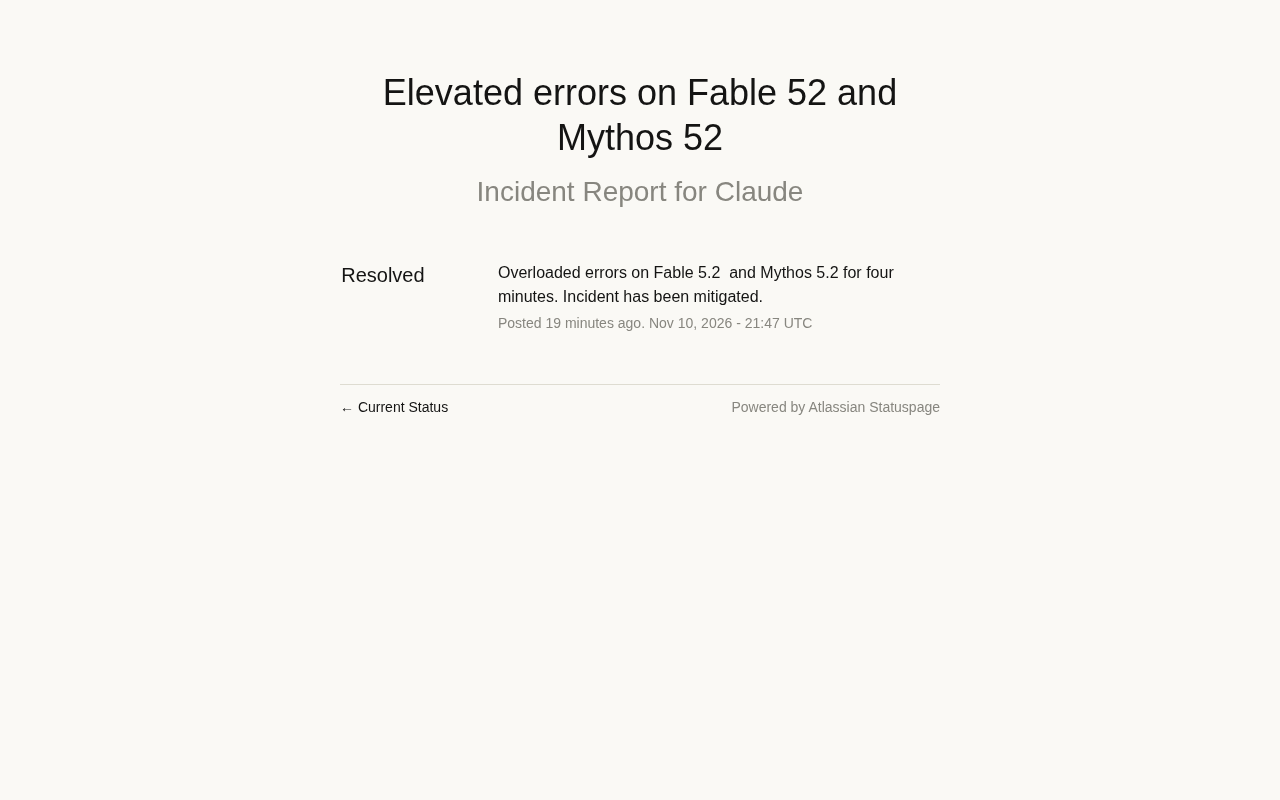
Fable 5.2 and Mythos 5.2 had a four-minute overload error; officials say mitigated, root cause unclear.
According to an RSS status update, Fable 5.2 and Mythos 5.2 experienced about four minutes of overloaded errors at 21:47 UTC on November 10. Officials marked it "Resolved" and confirmed mitigation. The notice disclosed no error rate, scope, or affected user count, and the "mitigated" wording only hints at emergency measures like rate limiting or scaling; whether the root cause is fully eliminated remains unclear. Both services being affected simultaneously suggests shared underlying resources or the same scheduling domain. For developers, the four-minute window has limited impact on batch processing, but real-time interactive apps may see user-perceivable failures. Exponential backoff retries and circuit breaker degradation are recommended, with status page RSS as a low-cost monitoring supplement.
Incident Overview
According to a status update from an RSS source, two services—Fable 5.2 and Mythos 5.2—experienced an elevated error rate at 21:47 UTC on November 10. The event was classified as "Overloaded errors" and lasted approximately four minutes. The status is now marked as "Resolved," with confirmation that the incident has been mitigated.
This status notice is extremely brief, disclosing no specific error rate, scope of impact, or number of affected users. From an operations perspective, a four-minute overload window is a typical short-lived capacity surge, usually triggered by a sudden traffic spike, jitter in a dependent service, or delayed resource scheduling.
Incident Timeline and Classification
Four-Minute Overload Window
The notice shows the incident lasted only four minutes from onset to mitigation. For AI services, this timescale means the system quickly regained stability after the overload. The official wording uses "mitigated" rather than "fixed," suggesting that emergency measures such as rate limiting, capacity scaling, or traffic switching may have been taken rather than the root cause being fully eliminated.
In the context of AI inference services, "Overloaded errors" typically refer to errors returned when request volume exceeds the system's currently schedulable compute (GPU/TPU resources, memory bandwidth, or concurrent connection pools). Common forms include HTTP 429 (Too Many Requests) or 503 (Service Unavailable), and some platforms use custom error codes. Unlike deterministic failures caused by code defects, overload is self-limiting: once the load subsides or capacity is replenished, the errors fade. Service providers therefore tend to prioritize mitigation measures such as rate limiting, queueing, or elastic scaling rather than waiting for a root-cause fix. For callers, distinguishing overload errors from authentication failures and parameter errors is critical, because the former is suitable for retries while the latter is not.
Wording Differences on the Status Page
The simultaneous presence of the "Resolved" status and the "mitigated" wording indicates the service has returned to an acceptable level, but it remains unclear whether a root cause analysis (RCA) will follow. For developers relying on these two model services, such short-lived errors typically manifest as request timeouts, 429 rate limiting, or 5xx errors, requiring client-side retry mechanisms.
In incident management terminology, "mitigated" means effective measures have been taken to reduce impact to an acceptable level, but the incident may not yet be closed and still requires observation; "resolved" means the incident is over and the service has returned to normal. The two can appear sequentially, or side by side in different fields of the status page. Root cause analysis (RCA) is a post-incident review document, typically containing a timeline, triggering factors, quantified impact, and improvement items. Most cloud service providers only publicly release RCAs when a certain severity level (e.g., P1/P2) is reached; short-lived overload events often only get a brief status page notice, which explains the limited information in the notice described here.
Practical Impact on Developers
The simultaneous overload of Fable 5.2 and Mythos 5.2 suggests these two services may share underlying resources or reside in the same scheduling domain. The four-minute error window has limited impact on batch processing tasks, but for real-time interactive applications it may cause user-perceivable failures.
When integrating such services, it is recommended to introduce exponential backoff retries and circuit breaker degradation strategies to prevent short-lived overloads from escalating into client-side cascading failures. Meanwhile, subscribing to the status page's RSS updates is the lowest-cost supplementary monitoring measure.
Exponential backoff means increasing the wait time by a multiple before each retry (e.g., 1s, 2s, 4s, 8s), usually combined with random jitter to prevent a large number of clients from retrying simultaneously and causing a "retry storm." Circuit breaker degradation, on the other hand, temporarily cuts off downstream calls after consecutive failures reach a threshold, directly returning degraded results or cached data, and then tentatively restoring after a cooling-off period. Used together, the two can isolate upstream short-lived overloads within the client boundary, preventing local failures from escalating into systemic cascading failures along the call chain. For applications depending on both Fable 5.2 and Mythos 5.2, consider setting up independent circuit breakers for each to avoid one service's jitter dragging down both call paths.
Information Gaps to Watch
This notice did not include key information such as error rate figures, affected regions, or whether specific API endpoints were impacted. For production dependents, such brief notices can only be used for after-the-fact confirmation and are hard to support capacity planning. It is worth watching whether the official team releases a more detailed post-incident review.
Note: The information in this article comes only from a single status page notice. The technical details and root cause of the incident have not been made public, and the related analysis is inference based on operational common sense.
Status page RSS (Really Simple Syndication) is an XML-based event push format. Service providers generate new entries when publishing or updating incident notices, and subscribers can learn about outage developments in near real time through polling or push gateways. Compared with actively calling a status API or manually checking a webpage, RSS has extremely low integration cost and does not depend on vendor SDKs, making it suitable as a supplementary signal source for monitoring systems. But its limitations are also obvious: coarse notice granularity, no structured error codes, and typically a lag behind the actual failure time. Therefore, it should only be used for after-the-fact confirmation and alert enhancement, not as a replacement for success rate and latency monitoring based on real requests.
One-line Summary
Fable 5.2 and Mythos 5.2 experienced an approximately four-minute overload error; officials say it has been mitigated, root cause unknown.
Paragraph Summary
According to an RSS status update, Fable 5.2 and Mythos 5.2 experienced approximately four minutes of overloaded errors at 21:47 UTC on November 10. Officials have marked the incident as "Resolved" and confirmed mitigation. The notice disclosed no error rate, scope of impact, or number of affected users, and the "mitigated" wording only hints that emergency measures such as rate limiting or scaling were taken; whether the root cause has been fully eliminated remains unclear. Both services being affected simultaneously suggests they may share underlying resources or reside in the same scheduling domain. For developers, the four-minute window has limited impact on batch processing, but real-time interactive applications may experience user-perceivable failures. It is recommended to introduce exponential backoff retries and circuit breaker degradation, and to use the status page RSS as a low-cost monitoring supplement.
Related articles

How Do Cursor, Devin, TRAE, and Copilot Compare on Price? Calculate Your Credits Before You Compare Monthly Fees
Side-by-side comparison of individual and team pricing for Cursor, Devin Desktop, TRAE, and Copilot, breaking down credit rules, third-party model inclusion, overage billing, and practical methods for measuring usage before paying, setting spending caps, and choosing the right tool.

Copilot Retires Three Models: Pro Users Left With Only One Alternative
GitHub Copilot retires Claude Opus 4.8, Claude Opus 5, and GPT-5.6 Tera on Nov 16 across Chat, code completion, and Agent mode. Pro users have only GPT-6 Luna left; Legacy annual plans miss Opus 5.5; admins must enable replacements manually.

Gemini 4 Carbon Arrives: The LLM Race Enters the Era of Million-Token Context and Trillion-Parameter Open Source
Google launches Gemini 4 Carbon and multi-agent tool Swarm; Anthropic debuts million-context Fable 5.2 and Mythos 5.2; OpenAI releases security-focused GPT-6 Cyber; Mistral and Kimi open-source trillion-parameter models — the LLM race accelerates across the board.