Fable 5.2 One-Shots My Nephew's Dream Game

Fable 5.2's one-shot playable game sparks debate over prototypes vs. finished products.
The article covers the Hacker News discussion around AI game generation tool Fable 5.2. A developer used it to one-shot his nephew's game concept, and the post drew 290 points and 205 comments. Supporters value how it compresses the path from idea to playable prototype, with real value for indie developers, parents, and education; skeptics note that one-shot results tend to be toy-grade with simple mechanics and little polish—a scene that runs is not the same as a game people want to keep playing. The author sees this as a watershed as AI coding moves from code completion to building complete interactive systems, and argues the pragmatic approach is to treat one-shot generation as an iteration starting point, not an endpoint, with real value in lowering the cost of trial and validation.
AI game generation tool Fable 5.2 recently sparked heated discussion on Hacker News—a developer used it to build his nephew's dream game "in one shot." The article from notesbylex.com earned 290 points and 205 comments on HN, which says a lot about how much the community cares about whether AI can actually make playable games.
A Kid's Dream Game, Generated in One Shot
According to the original title and the HN discussion, the scenario the author describes is quite representative: his nephew had a specific game concept in mind, and the author handed that concept to Fable 5.2, which "one-shotted" a working game prototype. The phrasing itself is a bit hyperbolic, but it points to a real trend—game generation tools are moving from "generating assets" to "generating a complete playable experience."
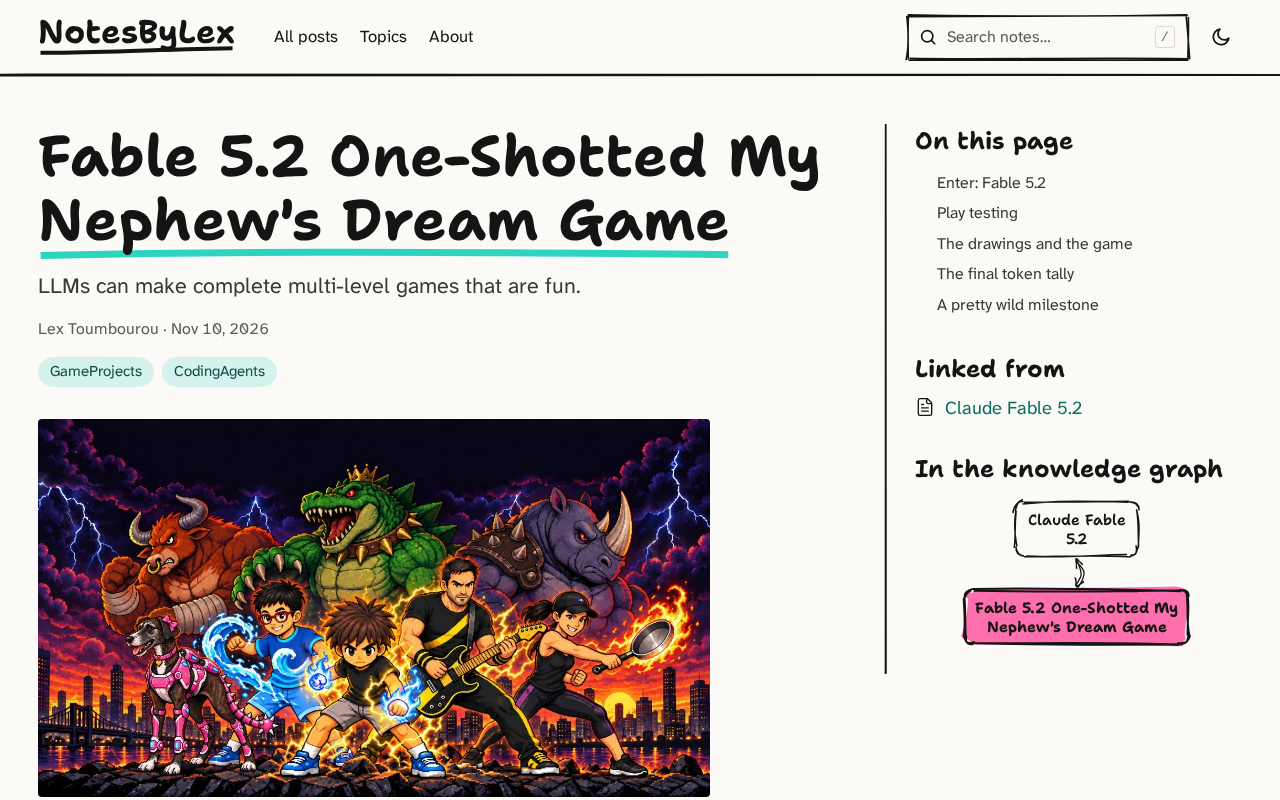
The focus of the 205 HN comments quickly shifted from "can it do it" to "does what it made count as a game." That's exactly what makes this kind of tool worth discussing.
Two Camps in the HN Community
Supporters argue that Fable 5.2's value isn't about replacing game developers, but about compressing the path from "idea to playable prototype" to almost nothing. For indie developers, parents, and educational settings, that capability matters on its own—a child can watch their own concept turn into something they can actually control, a feedback loop that barely existed before.
Skeptics point out that one-shot games tend to stay at "toy-grade" complexity: simple mechanics, limited content, and little polish. HN commenters were also direct in scrutinizing the word "one-shotted"—generating a scene that runs and making a game people want to keep playing are two completely different things.
Hacker News's voting and commenting mechanics deserve a brief note: a post's heat reflects both points and comment activity. 290 points is upper-middle range, while 205 comments is relatively high, which usually signals genuine controversy rather than one-sided agreement. The HN community is dominated by engineers and founders who are naturally sensitive to marketing-style phrasing, so wording like "one-shotted" is easy fodder for line-by-line takedowns. When reading these discussions, the ratio of comments to points often reveals the true level of disagreement around a technology better than raw popularity.
Why "One-Shot Generation" Deserves Serious Attention
Setting aside the marketing-style headline, the discussion Fable 5.2 triggered actually touches on a watershed moment for AI coding tools: moving from code completion and function generation toward end-to-end construction of complete interactive systems. Games are an excellent test case for this capability because they demand logic, state management, interaction feedback, and a degree of aesthetic judgment all at once.
One detail: many HN commenters linked Fable 5.2 to "vibe coding"-style workflows—generate a working version fast, then iterate on top of it. That framing is more useful in practice: treating "one-shot generation" as a starting point rather than an endpoint is the more pragmatic way to use these tools today.
"Vibe coding" is a term coined by Andrej Karpathy in early 2025 that quickly went mainstream. It refers to developers no longer writing code line by line, but describing intent in natural language and letting an LLM generate working code, with the human responsible only for running it, observing results, and giving the next round of feedback. It emphasizes moving "by feel"—get something running first, then adjust based on real behavior, rather than designing the architecture before touching code. This approach is extremely efficient during prototyping, but the cost is that maintainability, edge cases, and performance often get neglected, which is why the industry generally sees it as suited to exploration and validation, not direct delivery to production systems.
Practical Takeaways for Developers
For developers, the more realistic value of tools like Fable 5.2 is lower trial-and-error cost. A concept in your head and a concept in your hands are completely different in persuasive power. Rapidly generating playable prototypes lets discussions, validation, and trade-offs all be grounded in actual experience.
For parents and educators, the nephew in this story is the real protagonist: AI gives a child the first chance to see their idea "made." This may not be the future of the game industry, but it's very likely to be the normal way the next generation of creators gets started.
The original article was published on notesbylex.com; the HN discussion item is 50433659. Community response was strong, with both controversy and approval—a good sample for observing the boundaries of AI game generation capabilities.
In game development, "playable prototype" is a stage concept with a clear meaning: it doesn't aim for art, sound, or content volume—it only needs to validate whether the core gameplay loop holds up: what the player does, how the system responds, and whether there's motivation to keep playing. Common industry practices like greybox prototypes and paper prototypes fall into this category. The value of a prototype lies in disproving an idea at the lowest possible cost, so the significance of AI-generated rapid prototypes should be understood as a "validation tool" rather than a "production tool."
Related articles

How Do Cursor, Devin, TRAE, and Copilot Compare on Price? Calculate Your Credits Before You Compare Monthly Fees
Side-by-side comparison of individual and team pricing for Cursor, Devin Desktop, TRAE, and Copilot, breaking down credit rules, third-party model inclusion, overage billing, and practical methods for measuring usage before paying, setting spending caps, and choosing the right tool.

Copilot Retires Three Models: Pro Users Left With Only One Alternative
GitHub Copilot retires Claude Opus 4.8, Claude Opus 5, and GPT-5.6 Tera on Nov 16 across Chat, code completion, and Agent mode. Pro users have only GPT-6 Luna left; Legacy annual plans miss Opus 5.5; admins must enable replacements manually.

Gemini 4 Carbon Arrives: The LLM Race Enters the Era of Million-Token Context and Trillion-Parameter Open Source
Google launches Gemini 4 Carbon and multi-agent tool Swarm; Anthropic debuts million-context Fable 5.2 and Mythos 5.2; OpenAI releases security-focused GPT-6 Cyber; Mistral and Kimi open-source trillion-parameter models — the LLM race accelerates across the board.