Fable 5.2 Reclaims Global Top Spot as Anthropic IPO Roadshow Kicks Off Same Day
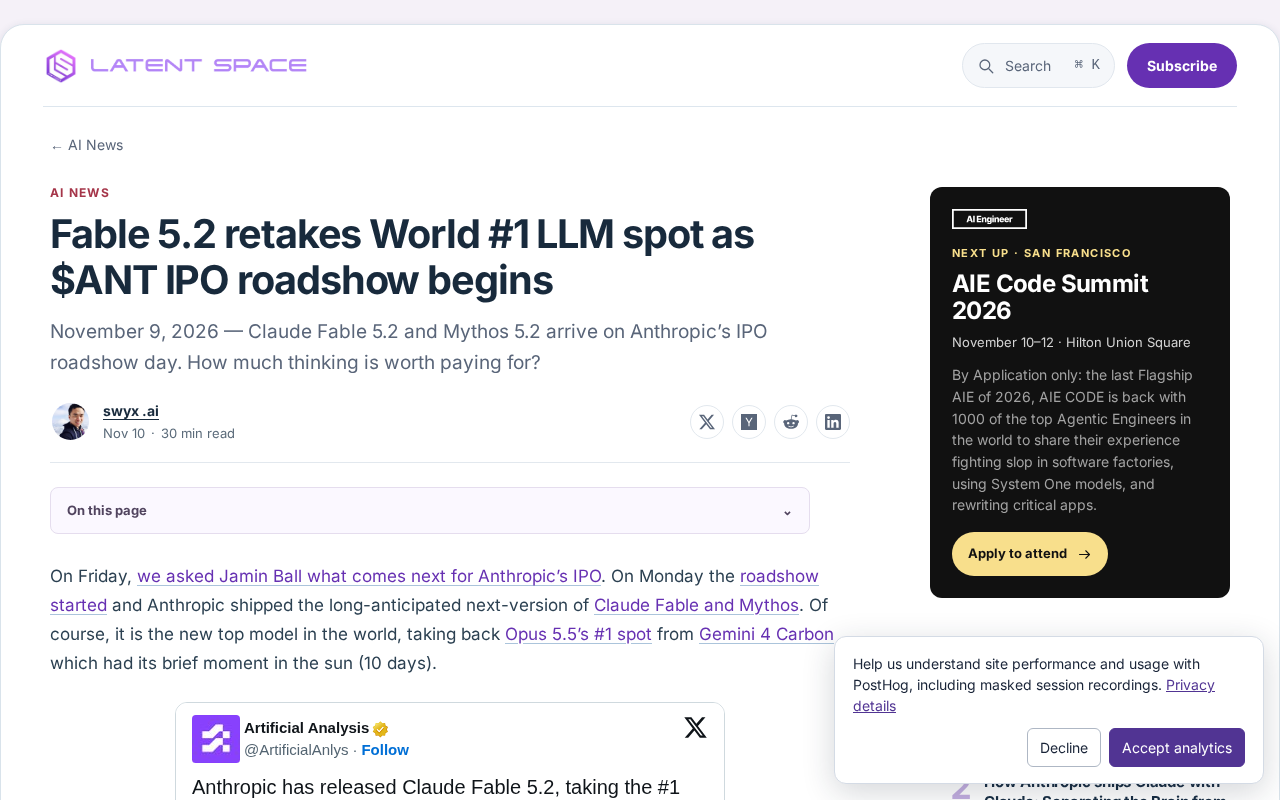
Anthropic releases Fable 5.2 on IPO roadshow day one to reclaim the world's strongest LLM, backing valuation with technical narrative.
On November 9, the first day of the $ANT IPO roadshow, Anthropic simultaneously released Claude Fable 5.2 and Mythos 5.2, with the former reclaiming the world's strongest LLM title on third-party leaderboards. The article argues this timing is deliberate, stitching product narrative to capital narrative and using technical leadership to address investor questions about moats and commercialization. The core question of "how much thinking is worth paying for" targets reasoning-model unit economics, while the dual-model approach signals tiered coverage of different payment levels.
Anthropic dropped a bombshell on the first day of its IPO roadshow: Claude Fable 5.2 and Mythos 5.2 arrived simultaneously, with the former reclaiming the title of the world's most powerful LLM. The announcement came on November 9, landing on the exact same day as the launch of the $ANT IPO roadshow. The timing is hard to call a coincidence—product narrative and capital narrative have been deliberately stitched together.
A Carefully Choreographed Dual-Track Narrative
Product Launch Collides with a Capital Markets Moment
Fable 5.2's "world's #1" title comes from a reshuffling of third-party benchmark leaderboards. According to the original information, Fable 5.2 and Mythos 5.2 landed on the Anthropic platform on the same day—the very day the company kicked off its IPO roadshow. For an AI company about to be priced by the public markets, demonstrating technical leadership on day one of the roadshow is the most direct way to support its valuation.
What the $ANT Roadshow Means
The launch of the $ANT IPO roadshow marks Anthropic's transition from private markets to public markets. During the roadshow, institutional investors care about essentially two things: whether the technical moat is real, and whether the commercialization path is sustainable. Fable 5.2's climb to the top answers the first question neatly.
IPO roadshow refers to a series of promotional events a company holds for institutional investors before going public. Over several weeks, management meets intensively with potential investors to explain the business model, financials, and growth story, while gathering subscription interest and setting the price range. Roadshow performance directly affects final pricing and first-day share price, so companies often time their most favorable news to coincide with the roadshow. For AI companies, the core challenge of a roadshow is explaining massive compute spending and a not-yet-stable profit model to the public markets—which is precisely why technical demonstrations get scheduled into the roadshow calendar.
"How Much Thinking Is Worth Paying For": A Shift in Pricing Philosophy
The core question raised by the source material is provocatively framed: How much thinking is worth paying for? This isn't merely a technical discussion—it strikes directly at the commercial essence of reasoning models.
The stronger the reasoning capability, the more compute a model consumes before producing an answer, and the higher the cost per call. Through its two product lines, Fable and Mythos, Anthropic appears to be testing a spectrum: how much of a premium users are willing to pay for "deeper thinking." The IPO roadshow amplifies this question from the product level to the capital markets level—investors need to judge whether the cost structure driven by reasoning latency and compute consumption can be covered by corresponding pricing power.
The Signal of a Dual-Model Strategy
The simultaneous release of Fable 5.2 and Mythos 5.2 suggests Anthropic maintains a differentiated product matrix beyond its flagship model. Mythos's positioning isn't elaborated in the original information, but the parallel two-track approach itself makes clear that a single model can't cover all willingness-to-pay tiers—tiered supply is the more realistic commercialization choice.
A reasoning model refers to a class of models that perform explicit thinking steps before outputting an answer—for example, using longer chains of thought or test-time compute to improve performance on complex tasks. Its key characteristic is "test-time scaling": adding compute during the inference stage typically buys higher accuracy, but also drives up latency and per-call cost. As a result, pricing for these models can't simply be per-token; it requires trade-offs among "depth of thinking—cost—usability." The article's question of "how much thinking is worth paying for" is essentially asking how much of a premium the market is willing to pay for additional inference compute.
The Competitive Landscape Behind the Top Ranking
The word "reclaim" is worth savoring. It implies Anthropic had previously lost this position and has now taken it back with Fable 5.2. The title of world's strongest LLM changing hands frequently among leading labs itself shows that the performance gap between frontier models has compressed into a narrow band—leaderboard rankings reflect misalignment in release cadence and evaluation windows more than any generational divide.
For the IPO roadshow, this kind of leadership—"reclaimable, and liable to be lost again"—is a double-edged sword. It proves the team's iteration speed while reminding investors that the window for technical leadership may be shorter than expected.
The "world's strongest LLM" title in this article relies on third-party benchmark leaderboards, and rankings on such leaderboards are quite sensitive to evaluation set composition, prompt templates, sampling parameters, and submission timing. When the composite scores of leading models narrow to the level of statistical noise, a single new version release or an evaluation window that has yet to include other labs' latest models is enough to flip the rankings. Understanding this helps gauge how much "reclaiming #1" reflects a real capability gap versus how much is the result of misalignment between release cadence and evaluation cycles.
Several Judgments Worth Watching
Combining the overlap between the product launch and the IPO timeline, several interpretive directions emerge:
- Technical narrative serves valuation narrative: releasing a flagship model on day one of the roadshow is a classic capital markets communication strategy, and Fable 5.2's benchmark performance will go straight into the investment story.
- Inference cost is the core variable: the original question "how much thinking is worth paying for" points to the unit economics of reasoning models, which will be one of the focal points in roadshow Q&A.
- High volatility of leadership: with the top leaderboard spot changing hands frequently, investors need a more dynamic lens to assess Anthropic's competitive position.
- The commercial intent of the dual-model matrix: Fable and Mythos running in parallel reflects an attempt to cover different payment tiers.
Fable 5.2's climb to the top and the $ANT roadshow happening on the same day form a condensed case study in AI commercialization: technical leadership can generate buzz, but what ultimately determines valuation is whether the market is willing to keep paying for that "thinking."
One-line Summary
Anthropic releases Fable 5.2 on the first day of its IPO roadshow to reclaim the world's strongest LLM, using technical narrative to support valuation.
Paragraph Summary
On November 9—the first day of the $ANT IPO roadshow—Anthropic simultaneously released Claude Fable 5.2 and Mythos 5.2, with the former reclaiming the title of world's strongest LLM on third-party leaderboards. The article argues this timing is no coincidence but a deliberate stitching of product narrative and capital narrative, using technical leadership to answer investors' questions about moats and commercialization paths. The core question "how much thinking is worth paying for" points directly at the unit economics of reasoning models: deeper reasoning means higher compute and latency costs, and whether pricing can cover costs becomes the roadshow focus. The parallel dual-model approach shows an attempt to cover different payment tiers. And the frequent changing of the top leaderboard spot reminds investors that the window for technical leadership may be shorter than expected.
Related articles

How Do Cursor, Devin, TRAE, and Copilot Compare on Price? Calculate Your Credits Before You Compare Monthly Fees
Side-by-side comparison of individual and team pricing for Cursor, Devin Desktop, TRAE, and Copilot, breaking down credit rules, third-party model inclusion, overage billing, and practical methods for measuring usage before paying, setting spending caps, and choosing the right tool.
Copilot Retires Three Models: Pro Users Left With Only One Alternative
GitHub Copilot retires Claude Opus 4.8, Claude Opus 5, and GPT-5.6 Tera on Nov 16 across Chat, code completion, and Agent mode. Pro users have only GPT-6 Luna left; Legacy annual plans miss Opus 5.5; admins must enable replacements manually.
Gemini 4 Carbon Arrives: The LLM Race Enters the Era of Million-Token Context and Trillion-Parameter Open Source
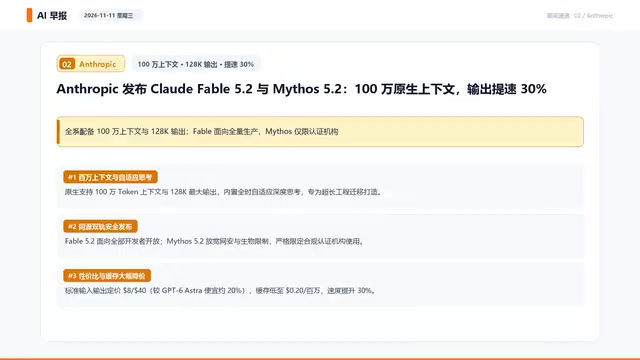
Google launches Gemini 4 Carbon and multi-agent tool Swarm; Anthropic debuts million-context Fable 5.2 and Mythos 5.2; OpenAI releases security-focused GPT-6 Cyber; Mistral and Kimi open-source trillion-parameter models — the LLM race accelerates across the board.