Fable 5.2's Dual Restrictions Spark Debate: Guardrails and Capability Caps Coexist
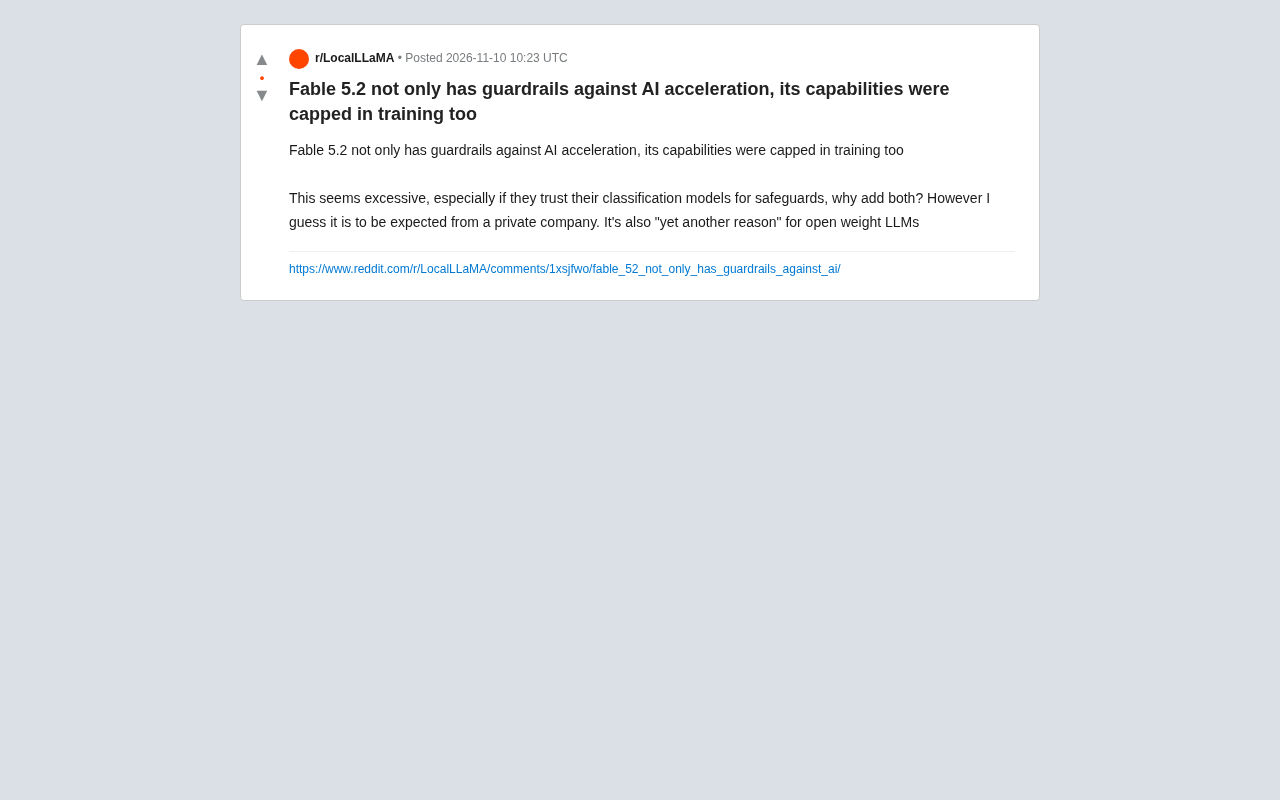
Fable 5.2 sets both inference guardrails and training capability caps, sparking safety redundancy debate and fueling open-weight discussion.
A Reddit discussion notes that Fable 5.2 not only has inference guardrails against AI acceleration but also caps model capabilities during training. The poster questions why training-stage constraints are layered on top if the company already trusts its classifier model as a safeguard. The article argues that guardrails and capability caps operate at inference and training layers respectively; dual restrictions may stem from distrust of classifier reliability or excessive precaution against extreme risks, and fit private companies' conservative tendency to avoid legal and ethical risks. The approach is seen as another reason to favor open-weight LLMs, since closed-source capability ceilings may push users toward self-controlled open-source solutions, though open source also faces the challenge of shifting safety responsibility, reflecting the ongoing tug-of-war between AI safety and capability openness.
Background: Fable 5.2's Dual Restrictions
Recently, a discussion on Reddit about Fable 5.2 has drawn attention. According to the post title and content, Fable 5.2 not only has guardrails against AI acceleration, but its capabilities were also capped in training. The poster considers this approach "seems a bit excessive" and questions: if the company trusts its classifier model as a safety safeguard, why impose two restrictions at the same time?
This discussion touches on a core contradiction in current AI model development: the balance between safety controls and capability openness. Fable 5.2's approach is not an isolated case, but combining a training-phase capability cap with inference-phase guardrails does reflect some vendors' cautious attitude toward advanced AI risks.
The Logic and Controversy of Dual Restrictions
The Difference Between Guardrails and Capability Caps
Guardrails usually refer to safety mechanisms at the inference stage, such as refusing to generate harmful content or restricting outputs in specific domains. A training-stage capability cap, on the other hand, means the model is constrained during learning in terms of certain capability ceilings, which may involve reasoning depth, breadth of knowledge, or performance on specific tasks. Together, the two form an end-to-end restriction from training to deployment.
The poster points out that if the company already trusts its classifier model to implement safety safeguards, then an additional capability cap appears redundant. This "double insurance" may stem from distrust in the reliability of the classifier model itself, or from excessive precaution against extreme risk scenarios.
Classifier models in the AI safety context usually refer to discriminative models specifically trained to identify harmful content, jailbreak attempts, or high-risk intent. They run as "guards" independent of the main generative model, classifying user inputs and model outputs in real time. When a vendor trusts a classifier model, it means relying on its judgment to decide whether to block a request, but classifier models themselves have error rates, adversarial bypass risks, and distribution shift issues, so they are often layered with rule filtering, output review, and other mechanisms. The controversy around Fable 5.2 lies precisely here: if the classifier model is already regarded as a reliable safety safeguard, does a training-stage capability cap constitute a duplicate constraint, or is the uncertainty of the classifier model exactly what requires the capability cap as a fallback?
Private Companies' Conservative Choice
The post mentions that "this is perhaps to be expected from a private company." Compared with open-source models, closed-source vendors tend to adopt more conservative strategies to avoid potential legal and ethical risks. But this conservatism may also suppress the model's practical value, especially when users need the model to demonstrate stronger capabilities in complex tasks.
Open-weight models refer to models whose parameters (weights) are publicly downloadable and allow users to deploy and fine-tune them themselves, such as the Llama and Mistral series. Compared with closed-source models that only provide an API, open weights give users full control over the inference process, safety alignment, and hardware environment, and users can remove vendor-preset refusal behaviors or capability limits. But this also means safety responsibility shifts to the deployer, and improper fine-tuning may amplify misuse risks. In the Fable 5.2 case, the poster regards the capability cap of closed-source models as an argument for the open-weight route, precisely because open-source models do not have hard capability ceilings implanted by vendors during training, although their base capabilities are still constrained by pretraining data and compute.
An Indirect Boost for Open-Weight Models
The poster calls this "yet another reason for open-weight LLMs." When closed-source models are capability-limited due to safety restrictions, models provided by the open-source community allow users to adjust and deploy them themselves, free from vendor-preset capability caps. This contrast may push some developers and enterprises toward open-source solutions, especially in scenarios requiring customization or high performance.
However, open-source models also face safety challenges; it is just that control shifts to users. The Fable 5.2 case reminds us that AI safety governance has no one-size-fits-all answer, and the trade-offs differ across deployment models.
AI acceleration in safety discussions usually refers to the risk of loss of control that may come with rapid jumps in model capabilities, such as autonomous replication, assistance with cyberattacks, or large-scale generation of deceptive content. Guardrails against AI acceleration aim to slow or prevent rapid progress in sensitive capabilities, with common measures including restricting fine-tuning in specific domains, monitoring anomalous capability emergence, and reducing high-risk data during training. Fable 5.2 imposing both inference guardrails and training caps reflects the vendor's anticipation that "capability growth itself is a risk," rather than focusing only on specific harmful outputs, which is fundamentally different from traditional output-filtering approaches.
Industry Implications: The Difficult Balance Between Safety and Capability
Fable 5.2's dual restrictions reflect the ongoing tug-of-war in the AI industry between safety and capability. On one hand, regulatory pressure and ethical requirements push vendors to strengthen controls; on the other hand, users' expectations for model performance keep rising. How to find a balance between the two is a question every AI developer must face.
Based on the available information, Fable 5.2's choice leans toward safety first, but whether this will affect its market competitiveness remains to be seen. The open-source community's response and actual user feedback will gradually reveal the long-term effects of this strategy.
One-line Summary
Fable 5.2 sets both inference guardrails and training capability caps, sparking debate over safety redundancy and fueling discussion of open-weight models.
Paragraph Summary
A Reddit discussion points out that Fable 5.2 not only sets inference guardrails against AI acceleration but also imposes a cap on model capabilities during training. The poster questions: if the company already trusts a classifier model as a safety safeguard, why add training-stage capability constraints on top? The article analyzes that guardrails and capability caps belong to two different layers, inference and training, and that dual restrictions may stem from distrust in the classifier model's reliability or excessive precaution against extreme risks, and also align with private companies' conservative tendency to avoid legal and ethical risks. This approach is seen as another reason to favor open-weight LLMs, because capability ceilings in closed-source models may push users toward open-source solutions they can control themselves, though open source also faces the challenge of shifting safety responsibility, reflecting the ongoing tug-of-war between AI safety and capability openness.
Related articles

How Do Cursor, Devin, TRAE, and Copilot Compare on Price? Calculate Your Credits Before You Compare Monthly Fees
Side-by-side comparison of individual and team pricing for Cursor, Devin Desktop, TRAE, and Copilot, breaking down credit rules, third-party model inclusion, overage billing, and practical methods for measuring usage before paying, setting spending caps, and choosing the right tool.

Copilot Retires Three Models: Pro Users Left With Only One Alternative
GitHub Copilot retires Claude Opus 4.8, Claude Opus 5, and GPT-5.6 Tera on Nov 16 across Chat, code completion, and Agent mode. Pro users have only GPT-6 Luna left; Legacy annual plans miss Opus 5.5; admins must enable replacements manually.

Gemini 4 Carbon Arrives: The LLM Race Enters the Era of Million-Token Context and Trillion-Parameter Open Source
Google launches Gemini 4 Carbon and multi-agent tool Swarm; Anthropic debuts million-context Fable 5.2 and Mythos 5.2; OpenAI releases security-focused GPT-6 Cyber; Mistral and Kimi open-source trillion-parameter models — the LLM race accelerates across the board.