Fable-OS: A Self-Evolving Operating System That Writes Its Own Drivers

Fable-OS is a bare-metal OS where an AI agent writes its own drivers and evolves at runtime.
Fable-OS is an open-source operating system that runs directly on bare metal, using natural language as its sole interface. Its AI agent operates entirely in Ring 0, using kernel system calls as tools to autonomously identify missing hardware drivers, write them from scratch, and load them at runtime. While the project raises fascinating questions about self-evolving systems, concerns remain about security, stability, and whether it can handle anything beyond well-documented legacy hardware.
An "Agent Operating System" Running on Bare Metal
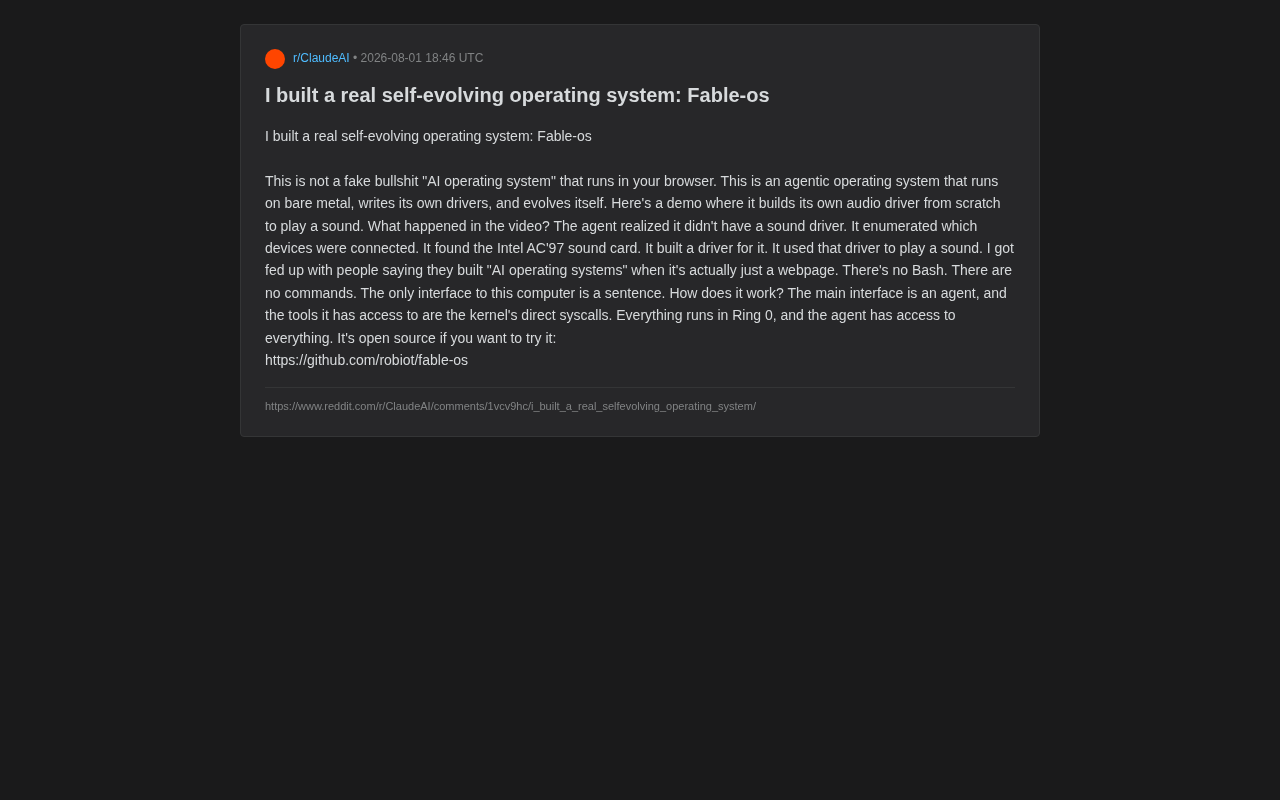
Recently, a developer posted an open-source project called Fable-OS on Reddit, claiming to have built a "truly self-evolving operating system." Unlike the so-called "AI operating systems" on the market that run in browsers and are essentially just web pages, Fable-OS runs directly on bare metal — it can write its own drivers and continuously evolve itself during runtime.
Running on bare metal means the software executes directly on physical hardware with no host operating system like Linux or Windows as an intermediary layer. Traditional applications rely on the abstraction layers provided by operating systems to access hardware, while bare-metal programs must handle all low-level work themselves — CPU initialization, memory management, interrupt handling, device I/O, and more. The developer (or in this case, the AI agent) must interact directly with hardware registers, understanding the timing requirements and protocol specifications of specific chipsets. Bare-metal development is far more difficult than application-layer development because without an operating system's protection mechanisms, a single erroneous memory write can freeze the entire system.
The author's attitude is refreshingly blunt: "I'm tired of people claiming they built an 'AI OS' when it's just a webpage. There's no Bash here, no command line — the only interface to interact with this computer is a sentence." This statement highlights Fable-OS's most radical design philosophy: using natural language as the operating system's sole interaction interface.
Demo: Building an Audio Driver from Scratch
In the demo video, the author showcases Fable-OS's core capability — autonomously building a driver that didn't previously exist. The entire process can be broken down into several key steps:
- The agent recognizes that the system currently lacks a sound card driver;
- It proactively enumerates the currently connected hardware devices;
- It discovers an Intel AC'97 sound card;
- It writes a driver for this sound card from scratch;
- It uses the freshly written driver to play audio.
Here it's important to understand the technical paradigm of agents. In the current AI landscape, an agent refers to an AI system capable of perceiving its environment, formulating plans, using tools, and iteratively executing tasks. Unlike simple Q&A-style large models, agents possess a "observe-think-act" loop capability: they first perceive the current state (e.g., discovering a missing driver), then reason about the next step (need to enumerate hardware), then invoke tools to execute (reading the PCI bus device list), and finally evaluate results to decide whether to continue. Frameworks like ReAct, AutoGPT, and LangChain Agent all implement this paradigm at the application layer, while Fable-OS's innovation lies in pushing this paradigm down to the operating system kernel level.
The significance of this demo is that it doesn't involve pre-written drivers that the AI simply calls. Instead, the agent reasons on the spot, codes on the spot, and loads on the spot in a scenario where something is missing. If this workflow truly occurs on bare metal as described, it demonstrates an "on-demand self-extension" capability for the operating system, rather than the traditional fixed workflow of human developers writing, compiling, and installing drivers.
Technical Architecture: The Agent as Kernel Entry Point
According to the author's description, Fable-OS's core architecture can be summarized in several points:
The Main Interface Is an AI Agent
The system's primary interaction target is not a shell but an AI agent. Users express their intent in natural language, and the agent is responsible for translating that intent into concrete operations.
Tools Are the Kernel's System Calls
The "tools" available to the agent are directly the system calls (syscalls) exposed by the kernel. In other words, the agent isn't calling wrapped APIs in user space — it holds the operating system's most fundamental capabilities.
In traditional operating systems, system calls are the standard interface through which user-space programs request kernel services. Programs trap from Ring 3 to Ring 0 via software interrupts or dedicated instructions (such as x86's syscall/sysenter), where the kernel validates parameters before executing privileged operations and returning results to user space. This process includes strict parameter validation and permission checks. Fable-OS's approach essentially bypasses this security boundary — the agent doesn't "request" the kernel to do things; it directly "is" the kernel doing things. This is akin to giving AI a master key rather than having it pass requests through a gatekeeper.
Everything Runs in Ring 0
The most eye-catching and controversial point: everything runs in Ring 0, and the agent has complete access to the system.
The x86 architecture's Protected Mode defines four privilege levels (Ring 0 through Ring 3), forming concentric circles of permission layering. Ring 0 has the highest privilege, capable of executing all CPU instructions, accessing all memory addresses, and directly operating all I/O ports; the operating system kernel typically runs at this level. Ring 3 is the lowest privilege level where ordinary user programs run, prohibited from executing privileged instructions (such as directly operating hardware or modifying page tables). The core purpose of this layered design is isolation — even if a user program crashes or is maliciously exploited, it cannot damage the kernel or other processes.
Letting an LLM-driven agent have full privileges directly in Ring 0 means it can directly read and write arbitrary memory and operate any hardware — this is both the technical foundation of its "self-evolution" capability and a massive source of security risk. Fable-OS essentially removes the most critical security barrier that modern operating systems have carefully constructed over decades.
Why This Project Deserves Attention
It Touches the Real Question of "AI Operating Systems"
Over the past two years, the concept of "AI operating systems" has been massively abused, with the vast majority of projects simply wrapping a chat box on a web page. Fable-OS's value lies in pulling the discussion back to a more fundamental level: if AI is truly going to be the core of an operating system, it should be able to touch hardware, modify itself, and solve problems without pre-programmed code paths. This stands in stark contrast to the traditional paradigm where "humans write everything in advance."
The Imaginative Potential of Self-Evolution
"Self-evolving" is this project's biggest selling point. If a system can identify missing capabilities during runtime and fill them in on its own, theoretically it could continuously adapt to new hardware and new requirements without human intervention to write code. This offers an entirely new evolutionary direction for the ancient software form known as the "operating system."
Traditional OS development follows rigorous engineering processes: human developers write code, undergo code review, compile and test, and release patches. Every new driver or feature requires a development cycle of weeks or even months. The Linux kernel currently contains over 30 million lines of code, representing over 30 years of accumulated human engineering wisdom. Self-evolving systems attempt to replace this lengthy process with AI's instant reasoning capability, but in doing so lose the reliability guarantees accumulated through human engineering practices — code review, regression testing, long-term stability verification, and more. This is a fundamental tradeoff of flexibility for reliability.
Issues That Warrant Sober Assessment
As readers, we should maintain technical prudence. Currently, the project primarily relies on the author's own demo videos and descriptions, and still lacks independent third-party reproduction and verification:
- Stability and generality are questionable: Being able to write a driver for the Intel AC'97 — a classic, well-documented sound card — doesn't mean it can handle complex, proprietary, or poorly documented modern hardware. AC'97 happens to be the "beginner template" in driver development tutorials. Intel AC'97 is an audio codec standard released in 1997, with fully public specification documents, a relatively simple register interface, and a standardized initialization process — requiring only configuration of a few I/O ports and DMA buffers to achieve basic audio output. For this reason, it's the most commonly used driver-writing exercise target in the OSDev community. By comparison, modern audio subsystems (such as Intel HDA) have specifications that are orders of magnitude more complex, and many vendors' specific implementations have undocumented behavioral differences. Having AI write a driver for AC'97 is more like passing an open-book exam.
- Security is virtually nonexistent: Running entirely in Ring 0 with the agent having full privileges means any single erroneous inference or malicious injection could crash the system or result in complete takeover. This is viable in experimental environments but far from production-ready. Even more concerning is that large models inherently suffer from hallucination problems — they may confidently generate code that appears correct but actually damages hardware, and in a Ring 0 environment there is no mechanism to prevent such code from executing.
- The boundaries of "self-evolution": Whether writing drivers on the fly truly represents continuous, cumulative self-evolution, or whether each instance is a one-off improvised generation, still requires more evidence from long-term operation. True self-evolution should mean the system retains past experiences, learns from mistakes, and progressively optimizes existing code — rather than starting from zero after every reboot.
Conclusion
Fable-OS is now open-sourced on GitHub (robiot/fable-os), and interested developers can try it themselves. Setting aside the marketing-style rhetoric, it genuinely poses a thought-provoking question: when large models become powerful enough, can an operating system transform from a "static system pre-written by humans" into a "dynamic system capable of autonomously writing itself"?
Regardless of where Fable-OS ultimately ends up, it at least provides a more hardcore, more essential reference sample for the over-packaged concept of "AI operating systems." The real value isn't in how much it can do now, but in the fact that it points toward a technical path different from "a web page with a wrapper."
Related articles

DeepSeek V4 Pro: Why the Open-Source LLM Community Is Eagerly Waiting
DeepSeek V4 Pro sparks open-source community buzz. Analysis of DeepSeek's V2-to-V3 evolution, MoE architecture cost advantages, and what developers should expect from the next-gen open-source LLM.

The Real Efficiency Bottlenecks for AI Developers: It's Not the GPU — It's These Overlooked Areas
AI developers often think a bigger GPU will boost efficiency, but the real bottlenecks are often RAM, storage, networking, and workflow. Discover the overlooked upgrades that deliver the highest ROI.

The Complete Machine Learning Learning Roadmap: From Anxiety to Clarity
Overwhelmed by machine learning? This practical ML roadmap breaks the journey into three phases—math basics, classical ML, and deep learning—with mindset tips and project strategies for engineers.