Fact-Check: Is AI Really Being Renamed 'Super Intelligence' in U.S. Documents?

A viral Reddit claim that AI is being renamed 'super intelligence' in U.S. documents lacks any credible sourcing.
A Reddit post alleging that "AI will be renamed 'super intelligence' in all U.S. official documents" after a UN General Assembly announcement has been circulating online — but it offers no official links, no media coverage, and ends with a joke about find-and-replace scripts. The article examines why such claims spread easily (the term carries futuristic weight and is paired with authoritative institutions), explains the real concept of superintelligence as defined by Nick Bostrom, and offers practical tips for verifying similar claims. The post currently has no credible backing and should be treated as an unverified rumor.
A Social Media Post That Sparked Debate
A controversial post has been circulating on Reddit claiming that "AI will be renamed 'super intelligence' in all U.S. official documents," with the author asserting the announcement was made "at the UN General Assembly just minutes ago" — and joking that "a lot of find-and-replace scripts are about to go live."
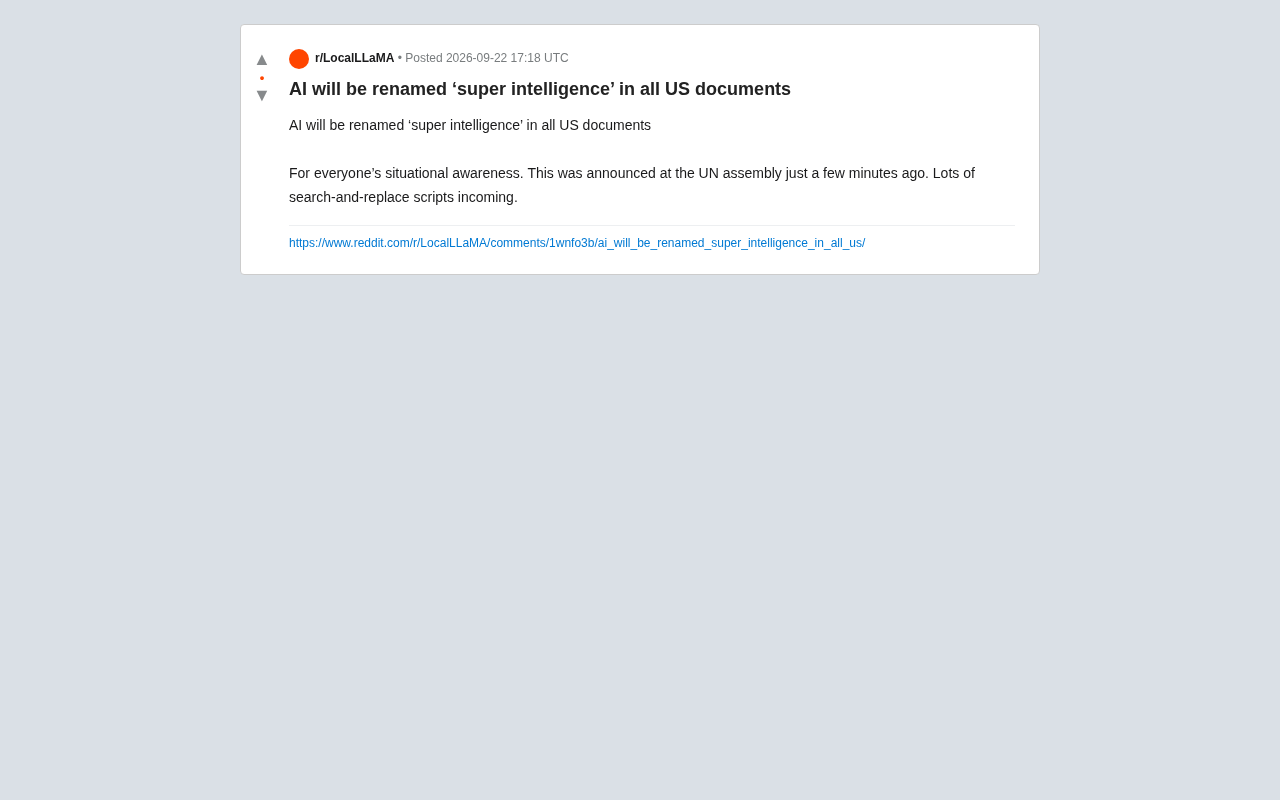
The post spread quickly through online communities, but its credibility is far from established. When encountering claims about sweeping policy changes like this, a healthy dose of skepticism and some basic fact-checking skills go a long way.
Red Flags in the Claim
Taken at face value, the post raises several warning signs worth noting.
The source is vague. The only evidence offered is that the announcement was made "at the UN General Assembly just minutes ago" — with no link to an official statement, no news coverage, and no verifiable document. Genuine major policy shifts come with formal announcements from the White House, the UN, or established news outlets.
The joking tone undermines its credibility. The quip about "a lot of find-and-replace scripts" reads more like community humor or satire than a serious policy bulletin. This kind of content is common on Reddit, where irony and parody often masquerade as breaking news.
It doesn't hold up logically. Replacing a widely entrenched term like "AI" with "super intelligence" across all U.S. official documents via a single General Assembly statement would be highly unusual. Terminology changes at the governmental level typically require extensive cross-agency coordination — they don't happen overnight with a single announcement.
Why Claims Like This Spread So Easily
"Superintelligence" is a real and widely discussed concept in AI — it refers to a hypothetical system that surpasses human cognitive abilities across virtually all domains. Because the term carries a strong futuristic charge and is inherently provocative, attaching it to a supposed policy announcement makes the story feel weightier than it likely is.
When a claim bundles together a genuine technical term, authoritative institutions (the UN, the U.S. government), and the urgency of "just announced," it has all the ingredients for going viral. People tend to share first and verify later — or never verify at all.
This is also a reflection of the broader AI information landscape: the technology is evolving rapidly, the public is acutely sensitive to what might happen next, and that uncertainty creates fertile ground for unverified claims to take root.
The concept of "superintelligence" was systematically articulated by philosopher Nick Bostrom in his 2014 book Superintelligence, where he described a hypothetical agent that surpasses the best human minds across fields including scientific discovery, social manipulation, and general software development. It is fundamentally different from today's existing AI systems — including large language models like GPT-4 and Claude, which fall under the category of "narrow AI" or AGI candidates and are nowhere near the superintelligence threshold. Because the term is so well known in academic and popular science contexts, and is often tied to existential-scale questions about humanity's future, any news linking it to government policy naturally carries viral momentum. Readers may instinctively think, "This sounds important enough to be true," and skip the verification step entirely.
How to Evaluate Claims Like This
When confronted with supposed "policy-level" announcements, a few simple checks can help separate fact from fiction.
Trace it back to a primary source. If a claim references a UN General Assembly session or a government announcement, there should be a corresponding record on an official website or in mainstream media coverage. If you can't find one, treat the claim with skepticism.
Pay attention to tone. Posts that mix in jokes, lack specifics, and offer conclusions without supporting evidence tend to have lower credibility.
Cross-verify. Genuinely major news gets covered by multiple independent outlets — it doesn't live exclusively in a single anonymous post on one social platform.
Based on the information currently available, the "AI renamed to super intelligence" claim has no authoritative backing whatsoever. It looks far more like an unverified rumor or a joke making the rounds on social media than a real policy development.
Closing Thoughts
This Reddit post is a timely reminder that as AI continues to dominate headlines, the ability to critically evaluate information has never been more important. Until an official source confirms it, claims that "AI has been officially renamed" deserve serious scrutiny. The more valuable approach is to wait for verifiable, authoritative information — rather than letting a single social media post shape your understanding of reality.
Related articles

Build an AI Super Employee System at Zero Cost: A Full Breakdown of Automated Agent Workflows
A deep breakdown of the AI super employee system demoed on Bilibili: agent orchestration, digital human voiceovers, map and enterprise lead generation, 24/7 customer service, and legal modules. We analyze the business logic and compliance risks behind zero-cost signup to help entrepreneurs judge the real ROI of this AI digital employee system.

The Essential Difference Between Chatbots and AI Agents: Crossing from Conversation to Execution
What's the difference between a chatbot and an AI agent? Based on the MCP series on the Learn Tech channel, this article uses examples like booking flights and summarizing notes to explain: a chatbot only gives answers, while an agent actually completes tasks through a think-act-observe loop. It breaks down the four core components—model, tools, memory, and goal—as well as MCP's role as a bridge, and discusses agents' applicable boundaries and permission risks.

Free GitHub Repo: 342 Hours of AI Courses, from Math to MCP Servers
A free GitHub repo offers 342 hours of AI courses: 523 lessons across 20 phases, from math fundamentals to agent building and MCP servers. Nearly 100,000 learners have started.