Fairphone Fairbuds 2 Review: Repairable Earbuds Evolve

Fairphone launches its second-gen repairable true wireless earbuds, the Fairbuds 2, with nearly double the battery life and a smaller size.
Fairphone has released the Fairbuds 2, its second-generation true wireless earbuds, continuing its signature modular, repairable design that lets users replace the battery module themselves and avoid scrapping the device when the battery degrades. Compared with the first generation, the Fairbuds 2 improves sound quality, battery life, size, and weight, with nearly doubled battery life being the most notable upgrade. Priced from £99 in the UK, €119 in Europe, and $119 in the US, it differentiates itself through sustainability and repairability rather than top-tier noise cancellation.
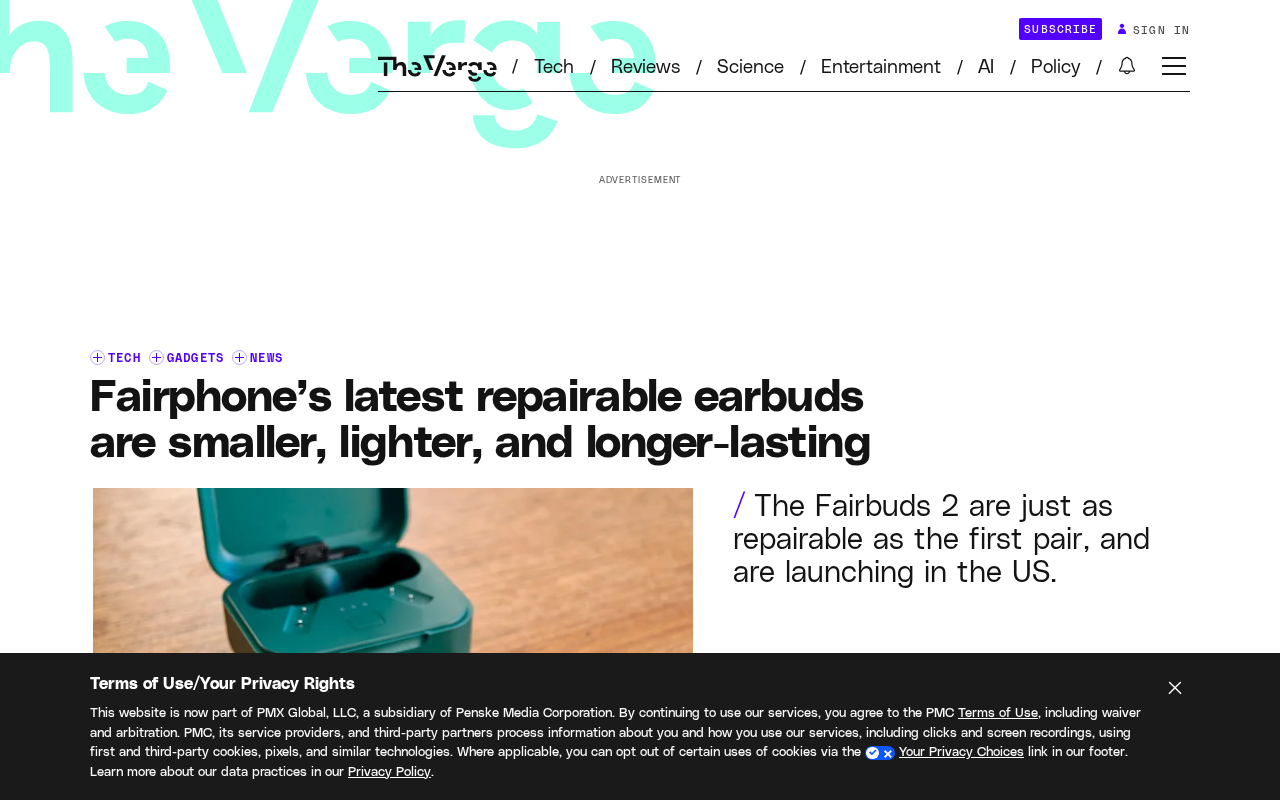
In consumer electronics, "repairability" and "thin, light, long battery life" often seem mutually exclusive. But Fairphone, known for its modular phones, is proving with its second-generation true wireless earbuds, the Fairbuds 2, that eco-friendly design doesn't have to come at the cost of experience.
From Phones to Earbuds: Fairphone's Repair Philosophy
Fairphone first entered the public eye with modular phones that let users swap out the battery, screen, or even camera modules themselves with a screwdriver. Now that product line has extended to audio devices. The Fairbuds 2 is Fairphone's second-generation true wireless earbuds, carrying on its signature repairable design.
This means that when the earbud battery degrades, you don't have to throw away the whole pair—you can replace just the battery module. Given an industry that generates tens of millions of discarded TWS earbuds every year, this is a direction worth paying attention to.
Why TWS earbuds are hard to repair
True wireless stereo (TWS) earbuds have become a major source of e-waste, and the root cause lies in their structural design. To cram a battery, dynamic driver, Bluetooth chip, microphone, and touch module into a shell weighing just a few grams, manufacturers generally adopt highly integrated stacked designs and seal everything with plenty of glue to achieve IPX-level water resistance. This leaves virtually no room for users to disassemble anything: the battery is usually firmly glued inside the housing, and once it degrades to the point where it can't last a single commute, the whole pair is declared dead.
Fairphone's approach is to treat "swappable battery" as a first principle of product definition, rather than an afterthought. Through a modular snap-fit structure and a removable battery compartment, the Fairbuds 2 turns the battery from a "sealed-in disposable consumable" back into a "replaceable component," fundamentally changing how the product's lifecycle is calculated.
Core Upgrades: Smaller, Lighter, Nearly Double the Battery Life
According to Fairphone's official information, the Fairbuds 2 brings several key improvements over the first generation:
- Improved sound quality: Fairphone says the Fairbuds 2 has been optimized for audio performance, addressing the first generation's shortcomings in listening experience.
- Nearly double the battery life: This is the most notable improvement. The original Fairbuds' battery life was merely average, while the Fairbuds 2 significantly extends this weak point.
- Smaller and lighter: Both the earbuds themselves and the charging case have been redesigned, further reducing the burden of wearing them.
- Repairability unchanged: Despite the smaller size, the Fairbuds 2 still retains its user-repairable nature.
In the true wireless earbuds market, achieving both "smaller and lighter" and "longer battery life" at the same time is itself an engineering challenge. Fairphone advancing on both fronts shows that the second-generation product is not a simple shell swap.
Why "smaller + longer battery life" is contradictory
In TWS earbuds, battery life is almost directly determined by battery capacity, and battery capacity is constrained by the size of the housing. When manufacturers want to shrink the earbuds and charging case, the available battery space is compressed accordingly, and battery life usually declines as a result.
The reason the Fairbuds 2 can achieve both "smaller" and "nearly double the battery life" typically relies on several engineering optimizations: higher-energy-density cells, improved power efficiency in the Bluetooth chip and audio amplifier, a re-layout of the charging case battery, and improved power scheduling strategies. This also explains why the second-generation product is not a simple shell swap—it requires finding a new balance among power consumption, size, and repairability, and the repairable structure itself takes up internal space, making that balance even harder to achieve.
Pricing and Availability
The Fairbuds 2 is now officially on sale:
| Market | Price |
|---|---|
| UK | From £99 |
| Europe | From €119 |
| US | $119 (coming soon) |
This pricing sits in the mid-range true wireless earbuds segment. Compared with competitors at the same price, the Fairbuds 2's core differentiation is not noise cancellation depth or codec specs, but its sustainability and repairability.
Who This Product Is For
The Fairbuds 2's target user profile is fairly clear:
- Environmentally conscious consumers: If you care about the e-waste problem and want to use one pair of earbuds for longer, the Fairbuds 2's design philosophy aligns directly with that.
- Users tired of "throw away after two years": The most common reason TWS earbuds die is battery degradation. A replaceable battery means the product's lifespan can be significantly extended.
- Users who don't need top-tier noise cancellation: Fairphone's product positioning has never been about stacking specs, but about achieving sustainability on the basis of a reasonable experience.
If what you're after is Bose- or Sony-level active noise cancellation, the Fairbuds 2 may not be the best choice. But if you're willing to accept a "good enough" level of sound quality and noise cancellation in exchange for a longer usage cycle and lower long-term cost of ownership, this product offers a rare option on the market.
The Industry Significance of Repairable Earbuds
True wireless earbuds are one of the categories with the lowest recycling rates in consumer electronics. Because of their small size, high integration, and glue sealing, most TWS earbuds were never designed with disassembly and repair in mind. Fairphone's choice to stick with a modular approach in this category sets an example for the entire industry.
Of course, repairable design also brings compromises—greater internal space requirements, higher manufacturing costs, and potential limitations on water and dust resistance. The fact that the Fairbuds 2 can maintain repairability while shrinking in size shows that this design approach still has room for optimization.
For readers who follow sustainable tech, the Fairbuds 2 is worth keeping an eye on—not only because of the product's own upgrades, but because it represents a product logic that runs counter to mainstream "planned obsolescence."
Planned obsolescence and right-to-repair legislation
"Planned obsolescence" refers to products being given a limited lifespan at the design stage, pushing consumers to repeatedly repurchase on a cycle. The battery degradation of TWS earbuds is a typical manifestation of this logic: when the battery is not replaceable, the earbuds' lifespan is locked at around two to three years.
In recent years, markets such as the EU have been advancing "right to repair" regulations, requiring manufacturers to provide spare parts, repair manuals, and longer software support cycles, and the repairability of electronic products is gradually shifting from a moral claim to a compliance requirement. Fairphone has long used modular design as its core selling point, in a sense converting the regulatory trend into a product advantage ahead of time. The Fairbuds 2 arrives against this backdrop, continuing the brand's philosophy while laying the groundwork for the coming compliance environment—it proves that sustainable design is commercially viable at mid-range prices too.
One-line Summary
Fairphone launches its second-generation repairable true wireless earbuds, the Fairbuds 2, with nearly double the battery life and a smaller size.
Paragraph Summary
Fairphone has released the Fairbuds 2, its second-generation true wireless earbuds, continuing its signature modular, repairable design that lets users replace the battery module themselves and avoid scrapping the whole device when the battery degrades. Compared with the first generation, the Fairbuds 2 improves sound quality, battery life, size, and weight, with nearly doubled battery life being the most notable upgrade, while retaining user repairability. The product is already on sale in the UK from £99 and in Europe from €119, and will launch in the US at $119, positioned in the mid-range true wireless earbuds segment. Its core differentiation is not noise cancellation depth or codec specs, but sustainability and repairability, targeting people who value the environment and want to extend their product's usage cycle, rather than spec-chasers seeking top-tier noise cancellation.
Related articles

Bilibili's Hit Dify Tutorial: A Practical Guide to Building 20+ AI Apps from Scratch
A distilled guide to Bilibili's top-rated Dify tutorial: Windows + Docker deployment, MySQL connection, five app types, model integration strategy, and publishing.

Agent Skills Beginner's Guide: From Concepts to Multi-Agent Collaboration in Practice
A comprehensive guide to Agent Skills: core concepts, components, the importance of Description, standardization, beginner learning paths, and multi-agent collaboration.

One Neuron Detects Both Cats and Cars? We Reproduced It and Found a New Explanation
The cat-car neuron reinterpreted: researcher Cammarata argues it distinguishes pointy from round, not cats from cars. We reproduced the experiment and found the new explanation holds on most inputs—but cars are the exception. The interpretability debate continues on language models.