FBI Warns: ARTEX AI Hacking Tool Breaches Systems in Three Hours
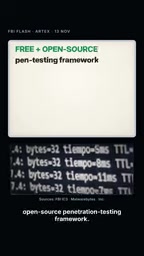
FBI warns the open-source AI pentesting framework ARTEX is being abused, with attackers gaining privileged access within three hours.
The FBI recently warned that the open-source AI pentesting framework ARTEX is being abused by cybercriminals, with some intrusions gaining privileged access in under three hours. The tool lets AI agents automatically turn targets into attack commands with almost no human input, turning it from a security assessment tool into a criminal weapon. Although the developer removed it from GitHub in October, copies and commercial versions still circulate, and over 1,600 exposed ARTEX consoles have been found online. Related attacks have caused data breaches affecting about 67,000 people at multiple South Korean financial institutions, and a ConnectWise supply chain intrusion affected more than 2,250 customer tenants. The FBI recommends basic measures such as inventorying internet-facing applications, restricting administrator privileges, and rotating credentials, stressing that solid security hygiene remains an effective defense.
FBI Raises the Alarm: The AI Hacking Tool ARTEX Emerges
The U.S. Federal Bureau of Investigation (FBI) recently issued a warning that an open-source AI penetration testing framework called ARTEX (sometimes reported as ARDEX) is being abused by cybercriminals. The FBI noted that some intrusions using the tool achieved privileged access in under three hours—a speed fast enough to catch traditional security teams off guard.
ARTEX is positioned as a free, open-source penetration testing framework, intended for security professionals to conduct security assessments within authorized scope. Its core mechanism lets AI agents automatically translate targets into attack commands, with almost no human input required. Yet it is precisely this "low barrier, high automation" nature that has turned it from a security tool into a convenient weapon for criminals.
Penetration Testing refers to security professionals simulating real attackers' techniques—probing and exploiting systems, networks, or applications with authorization—to discover and fix security vulnerabilities. Legitimate penetration testing typically involves explicit authorization letters, scope definitions, and reporting processes, and is part of defensive security work. What makes frameworks like ARTEX dangerous is that they highly automate the penetration testing chain of "reconnaissance—weaponization—exploitation—lateral movement": an AI agent receives a target or intent and can automatically generate and execute attack commands with almost no step-by-step human operation. This compresses offensive and defensive techniques that once required years of experience into a black-box process of "input a target, wait for results," and also makes unauthorized malicious use exceptionally easy.
From Security Tool to Criminal Weapon: ARTEX's Runaway Trajectory
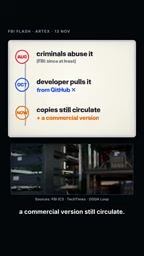
The FBI stated that criminals began abusing ARTEX at least as early as last August. The developer took it down from GitHub in October, but it was too late—copies of the tool and commercial versions are still circulating in the shadows. This means that even though the official repository has been closed, attackers can still easily obtain and use the tool.
Even more concerning is the scale of exposure. Security researchers found more than 1,600 exposed ARTEX consoles on the internet. These consoles are essentially the attackers' "operation panels," and such a large number indicates that the tool's deployment and spread have been extensive.
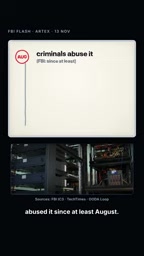
The double-edged sword effect of open-source tools is particularly evident in this incident. Open source means the code is public and freely copyable and modifiable. Once released on platforms like GitHub, even if the original author deletes the repository, clones or forks that have already been made will continue to circulate on the internet and cannot truly be "recalled." This is exactly why ARTEX continued to spread after being taken down in October. In addition, open-source projects are often packaged by third parties into commercial or derivative versions, further expanding distribution channels. For the security industry, this raises a practical question: should automated frameworks with offensive capabilities come with usage thresholds, license restrictions, or responsible disclosure mechanisms at release, rather than remediation afterward?
Real Attack Cases: Data Breaches and Supply Chain Crises
The harm caused by ARTEX is not merely theoretical. The FBI disclosed an attack campaign related to the tool: attackers stole data on approximately 67,000 people from multiple South Korean financial institutions. Financial institutions have always been high-value targets for cybercrime, and the boost from AI tools has significantly increased attack efficiency.
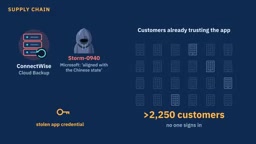
Another incident points to the supply chain. According to the FBI, a supply chain intrusion at ConnectWise put more than 2,250 customer tenants at risk. The terrifying aspect of supply chain attacks is their chain effect—breaching one link can affect hundreds or thousands of downstream enterprises.
Supply Chain Attacks refer to attackers not directly attacking the final target, but first breaching third-party software, service providers, or hosting platforms that the target relies on, then spreading downstream through trust relationships. ConnectWise is a well-known IT management and remote monitoring and management (RMM) software provider, and many managed service providers (MSPs) use its products to operate and maintain systems for numerous enterprise clients. Once such platforms are compromised, attackers may gain access to thousands of customer tenants, creating an amplifying effect of "strike one point, affect a whole area." Such attacks are harder to detect because malicious activity often travels through legitimate management channels, making it difficult for conventional perimeter defenses to distinguish.
Defense Recommendations: Cliched but Still Effective
Facing AI-driven attack tools, the FBI's recommendations sound nothing new: inventory internet-facing applications, restrict administrator access, tighten permission configurations, rotate exposed credentials, report errors, and guard against fraud.
These measures were described by the FBI as "boring basics," but it is precisely these basics that remain effective. The core problem is that many organizations have not even gotten this basic security hygiene right, which is what allows automated tools to march right in.

Credential Rotation refers to regularly changing passwords, API keys, access tokens, and other authentication credentials, and ensuring that leaked or potentially exposed credentials are immediately invalidated. In AI-automated attack scenarios, this is especially critical: attack tools can scan and attempt to exploit exposed credentials at extremely high speed, so if credentials remain unchanged for long periods or are not revoked promptly after a leak, it is equivalent to opening the door to automated attacks. Complementing this is the principle of least privilege (PoLP)—granting accounts only the minimum permissions necessary to complete their work, thereby limiting the scope of lateral movement if credentials are stolen. The FBI's emphasis on "inventorying the internet exposure surface" is likewise a prerequisite: if you don't know what you have exposed, you cannot effectively rotate and protect it.
Analysis: AI Lowers the Attack Barrier, but Defenses Can Still Be Hardened
The ARTEX incident reveals a broader trend: AI is "democratizing" penetration testing capabilities that previously required specialized skills. In the past, launching an organized attack required experienced hackers; now, a single AI agent can automatically break a target down into an executable command chain. Attack speed is measured in hours, and defenders must re-examine their response cadence.
But this does not mean defenders have no cards to play. Consoles exposed on the public internet, unrotated credentials, overly broad permissions—these entry points exploited by attackers are also gaps defenders can proactively close. The threat of AI attack tools is real, but what they often amplify are security vulnerabilities that already existed. Getting the basics right first remains the most pragmatic response today.
One-line Summary
FBI warns that the open-source AI penetration testing framework ARTEX is being abused, allowing attackers to gain privileged access within three hours.
Paragraph Summary
The FBI recently warned that the open-source AI penetration testing framework ARTEX is being abused by cybercriminals, with some intrusions achieving privileged access in under three hours. The tool lets AI agents automatically translate targets into attack commands with almost no human input, turning it from a security assessment tool into a criminal weapon. Although the developer removed it from GitHub in October, copies and commercial versions continue to circulate, and more than 1,600 exposed ARTEX consoles have been found online. Related attacks have caused data breaches affecting about 67,000 people at multiple South Korean financial institutions, and a ConnectWise supply chain intrusion affected more than 2,250 customer tenants. The FBI recommends basic measures such as inventorying internet-facing applications, restricting administrator privileges, and rotating credentials, emphasizing that solid security hygiene remains an effective line of defense.
Related articles

FBI Warns About AI Hacking Tool Artex: Systems Breached in Three Hours
FBI warns about AI hacking tool Artex: describe targets in natural language for automated scanning and intrusion, with some attacks achieving full privileged access within three hours. It affected over 2,000 Microsoft 365 organizations and South Korean banks. Copies still circulate after the developer took it down in October; security fundamentals remain key.
FBI-Warned AI Hacking Tool ARTEX: Cost Disruption and Defensive Restructuring
The FBI-warned AI hacking tool ARTEX reduces penetration testing costs to $150-$1,500, causing financial data breaches and supply chain attacks. Learn how it works, real cases, and a five-step defense strategy.
FBI Warns About Artex: AI-Driven Attack Framework Threatens Cloud Identity Security
FBI warns that the AI penetration testing framework Artex is being used for automated attacks: written in Go and driven by AI agents, it covers the full chain from reconnaissance to data exfiltration. This article analyzes its real threat to cloud identity and privilege security and key defense priorities.