Fina Business: A Flexible $20/Month Bookkeeping Alternative for Founders

Fina Business offers lightweight professional bookkeeping starting at $20/month, targeting solo founders and small teams.
Fina Business is the #2 financial tool on Product Hunt, positioned as a lightweight QuickBooks alternative starting at $20/month, with the tagline "you founded a company, not an accounting department." It packages the bookkeeping features founders actually need: simultaneous tracking of business and personal finances, automated invoicing, Stripe payments, client management, and double-entry bookkeeping with P&L and balance sheets. Low pricing and customization are its core selling points, making it friendlier for solo companies, freelancers, and small teams under ten people. The article also notes potential limitations: multi-currency, inventory, payroll, and integration depth with banks and tax systems remain to be verified. 164 upvotes and 29 comments show the pain point is real.
Small teams and solo founders often face a contradiction: the business needs professional bookkeeping, but traditional accounting software's learning curve and price tag are off-putting. Fina Business, ranked second on Product Hunt, tries to solve this with a $20/month subscription, positioning itself as "a flexible alternative to QuickBooks."
What Problem Does It Solve
Fina Business's core proposition is straightforward: you founded a company, not an accounting department. Traditional tools like QuickBooks are feature-complete, but for a team of one or two, most of those features go unused, while the interface and workflows demand dedicated time to learn.
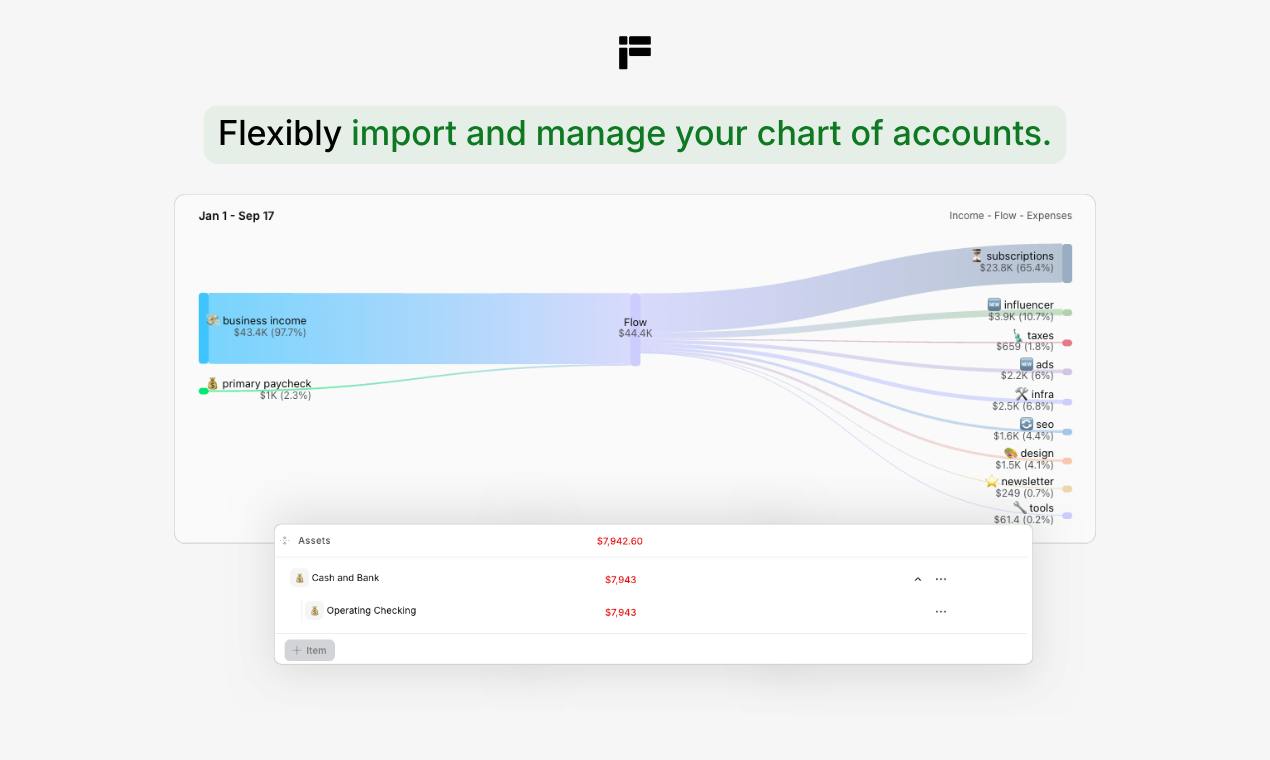
Fina's approach is to package "the bookkeeping features founders actually need" into a lightweight product: simultaneous tracking of business and personal finances, automatic invoice generation, Stripe payment integration, client management, plus double-entry bookkeeping, profit & loss statements, and balance sheets. These are the basic financial materials most commonly required for tax filing and fundraising, and the core needs most founders can't avoid.
Double-entry bookkeeping is the foundational method of accounting: every transaction is recorded in two accounts simultaneously, with a debit in one and a credit in the other, and the amounts must be equal. The benefit is that any transaction can be traced back to its source and destination, the books naturally stay balanced, and errors are easier to spot. A profit & loss statement (P&L) reflects revenue, costs, and profit over a period of time, answering "did we make money during this period?"; a balance sheet reflects a company's assets, liabilities, and owner's equity at a point in time, answering "what's our financial standing right now?" These three are the most common materials for tax filing, loan applications, and demonstrating financial health to investors — and the minimum bar for judging whether a bookkeeping tool is truly "professional."
Feature Breakdown: Sufficient, or Just Getting By
Based on the product description, Fina covers several key scenarios.
Income/Expense and Account Management: Supports separate tracking of business and personal finances, which is especially important for early-stage founders — many people mix their company and personal accounts, only to find the mess unmanageable come tax season. Fina lets you manage things "your way," suggesting a high degree of customization.
Automated Invoicing and Payments: Automatically generating invoices and accepting Stripe payments means the path from invoicing to payment collection is shortened. For freelancers and small service teams, this is a high-frequency operation.
Standard Financial Reports: Double-entry bookkeeping, P&L, and balance sheets are the foundational language of accounting. Fina doesn't sidestep these professional concepts but presents them in a lighter way, so founders can understand them and use them to communicate with accountants or investors.
Pricing is its most direct selling point: starting at $20/month, customizable around how your business actually operates. Compared to QuickBooks's often higher monthly fees and more complex tier structures, this price is friendlier for early-stage teams.
Stripe is an online payment infrastructure provider for developers and small-to-medium businesses, supporting credit cards, subscription billing, and other payment methods, with a relatively simple integration process, used by a large number of SaaS companies and freelancers. For bookkeeping tools, integrating Stripe means payment records can automatically sync to the accounting system, reducing manual entry and reconciliation work, and enabling an "invoice → payment → bookkeeping" closed loop. Compared to traditional bank transfers, Stripe's automation capability is one of the key links through which lightweight financial tools boost efficiency.
Market Positioning and Potential Trade-offs
Fina clearly isn't trying to be an "all-in-one financial system." It targets founders who aren't yet at the point of needing a dedicated accountant but can't get by on Excel alone. 164 upvotes and 29 comments show this pain point has genuine attention, but the relatively low comment count compared to upvotes also suggests the depth of discussion may be limited.
One thing to watch: lightweight bookkeeping tools often have to make trade-offs at the edges of functionality. For example, multi-currency support, inventory management, payroll, and the depth of integration with more banks and tax systems — these are standard in traditional software but need to be verified in lightweight products. Fina emphasizes "flexibility" and "customizability," which is both an advantage and potentially means some capabilities require users to configure themselves.
Multi-currency support refers to whether financial software can simultaneously record and settle transactions in different currencies and handle exchange rate differences. For small teams serving only local clients, it's not a must-have — but once cross-border payments, foreign currency purchases, or overseas suppliers are involved, lacking this capability forces founders back to manual Excel conversions, undermining the completeness of the bookkeeping software. Payroll involves individual income tax withholding, social security, and compliance filings, typically deeply tied to local tax law, with complexity far exceeding ordinary bookkeeping. Lightweight tools often leave these two areas to users or third-party plugins, so before choosing, confirm whether your business truly needs them.
Who Should Consider It
If you're a one-person company, freelancer, or a small team of under ten people, with a simple business structure and main needs being invoicing, collecting Stripe payments, and viewing profit and balance sheets, Fina Business's pricing and positioning are worth including in your comparison.
But if you already have multi-account, multi-currency, inventory, or payroll needs, or require deep integration with a specific tax system, traditional tools or more specialized solutions may be more reliable.
Fina Business's significance lies in lowering both the barrier and the price of "professional bookkeeping" by a notch, letting founders use proper double-entry books early on rather than scrambling to catch up when fundraising or an audit comes around.
One-line Summary
Fina Business offers lightweight professional bookkeeping starting at $20/month, targeting solo founders and small teams.
Paragraph Summary
Fina Business is the #2 financial tool on Product Hunt, positioned as a lightweight QuickBooks alternative starting at $20/month, with the tagline "you founded a company, not an accounting department." It packages the bookkeeping features founders actually need: simultaneous tracking of business and personal finances, automatic invoice generation, Stripe payment integration, client management, plus double-entry bookkeeping, P&L statements, and balance sheets. Low pricing and flexible customization are its core selling points, making it friendlier for one-person companies, freelancers, and small teams under ten people. The article also notes potential limitations: multi-currency, inventory, payroll, and depth of integration with banks and tax systems still need verification. 164 upvotes and 29 comments show the pain point is real.
Related articles

AI Compute Is the New Oil, But the Market Mechanism Has Yet to Take Shape
Hacker News compares AI compute to the new oil, noting the lack of price discovery, concentrated supply, and no hedging tools. The article analyzes structural issues in compute trading and explores a possible three-tier market of spot, contracts, and derivatives, plus the real impact on AI practitioners' cost management.

Running Full iOS 16.5 Firmware on Android Devices: Technical Demo or Marketing Gimmick?
A Hacker News post claims full iOS 16.5 firmware can run on Android, with 315 upvotes. This analysis argues it is more likely a web UI simulation than a true firmware port, and explores the value and risks of such projects.

Etsy Cracks Down on AI Slop: Addressing Buyer and Seller Anxieties
Etsy introduces stricter rules limiting AI-generated content in listings, addressing buyer confusion over AI products and seller fears of original work being diluted by AI slop.