Finantly: A Personal Finance Tool That Unifies Budgeting and Investing in One Place

Finantly unifies accounts, budgets, investments, and debt into one dashboard with data-driven planning tools.
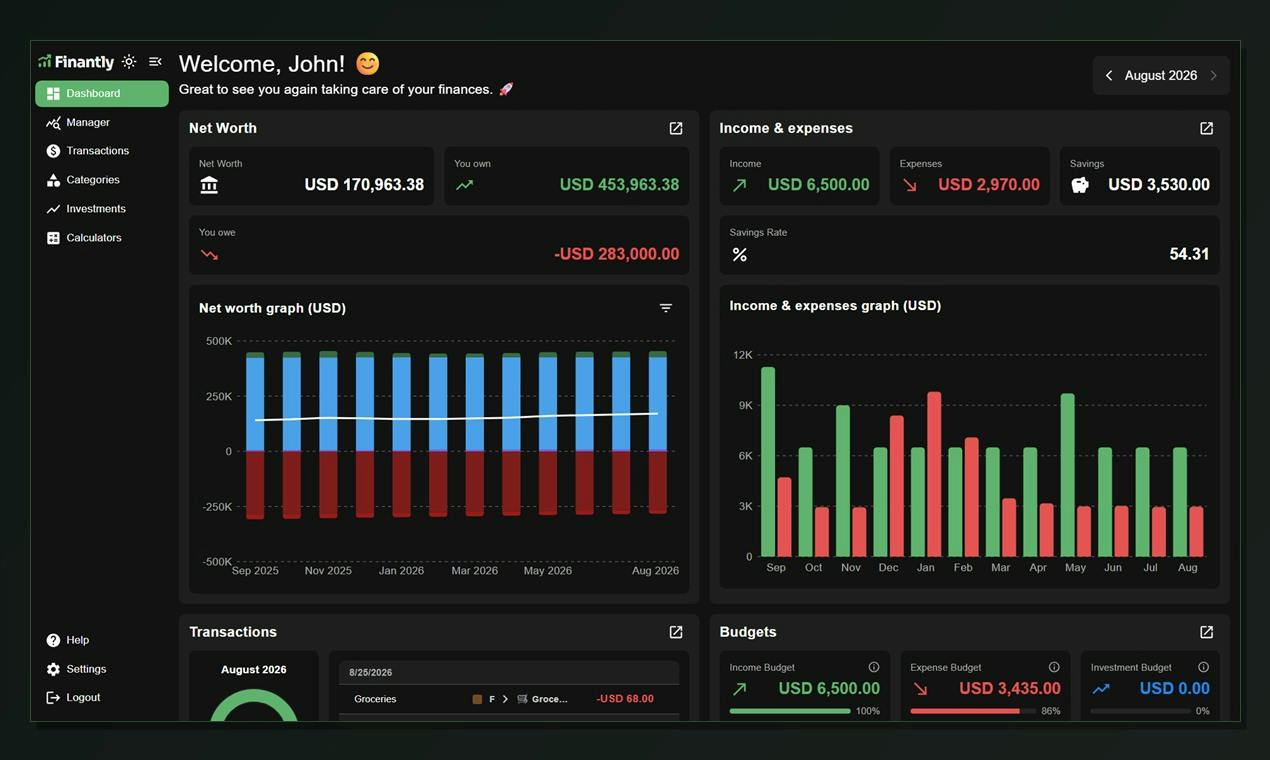
Finantly is a personal finance management tool freshly launched on Product Hunt, tackling financial fragmentation with a single-dashboard approach that brings together bank accounts, budgets, investments, and debt. Key features include CSV import with self-learning transaction categorization, real-time multi-currency net worth tracking, and FIRE, car, real estate, and loan calculators powered by the user's actual account data. Its standout differentiator is that planning tools draw from real financial data rather than hypothetical inputs. As an early-stage product, its auto-categorization accuracy, data reliability, and privacy safeguards are the key variables that will determine whether it can carve out a place in a crowded market.
Personal finance management has long relied on two extremes: either cobbling things together with a pile of hand-built spreadsheets, or constantly switching between multiple siloed banking apps. Finantly, which just launched on Product Hunt, aims to offer a third option — bringing accounts, budgets, investments, and debt into a single view, giving users complete visibility over their money without wrestling with Excel formulas.
The Core Problem Finantly Aims to Solve
For most people, financial information is fragmented: savings sit in one bank, credit cards live on another platform, investment accounts are a separate system entirely, and debt and loans are scattered across even more places. Getting a clear picture of your true net worth typically means manually pulling all these numbers into a spreadsheet — a process that's both time-consuming and error-prone.
Finantly positions itself as "All your finances in one place." It integrates budgeting and investing — two domains that are usually handled separately — into a single dashboard, giving users a unified view of their income, expenses, assets, and liabilities. This "single source of truth" philosophy is the most fundamental and compelling value proposition for any aggregation-style tool.
Feature Breakdown
CSV Import with Self-Learning Categorization
Finantly supports importing bank CSV statement files and offers an auto-categorization feature that "learns from your choices." This means the system's accuracy in classifying transactions gradually adapts to your personal habits over time, reducing the need to repeatedly tag things manually. For users without access to open banking API integrations, CSV import is a broadly compatible middle-ground solution.
Open Banking APIs are technical interfaces that allow third-party apps to directly access bank account data with user authorization. They've become increasingly common in regions like the EU (under PSD2), the UK, and Australia, enabling automatic account syncing without manually exporting files. CSV import, by contrast, requires users to periodically log into each bank and download transaction files — introducing data lag and operational friction. Finantly's current focus on CSV is broadly compatible in markets where open banking ecosystems are less mature (such as parts of Asia), but it also means that "real-time" tracking depends on how frequently users import files, rather than being truly automatic. This context is worth keeping in mind when evaluating the "real-time net worth" feature.
Real-Time Net Worth with Multi-Currency Tracking
The product emphasizes the ability to "track net worth in real time across currencies." For users who hold accounts in multiple countries, foreign currency assets, or cross-border income, multi-currency support is a genuinely useful differentiator — it eliminates the hassle of manually converting different currencies into a base currency before aggregating, keeping your net worth figure current at all times.
Financial Calculators Powered by Real Data
Finantly includes built-in calculators for FIRE (Financial Independence, Retire Early), car purchases, real estate, and loans — and these calculations are "built on your real data, not guesswork." This is the key distinction from generic calculator tools: planning isn't based on abstract assumptions, but is connected to the user's actual accounts and cash flows. For those doing FIRE planning or weighing major purchases, this data-driven approach carries significantly more practical value.
FIRE stands for "Financial Independence, Retire Early." Its core logic comes from the "25x rule": when your net worth reaches 25 times your annual expenses, you can theoretically sustain your lifestyle indefinitely by withdrawing 4% per year without depleting your principal — a rate derived from the "Trinity Study" of the 1990s. The challenge with FIRE planning is that results are highly sensitive to input parameters. Small changes in savings rate, expected annual returns, inflation assumptions, or target retirement age can shift the "years until FIRE" answer by several years. Traditional calculators require users to estimate these parameters themselves, whereas Finantly claims to read income and expense baselines directly from real account data — potentially reducing the planning errors that come from filling in numbers by guesswork.
Positioning and Market Assessment
Finantly is categorized on Product Hunt under Productivity, Fintech, and Personal Finance, and was built by Franciszek Karwowski and team. From a product logic standpoint, it targets users who have grown tired of spreadsheets but want to go further than a basic expense-tracking app — those looking to do more comprehensive financial planning.
To be clear-eyed about it: the personal finance aggregation space is not uncrowded. There are established legacy products as well as a wave of newer competitors. Finantly is currently ranked #19 on the leaderboard, with vote counts and comments still in early-stage territory — no significant community momentum yet. Whether it can stand out will largely depend on three factors: the real-world accuracy of its CSV auto-categorization, the reliability of multi-currency data, and whether the calculators actually deliver actionable planning recommendations.
Key Questions Worth Asking
For users considering trying it out, a few questions are worth clarifying before committing. First, does data ingestion rely solely on manual CSV imports, or does it also support automatic bank syncing? Second, what asset classes does the investment tracking cover (stocks, funds, crypto, etc.), and how frequently is market data updated? Third, what are the security and privacy protections for financial data? These details aren't fully addressed in the current promotional materials, yet they're critical to evaluating whether this tool is genuinely trustworthy.
Summary
Finantly offers a clear and practical value proposition: consolidating fragmented financial information into a single view, then layering on data-driven planning tools. CSV self-learning categorization, multi-currency net worth tracking, and FIRE/loan calculators powered by real account data are its three most compelling selling points. As an early-stage product, its real-world experience and data accuracy still need validation from a broader user base — but for personal finance enthusiasts looking for a "spreadsheet alternative," it's worth adding to your watchlist.
Related articles

2026 AI Coding Tools Comparison: Claude, ChatGPT, Gemini — Which Is the Best?
A 2026 comparison of five mainstream AI coding tools — Claude Code, ChatGPT Codex, Gemini, DeepSeek, and GitHub Copilot — on real projects, pricing, and code quality, to help you decide where that $20/month should go.

ChatGPT Codex Can Clone Any Software? Testing the Risks and the Truth
YouTube shorts claim ChatGPT Codex or Claude Code can clone Adobe, Excel, and Figma for lifelong free use. We break down the feasibility, legal risks, and DM-funnel tactics—and explain what AI coding tools are truly good for.

Kilo Code Is Free to Install but Charges for API: Cost Estimation and Configuration Guide
Kilo Code is free to install, but connected AI models are billed per token. This guide covers VS Code extension and CLI setup and shows how to estimate API costs.