Finite-Sample Guarantees for Fully Discrete Conditional Diffusion Models: A Unified Analysis of Statistical and Numerical Errors

First theoretical work providing unified finite-sample error guarantees for fully discrete conditional diffusion models.
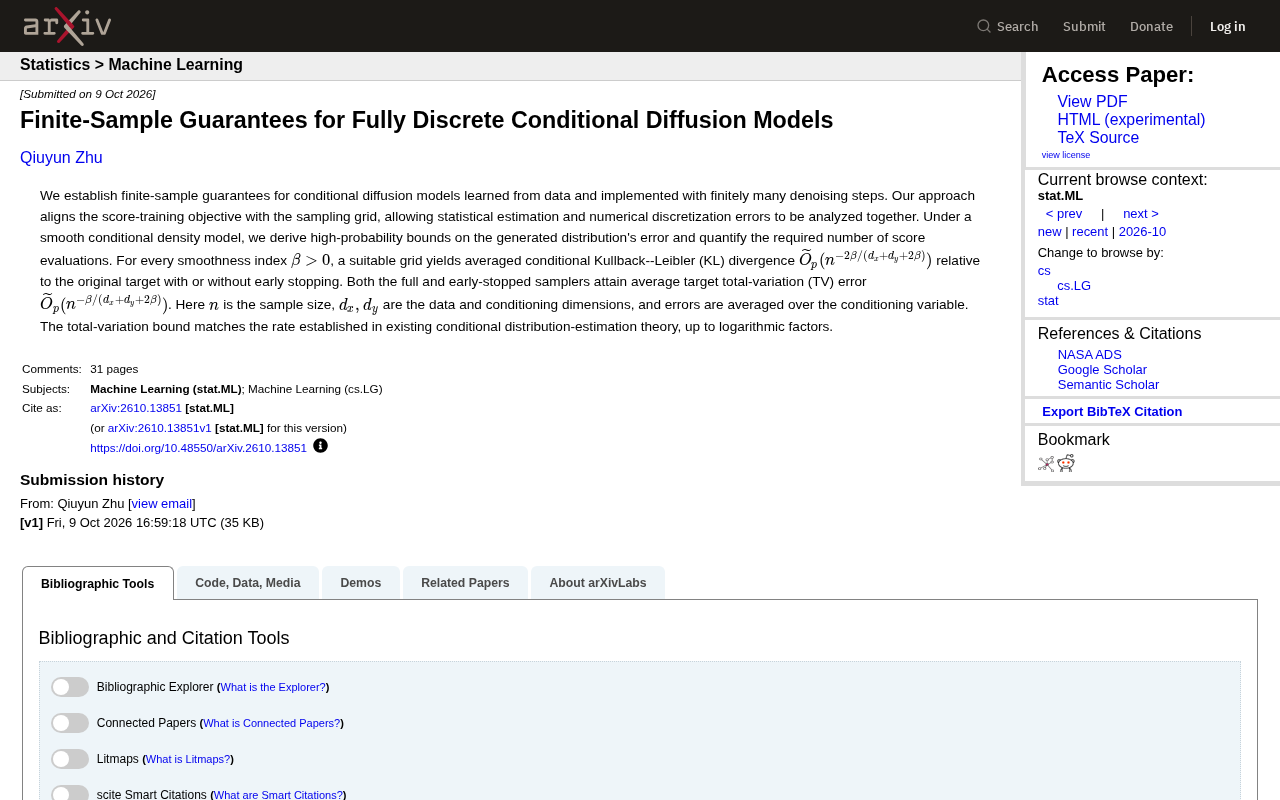
This paper establishes rigorous finite-sample theoretical guarantees for conditional diffusion models. Its core innovation is aligning the score function training objective with the discrete sampling grid, enabling a unified analysis of both statistical estimation error (finite-sample learning) and numerical discretization error (finite denoising steps). Under smooth conditional density assumptions, the paper proves that average conditional KL divergence and total variation error converge at rates of $\widetilde O_p(n^{-2\beta/(d_x+d_y+2\beta)})$ and $\widetilde O_p(n^{-\beta/(d_x+d_y+2\beta)})$ respectively, matching known optimal rates for nonparametric conditional density estimation. The study also shows that full sampling and early-stopped sampling achieve error bounds of the same order, providing theoretical support for the widely used early stopping technique.
Building Theoretical Foundations for Conditional Diffusion Models
Diffusion models have demonstrated remarkable capabilities in image generation, text-to-image synthesis, and beyond — yet their theoretical underpinnings have long lagged behind engineering practice. A new research paper, Finite-Sample Guarantees for Fully Discrete Conditional Diffusion Models, aims to close this gap by establishing finite-sample error guarantees for conditional diffusion models that are learned from data and implemented with a finite number of denoising steps.
The central question this work addresses is: when we have only a finite number of training samples and perform only a finite number of denoising steps at inference time, how well can the generated distribution be controlled relative to the true target distribution? This is not merely a theoretical inquiry — it has direct implications for assessing model reliability in real-world deployments.
Aligning the Training Objective with the Sampling Grid
A key methodological insight in this work is aligning the score-training objective with the sampling grid. In prior analytical frameworks, statistical estimation error (arising from learning the score function from finite samples) and numerical discretization error (arising from finite-step denoising) were typically treated in isolation, making it difficult to obtain a unified error characterization.
By coordinating the training and sampling processes on the same grid, the authors can handle both error sources within a single analytical framework. This alignment means the theoretical analysis no longer needs to assume an idealized continuous-time sampling process — instead, it directly addresses the "fully discrete" setting that actually exists in engineering implementations. This is precisely what "Fully Discrete" in the paper's title refers to.
The score function is a core concept in diffusion models, referring to the gradient of the log-density of the data distribution, $\nabla_x \log p(x)$. During the denoising process, the model must estimate this gradient at each noise level in order to gradually guide random noise back toward the data distribution. In practice, this function is approximated by a neural network (the "score network"), and the training objective is typically to minimize the mean squared error between the predicted and true scores.
Numerical discretization error arises from decomposing the theoretically continuous reverse-time stochastic differential equation (SDE) into a finite number of discrete time steps. Fewer steps mean larger approximation error per step. Prior theoretical analyses often assumed the score function was known exactly and only analyzed discretization error, or assumed continuous sampling and only analyzed statistical learning error. Treating these two error sources separately makes the resulting error bounds either overly conservative or difficult to apply in practice. By defining both the training loss and the sampling steps on the same time grid, this paper fundamentally eliminates the "seam" between the two analytical frameworks, enabling an end-to-end unified error bound.
High-Probability Error Bounds Under Smooth Conditional Density Assumptions
Under the assumption of a smooth conditional density model, the paper derives high-probability upper bounds on the error of the generated distribution and quantifies the number of score function evaluations (i.e., denoising steps) required to achieve a given accuracy.
The results are parameterized by a smoothness index $\beta > 0$. For any $\beta > 0$, with an appropriately chosen sampling grid, the average conditional KL divergence (Kullback–Leibler divergence) relative to the target distribution achieves a convergence rate of $\widetilde O_p(n^{-2\beta/(d_x+d_y+2\beta)})$; under the total variation (TV) metric, the average error is $\widetilde O_p(n^{-\beta/(d_x+d_y+2\beta)})$.
Here $n$ is the sample size, $d_x$ and $d_y$ are the dimensions of the data and conditioning variables respectively, and all errors are averaged over the conditioning variable. The convergence rate is affected by both the data dimension and the conditioning dimension — consistent with the curse of dimensionality that is ubiquitous in high-dimensional generative problems.
KL divergence (Kullback–Leibler divergence) and Total Variation (TV) are two commonly used measures of the difference between probability distributions. KL divergence is asymmetric: $KL(p|q) = \int p(x)\log\frac{p(x)}{q(x)}dx$. It is highly sensitive to cases where the true distribution has support but the generated distribution assigns very low probability. TV distance is defined as $TV(p,q) = \frac{1}{2}\int|p(x)-q(x)|dx$, is bounded and symmetric, and intuitively represents the maximum probability difference between the two distributions over all measurable events. The two are connected via Pinsker's inequality: $TV(p,q) \leq \sqrt{KL(p|q)/2}$, which explains why the KL convergence rate in this paper (with exponent $2\beta$) is exactly the square of the TV rate (with exponent $\beta$).
The smoothness parameter $\beta$ characterizes the regularity of the conditional density function: the larger $\beta$ is, the smoother the density, and in principle fewer samples are needed to achieve a given estimation accuracy. This is consistent with classical results in nonparametric statistics.
Early Stopping and Full Sampling Achieve the Same Rate
One noteworthy finding in the paper is that both the full sampler and the early-stopped sampler achieve error bounds of the same order.
In practice, early stopping is a widely used technique — by terminating the denoising process before it fully completes, it avoids the ill-conditioned behavior of score estimation near the data manifold while also saving computation. This work shows that with or without early stopping, the convergence rates of the KL divergence and TV error are equivalent up to logarithmic factors. This provides theoretical justification for the widespread use of early stopping in practice.
Furthermore, the total variation upper bounds established in the paper match the rates from existing theory on conditional distribution estimation (up to a logarithmic factor). This means that diffusion models, as conditional distribution estimators, are theoretically competitive with classical methods and achieve the known optimal convergence rate for this class of problems.
Early stopping in diffusion model sampling is necessitated by the data manifold hypothesis: high-dimensional data such as natural images tends to concentrate on a low-dimensional manifold far below the ambient dimension. As denoising approaches completion (i.e., as the noise level approaches zero), the score function $\nabla_x \log p_t(x)$ diverges in directions normal to the manifold, causing numerical instability. Early stopping truncates the denoising chain once the noise level falls below a certain threshold, sidestepping this ill-conditioned regime at the cost of retaining a small amount of residual noise. In practice, this rarely affects perceptual quality and can even have a regularizing effect. This paper theoretically proves that such truncation does not worsen the overall convergence rate, providing solid theoretical backing for this widely used engineering technique.
Implications for Research and Practice
The value of this work lies in moving diffusion models from "empirically effective" to "theoretically provable." For researchers, the unified framework for analyzing both statistical and discretization errors offers a reusable paradigm for future analyses under weaker assumptions. For practitioners, the quantified number of required score function evaluations means that the trade-off between sampling steps and generation quality can be reasoned about in a more principled way.
Of course, the conclusions rest on assumptions such as smooth conditional densities, and whether real-world data distributions satisfy these conditions must be verified on a case-by-case basis. The direct dependence of convergence rates on $d_x + d_y$ also serves as a reminder that theoretical bottlenecks in sample efficiency persist for high-dimensional conditional generation tasks. Overall, this is a rigorous theoretical contribution that fills an important gap in our understanding of why conditional diffusion models work — and to what extent they can be trusted.
Related articles

Huberman's Rational Supplement Guide: A Five-Layer Health Framework and Scientific Decision-Making
Stanford neurobiology professor Huberman proposes a rational supplement framework: behavior and nutrition are the foundation, basic combination supplements serve as insurance, and sleep/hormonal/cognitive directions should stick to single-ingredient experiments. Omega-3 is the top single-ingredient choice, and melatonin is not recommended.

The Unsung Painter Behind Gilded Age Manhattan Interior Design
HN discussion highlights the painter behind Gilded Age Manhattan interiors: he created murals and decorative paintings but was long overlooked as his work was seen as architectural appendage.

Can AI Agents Be Socially Engineered? Understanding Prompt Injection and Tool Permission Risks
Through Invariant Lab's GitHub Issue injection and Brave's AI browser attack, this article analyzes how Prompt Injection induces AI Agents to perform unauthorized actions, and offers protection advice across three layers: least privilege, tool validation, and operation auditing.