Fired Three Weeks After a Tweet: The OpenAI Safety Researcher Incident Sparks Debate

A viral Reddit post alleging an OpenAI safety researcher was fired for a tweet reveals deep tensions between AI safety culture and commercial pressures.
A Reddit post claiming an OpenAI safety researcher was fired three weeks after posting a tweet quickly drew widespread attention. The article argues that safety researchers are structurally at odds with fast-moving product teams, and that such timing coincidences easily generate a chilling effect on public safety discourse. Against the backdrop of recent turbulence in safety teams — including OpenAI's own Superalignment Team and departures by figures like Jan Leike — the piece frames this as a systemic governance challenge across the frontier AI industry. It also cautions readers that the original information is incomplete and that chronological sequence does not equal causation, urging a wait-and-verify posture.
Overview
A Reddit post that spread widely claims an OpenAI safety researcher was fired three weeks after publishing a tweet. The story quickly ignited community discussion, with core concerns centering on: the safety culture inside AI companies, employee freedom of expression, and the potential tension between commercial interests and safety research.
Because the original source consists only of a headline-level account — with no specific identity of the researcher, the full content of the tweet, or an official response from OpenAI — this article focuses on the broader industry issues the incident reflects, rather than drawing conclusions about a single event.
Why This Kind of Incident Matters
AI safety researchers occupy a unique role at major labs. Their job is often to critically examine company products and research directions, and to identify potential risks. That function is inherently at odds with product teams that prioritize rapid iteration and commercialization.
When a safety researcher leaves or is fired shortly after making a public statement, it's easy for observers to connect the dots and interpret the sequence as retaliation for speech. Regardless of the actual reason, that temporal coincidence alone can chill the broader culture of safety discussion — other researchers may become more cautious about voicing concerns publicly.
AI safety research has well-defined subfields in academia, typically including Alignment, Red Teaming, and Interpretability. Inside major labs, the title "safety researcher" can cover a wide range of roles — from technical vulnerability testing to policy risk assessment. Because role boundaries are blurry, public statements from these researchers are especially sensitive. The same tweet might be treated internally as a personal opinion while being read externally as a signal of internal risk, triggering ripple effects in markets or regulatory circles. This information asymmetry means safety researchers face a more complex professional risk calculation when speaking publicly than their peers in other technical roles.
Safety Team Turbulence in Industry Context
Over the past period, safety teams at several leading AI companies have experienced notable personnel upheaval. News of senior researchers departing and safety departments being reorganized has become a recurring pattern. Taken together, these events point to a troubling trend: in an environment of fierce competition and intense capital scrutiny, are long-term safety investments being crowded out by short-term growth targets?
What the outside world expects from these companies goes beyond technological breakthroughs — it is whether they can establish internal governance mechanisms that genuinely respect and protect safety voices.
This trend is not isolated. Between late 2023 and 2024, OpenAI's own Superalignment Team experienced significant turbulence: co-leads Ilya Sutskever and Jan Leike departed in succession, with Leike publicly stating upon his exit that the company's "safety culture and processes have taken a back seat to shiny products." Several other researchers who had signed internal safety commitments also left under various circumstances over the same period. Institutions like Anthropic and DeepMind, though known for their safety-oriented reputations, face the same challenge of how researchers can balance academic openness with commercial confidentiality. These cases suggest that the structural tension between safety teams and product/commercial teams is a governance problem shared across the frontier AI industry — not a peculiarity of any single company.
How to Think Rationally About This Rumor
When evaluating this kind of social media exposé, caution is essential:
- Incomplete information: The post offers only a causal framework, lacking the original tweet, the formal grounds for termination, and other key details.
- Correlation is not causation: A chronological sequence is not sufficient to establish a direct causal relationship between the two events.
- Missing multiple sources: No official OpenAI statement or detailed account from the person involved is available for cross-verification.
Until more reliable information surfaces, the more reasonable stance is to treat this as a lead requiring further verification — not a conclusion that has already been established.
Conclusion
This Reddit post resonated because it touches on deep public concerns about AI company governance. The truly important question isn't whether a specific tweet caused a specific firing — it's whether the industry as a whole is building an environment where safety research can be conducted freely and independently. As more details emerge, this incident may yet become another catalyst for meaningful conversations about transparency.
Related articles
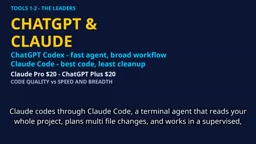
2026 AI Coding Tools Comparison: Claude, ChatGPT, Gemini — Which Is the Best?
A 2026 comparison of five mainstream AI coding tools — Claude Code, ChatGPT Codex, Gemini, DeepSeek, and GitHub Copilot — on real projects, pricing, and code quality, to help you decide where that $20/month should go.

ChatGPT Codex Can Clone Any Software? Testing the Risks and the Truth
YouTube shorts claim ChatGPT Codex or Claude Code can clone Adobe, Excel, and Figma for lifelong free use. We break down the feasibility, legal risks, and DM-funnel tactics—and explain what AI coding tools are truly good for.

Kilo Code Is Free to Install but Charges for API: Cost Estimation and Configuration Guide
Kilo Code is free to install, but connected AI models are billed per token. This guide covers VS Code extension and CLI setup and shows how to estimate API costs.