First AI-Designed Gun WASP Unveiled: A New Twist in the 3D-Printed Ghost Gun Saga

3D-printed gun pioneer Cody Wilson unveils WASP, the first AI-designed gun, escalating the twin challenges of AI weaponization and ghost gun regulation.
The article reports that Cody Wilson — maker of the world's first 3D-printed handgun 13 years ago — has again claimed a "first": WASP, the first gun designed and built by AI and already live-fire tested. Placing the event in the evolution of ghost guns, it notes that AI design lowers the barrier from professional 3D modeling skills to simply describing needs to an AI, sharpening the dark side of technological democratization. Wilson's controversial identity plus the ethics and legal disputes of AI weaponization make the regulatory dilemma even more acute: AI can bypass design review, 3D printing can bypass manufacturing controls, and regulation of AI-generated content is still in its infancy. The article ends with a core question — when making a gun becomes as easy as generating an image, are regulators, the tech community, and the public ready?
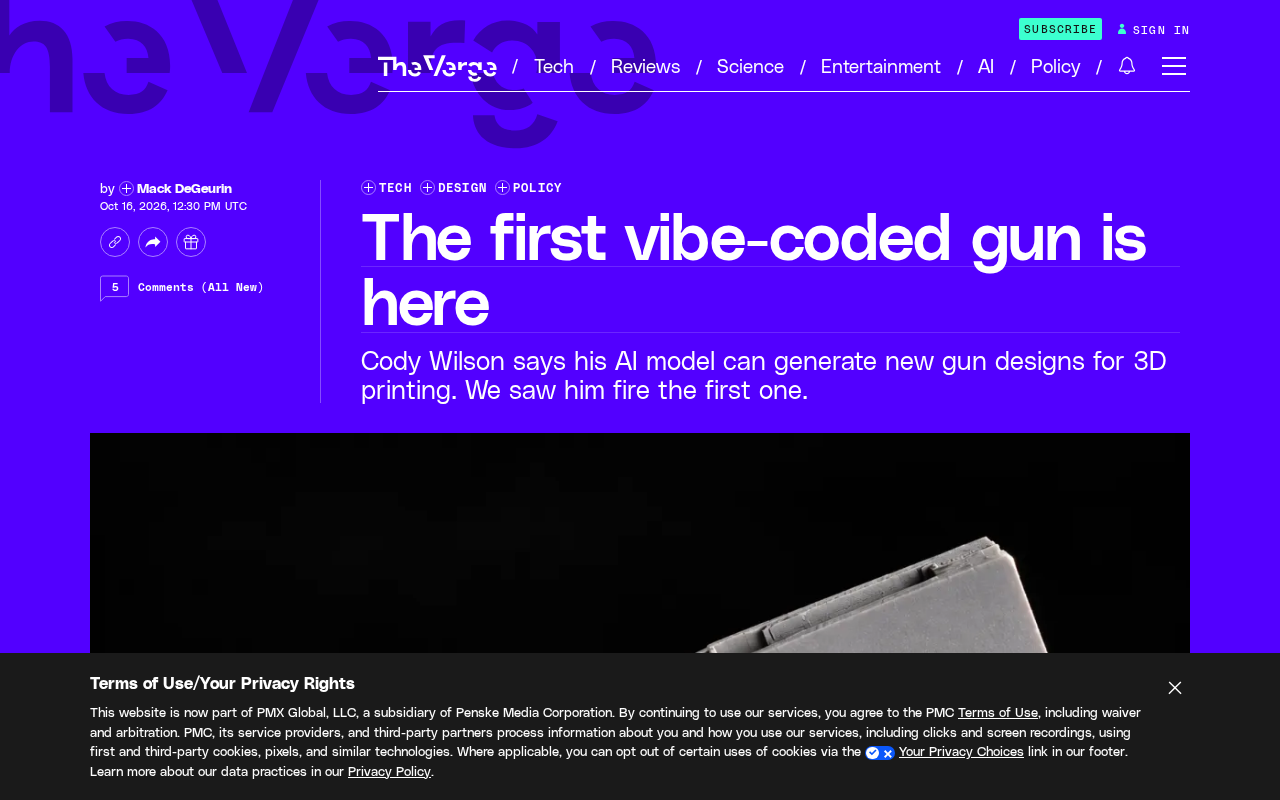
Cody Wilson, the father of 3D-printed guns, is at it again. Thirteen years after successfully rolling out the world's first 3D-printed handgun, the gun rights activist and far-right-friendly provocateur now claims to have pulled off another "first" — the first gun designed and built by AI, called WASP.
From 3D Printing to AI Design: The Evolution of Ghost Guns
Cody Wilson's name is inseparable from the history of "untraceable firearms." Thirteen years ago, he built the first 3D-printed gun, ushering in a chaotic era of ghost guns — weapons with no serial numbers that can't be traced through conventional means, posing enormous challenges to gun control worldwide.
Now Wilson claims WASP is "the first AI-made gun." According to eyewitness accounts, observers stood about 20 feet away as he and his partner secured WASP into position. That detail hints at both the authenticity of the test scenario and its potential danger — an AI-designed weapon is no longer a theoretical exercise, but has entered live-fire testing.
If the claim holds up, it means the barrier to making guns has been lowered even further: from requiring professional 3D modeling skills to simply describing what you want to an AI. The dark side of this technological democratization is coming into focus.
Ghost Gun refers to a firearm that is self-manufactured without a license, has no serial number, and cannot be traced through normal channels. Under U.S. federal law, commercially manufactured firearms must be stamped with a serial number and recorded, but guns made by individuals for personal use have long been exempt from this requirement. After Cody Wilson released the "Liberator" single-shot pistol in 2013, plastic 3D-printed guns quickly entered the public eye. Regulators have since tried to tighten the rules: the U.S. Department of Justice issued a rule in 2022 requiring kit manufacturers to treat "80% receivers" as firearms and stamp them with serial numbers, but the rule was immediately mired in litigation. The core problem with ghost guns is that — from design to finished product — they can exist entirely outside the traditional supply chain, rendering background checks, distribution tracking, and crime tracing all ineffective at once. AI design further eliminates the last remaining skill barrier.
The Compounding Effect of a Controversial Figure and Controversial Technology
Wilson's identity labels are themselves steeped in controversy: gun rights activist, alt-right-friendly provocateur. Every one of his technological breakthroughs has come with dual questions of ethics and legality. The concept of AI-designed weapons pushes that controversy to a new level.
Supporters might see it as yet another milestone in technological innovation, but critics see the risk of a total regulatory failure. When AI can bypass traditional design review, and when 3D printing can bypass manufacturing controls, the existing gun law framework is nearly powerless. This isn't just a technical problem — it's a deep challenge for governance.
The Real-World Perils of AI Weaponization
WASP's emergence raises an urgent question: when AI is used for weapons design, do we have enough capacity and will to regulate it?
From a technical standpoint, AI-assisted design isn't hard to achieve — generative AI has already shown its potential in engineering. But applying it to gun manufacturing crosses legal and ethical red lines. Regulation of AI-generated content is still in its infancy in most countries, let alone AI-designed physical weapons.
Wilson's WASP may just be the beginning. As AI tools become more widespread, similar "firsts" could emerge one after another. Finding the balance between protecting technological innovation and safeguarding public safety will be a challenge we must confront head-on in the years ahead.
This weapons manufacturing revolution, driven by both AI and 3D printing, is forcing regulators, the tech community, and the public to rethink: when making a gun becomes as easy as generating an image, are we ready?
Generative AI applications in engineering typically rely on topology optimization and parametric design: users specify constraints like loads, dimensions, and materials, and the model searches through millions of candidate structures for the optimal solution. These tools are widely used in aerospace, automotive lightweighting, and other scenarios. But when the same methods are applied to firearms, AI can output component designs that meet chamber pressure, recoil, and reliability requirements based on nothing more than a text description, bypassing the explicit knowledge bottleneck of human designers. Most mainstream AI platforms' terms of service prohibit generating weapons-related design content, but open-weight models and local deployment environments make such restrictions difficult to enforce. This means regulation can only target the manufacturing end (such as printing materials and machine tool sales) and the finished-product end (such as serial numbers and possession permits), not the design stage.
One-line Summary
Related articles

Build an AI Super Employee System at Zero Cost: A Full Breakdown of Automated Agent Workflows
A deep breakdown of the AI super employee system demoed on Bilibili: agent orchestration, digital human voiceovers, map and enterprise lead generation, 24/7 customer service, and legal modules. We analyze the business logic and compliance risks behind zero-cost signup to help entrepreneurs judge the real ROI of this AI digital employee system.

The Essential Difference Between Chatbots and AI Agents: Crossing from Conversation to Execution
What's the difference between a chatbot and an AI agent? Based on the MCP series on the Learn Tech channel, this article uses examples like booking flights and summarizing notes to explain: a chatbot only gives answers, while an agent actually completes tasks through a think-act-observe loop. It breaks down the four core components—model, tools, memory, and goal—as well as MCP's role as a bridge, and discusses agents' applicable boundaries and permission risks.

Free GitHub Repo: 342 Hours of AI Courses, from Math to MCP Servers
A free GitHub repo offers 342 hours of AI courses: 523 lessons across 20 phases, from math fundamentals to agent building and MCP servers. Nearly 100,000 learners have started.