Fitbit Edge Launches: Google's New Mid-Range Wearable Option

Google launches the $179.99 Fitbit Edge with OLED and a lightweight design to fill its wearable mid-range gap.
Google has released the Fitbit Edge at $179.99, positioned between the Fitbit Air and Pixel Watch to fill a mid-range price gap in its wearable lineup. It retains the Fitbit Air's lightweight feel and features an OLED display, targeting users who want long wear time without compromising on display quality. The launch marks the maturation of Google's dual-brand tiered strategy, though its success depends on software and health tracking differentiation.
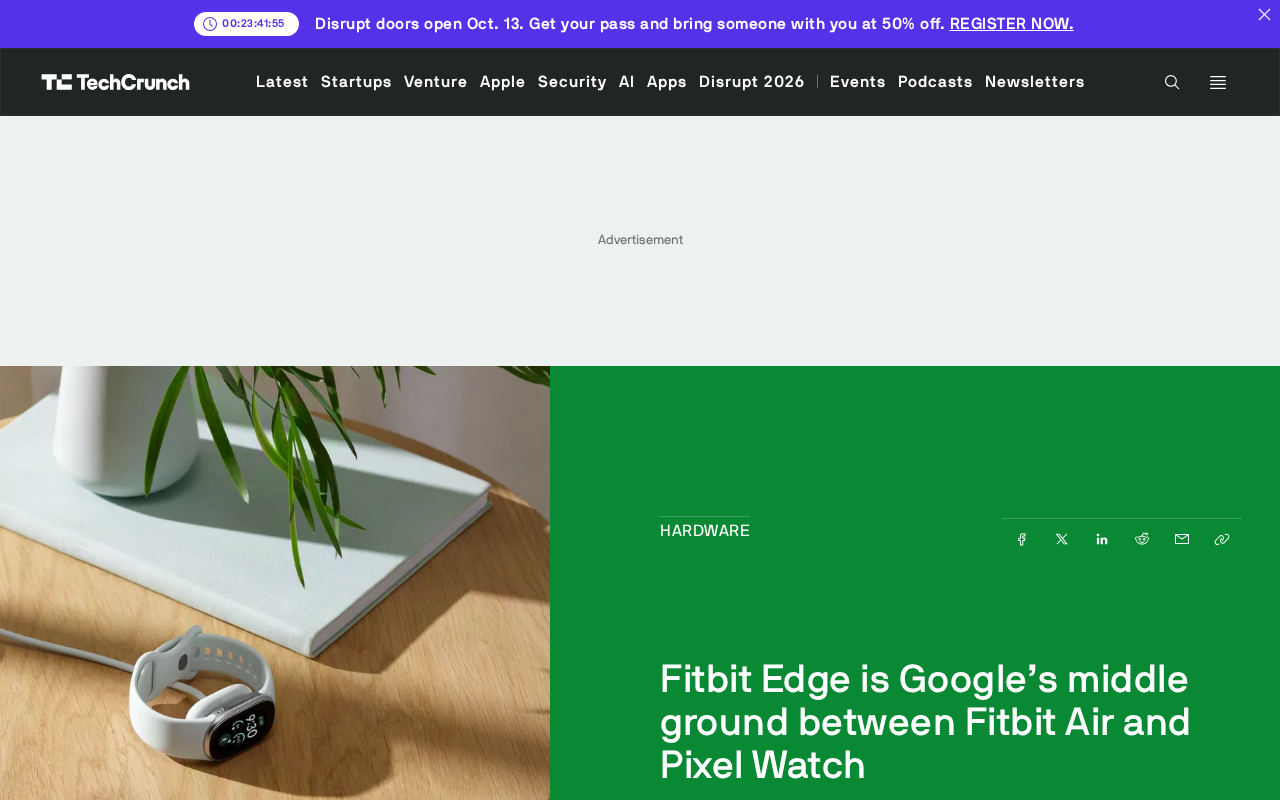
Google has added another member to its wearable lineup. The newly launched Fitbit Edge is priced at $179.99, positioning itself between the Fitbit Air and the Pixel Watch, in an attempt to strike a more precise balance between price and features.
Product Positioning: A Middle Option That Fills the Gap
Google's wearable lineup previously had an obvious price gap: the Fitbit Air focused on being lightweight and affordable, while the Pixel Watch represented a flagship experience, with nothing in between to bridge the two. The Fitbit Edge arrives precisely to close that gap.
The $179.99 price point is a clever strategy. It offers more quality than entry-level products while not intimidating budget-conscious users the way the Pixel Watch does. This "middle path" is hardly unusual in consumer electronics, but Google choosing to replicate this logic in wearables suggests the company has developed a clearer understanding of market segmentation.
Design Language: The Air's Lightweight Feel + OLED Display
According to the original source material, the Fitbit Edge carries on the "sleek feel" of the Fitbit Air while featuring an OLED display. This means it hasn't sacrificed display quality to cut costs — the contrast and color performance that OLED delivers is something many products at this price point struggle to offer.
A lightweight body paired with a high-quality screen points to a clear target audience: those who want to wear a device for extended periods without compromising on visual experience. For fitness tracking scenarios, a lightweight design directly impacts wearing comfort, while the OLED screen makes real-time viewing of heart rate, step count, and other data much clearer.
OLED (Organic Light-Emitting Diode) differs fundamentally from common LCD screens in how it works: each pixel in an OLED can emit light independently, and when displaying black, the pixels simply turn off, achieving near-infinite contrast with purer blacks and richer colors. The absence of a backlight layer also makes the screen module thinner and more power-efficient. These characteristics are especially critical for wearables — a thinner screen helps reduce overall device weight, while low power consumption directly extends battery life. By contrast, the LCD panels commonly used in products at this price point require an always-on backlight layer, resulting in washed-out blacks and higher power consumption. So offering OLED at the $179.99 price point is a substantive differentiator for the Fitbit Edge relative to competitors, not just a spec sheet bragging point.
Google's Wearable Chess Game
From a broader perspective, the launch of the Fitbit Edge reflects the maturing of Google's dual-brand strategy in wearables. The Fitbit brand carries a broader user base, the Pixel Watch anchors the high-end market, and the Edge sits right at the intersection of the two.
The potential benefit of this layout is broader coverage: whether users are trying a smart wearable for the first time or migrating from another brand, they can find an option at the corresponding price point within Google's product matrix. But challenges exist as well — mid-range products often need more precise selling points, otherwise they risk falling into the awkward position of being "not as good as the top, but better than the bottom."
Whether the Fitbit Edge can establish itself with its combination of OLED display and lightweight design depends on whether Google can deliver sufficient differentiation in software experience and health tracking features. Price is just the entry ticket — the real competition lies ahead.
Google completed its acquisition of Fitbit in 2021 and has since pursued a dual-brand parallel strategy: Fitbit continues its user base and accessible positioning in the mass health tracking market, while the Pixel Watch relies on Wear OS and the Pixel ecosystem to deliver a flagship experience with deeper smart features. The two have gradually been integrated in terms of operating system and account systems, but maintain separation in price bands and target audiences. The Fitbit Edge falls between the two, effectively a further refinement of this tiered strategy — using the same set of health data and software capabilities to cover a continuous price range from entry-level to high-end, thereby reducing the likelihood of users switching to competitors like Apple or Samsung.
One-line Summary
Google launches the $179.99 Fitbit Edge with an OLED screen and lightweight design to fill the mid-range gap in its wearable lineup.
Paragraph Summary
Google has released the Fitbit Edge at $179.99, positioned between the Fitbit Air and Pixel Watch to fill a long-standing mid-range price gap in its wearable lineup. The product retains the Fitbit Air's lightweight feel and features an OLED display, controlling costs without sacrificing visual experience. It targets users who want to wear a device for extended periods without compromising on display quality. Strategically, the Edge's launch marks the maturation of Google's dual-brand tiered strategy with Fitbit and Pixel Watch: Fitbit covers the mass market, Pixel Watch anchors the high end, and the Edge sits at their intersection, expanding overall coverage. However, a mid-range positioning also means it needs more precise selling points, and its success ultimately depends on whether software experience and health tracking features can form sufficient differentiation.
Related articles

Free Unlimited Claude Code Solution: Agnes AI + CC Switch Setup Guide
No paid subscription needed — pair the free AI platform Agnes AI with the open-source tool CC Switch to provide a backend for Claude Code, enabling unlimited free calls to text, image, and video models. This guide covers the full setup, test results, and usage boundaries.

A Complete Zero-Cost Guide to Getting Started with Claude Code for Beginners in China
A beginner's guide to Claude Code for users in China: two installation methods (command line and IDE plugin), full configuration steps for replacing the official API with the free domestic LongCat model, and a hands-on demo of building a small tool with natural language, plus tips.

When the NSA Gets Involved: The AI Supply Chain Crisis Behind Open-Source CVEs and API Key Hijacking
Multiple open-source projects disclosed severe CVEs in one day, PHP flaws alarmed the FBI, and Railway and OpenCode were breached with API keys stolen. This article breaks down the vulnerability window, AI-accelerated exploitation, and the AI supply chain crisis behind the API key black market, with a developer defense checklist.