Five Industry Implementations of LLM FDE: Vibe Coding and DeepSeek Harness Explained

An overview of implementation pathways and engineering key points for large models in five industries from the FDE role perspective.
Based on a Bilibili technical livestream, the article introduces FDE (Forward Deployed Engineer), a hybrid role connecting business and technology, and argues that the real difficulty for enterprises adopting large models lies in the last mile from demo to production. The livestream lists five industry scenarios—tax approval, smart logistics, medical records, e-commerce customer service, and defense/industrial early warning—with technology combinations mainly based on multimodal RAG, distributed retrieval, and multi-Agent collaboration. It also mentions Vibe Coding and DeepSeek Harness as efficiency tools but notes that the livestream did not elaborate on details. Finally, it summarizes three key points for deployment: progressive scenario prioritization, technology combinations rather than single points, and engineering capabilities such as high concurrency and permission control, and recommends that learners understand business logic before practicing with source code.
Large language model deployment is hard—the real challenge lies in the last mile from demo to production. In a technical livestream on Bilibili, instructor Dayu (who describes himself as nearly 40 years old and having spent 8 years as a project manager at a listed company in Beijing) presented multiple enterprise-level projects from the perspective of the FDE (Forward Deployed Engineer) role, covering industries such as e-commerce, power, healthcare, and logistics, and mentioned toolchains including Vibe Coding automated programming and DeepSeek Harness. Based on the livestream content, this article outlines the role of FDE in enterprise deployment, typical scenarios, and practical pathways.

FDE: A New Key Role in AI Deployment
FDE (Forward Deployed Engineer) is not simply an algorithm engineer, but a hybrid role that requires understanding both business scenarios and technology stacks. The livestream emphasized that traditional enterprises (such as tax and finance reimbursement, logistics, healthcare, and manufacturing) often get stuck between "technically available" and "business-embeddable" when introducing large models. The FDE's responsibility is to break down technologies such as RAG, Agents, and multimodal fine-tuning into deliverable engineering modules, and to be on-site to solve data, process, and system integration issues.
According to the livestream, enterprise-level projects currently show significantly rising demand for capabilities such as multimodal RAG, distributed retrieval, and high-concurrency Agents. For example, a group-level tax and finance reimbursement project needs to handle multi-format invoices, approval workflows, and permission control. Simply calling an API cannot meet compliance and accuracy requirements; multimodal models must be combined with rule engines.

RAG (Retrieval-Augmented Generation) is a technical paradigm that combines external knowledge base retrieval with large model generation: the system first retrieves snippets relevant to the user's question from a document library, then feeds these snippets as context to the large model to generate grounded answers. Compared with relying solely on memory in model parameters, RAG can significantly reduce hallucinations, support private data access, and allow knowledge updates without retraining the model. The difficulty of enterprise-level RAG lies not in calling it, but in document parsing, chunking strategies, embedding model selection, joint tuning of recall and reranking, and permission filtering—that is, different users can only retrieve content they are authorized to view. Multimodal RAG further brings images, tables, and scanned documents into the retrieval scope, which is exactly the capability needed for scenarios such as tax invoices and medical records.
Agent refers to a system with an LLM as its decision core that can autonomously plan steps and call external tools (retrieval, databases, business APIs) to complete complex tasks. Unlike single-turn question answering, an Agent typically includes a loop of task decomposition, tool selection, result validation, and multi-round reflection. Multi-Agent collaboration allows multiple agents with different roles (such as a retrieval Agent, validation Agent, and execution Agent) to collaborate on long-process tasks, at the cost of increased latency and state management complexity, so production environments often require orchestration frameworks and concurrency control.
Breakdown of Five Industry Implementation Scenarios
The livestream listed multiple projects, which can be summarized into five categories of industry scenarios:
Tax and approval: For large enterprise financial reimbursement, multimodal Agents are used to recognize invoices and extract fields, combined with RAG to retrieve historical approval records, reducing manual review costs.
Smart logistics: To address complex logistics nodes and high labor costs, a smart logistics system is built to enable inventory queries, warehouse data completion, and anomaly detection. The livestream mentioned that this scenario requires high-concurrency retrieval and multi-Agent collaboration.
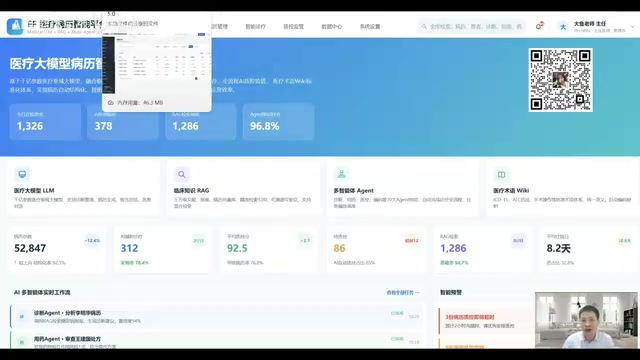
Medical record management: Writing medical records in tertiary/secondary hospitals consumes a large amount of doctors' time. The project uses multimodal RAG and multimodal Agents to structure and intelligently manage medical records while meeting medical data privacy requirements.
Smart customer service and e-commerce: Based on high-frequency retrieval needs in e-commerce scenarios, model selection and multi-path retrieval (such as distributed retrieval) are combined to improve customer service response accuracy. A project for a listed liquor company falls into this category, combining Agent, multimodal, and RAG technologies.
Defense and industrial early warning: Involves model fine-tuning and early warning surveillance systems, a scenario with extremely high reliability requirements. The livestream described this project as a central state-owned enterprise deployment, without elaborating on technical details.

Vibe Coding and DeepSeek Harness: The Leverage Effect of Toolchains
The livestream title mentioned Vibe Coding automated programming and DeepSeekAd Harness, but the main content did not elaborate on technical details. Inferring from context, Vibe Coding refers to a development paradigm driven by natural language intent for code generation, which can accelerate FDEs' prototype building and API integration in projects; DeepSeek Harness may refer to an evaluation/orchestration framework built around DeepSeek models for model selection and performance validation. For FDEs, such tools can compress repetitive engineering work and focus energy on business logic and data governance.
Note that the livestream did not provide specific usage demonstrations or performance data for these two tools, so readers should be cautious about their maturity.
Vibe Coding was coined by Andrej Karpathy in early 2025, referring to developers describing intent in natural language while AI directly generates and iterates code, with humans playing more of a reviewer and direction-setting role. Its typical workflow is: describe requirements → model generates code → runtime error → paste the error back to the model → continue fixing. It significantly improves efficiency for prototyping, scripting, and API glue code, but in production code involving complex state, concurrency safety, and compliance auditing, human review and test coverage are still required; otherwise, hidden defects that are difficult to locate can accumulate.
From Demo to Launch: Three Key Points for FDE Deployment
Based on the livestream content, enterprise deployment is not about stacking technologies but requires attention to three points:
First, scenario prioritization. The livestream repeatedly emphasized progression "from simple to medium to enterprise-level," recommending starting with scenarios that have clear boundaries and available data, such as tax reimbursement, and then expanding to complex systems such as logistics and healthcare.
Second, technology combinations rather than single points. Multimodal RAG, distributed retrieval, and multi-Agent collaboration often need to be used together. For example, the liquor e-commerce project simultaneously adopted Agent, multimodal, and RAG to cover retrieval, understanding, and decision-making.
Third, engineering capability. The livestream mentioned terms such as "high concurrency," "distributed," and "permission control," indicating that production environments have far higher requirements for stability and compliance than demos. FDEs need system integration and operations awareness.
For learners, the livestream recommended focusing on the ideas rather than merely copying code, and mentioned that beginners should first understand the logic and then practice with project source code. This view aligns with the current learning path for AI application development: tools will iterate, but business abstraction ability is more enduring.
Overall, the livestream provides an industry perspective and project list for the FDE role, but its technical depth is limited and it is more of a directional sharing. For implementation, specific architecture design and data solutions still need to be supplemented.
Distributed retrieval refers to a retrieval architecture that distributes indexes and queries across multiple nodes to support large-scale document volumes and high-concurrency queries. Common practices include vector index sharding, replica redundancy, approximate nearest neighbor (ANN) algorithms (such as HNSW and IVF), and query aggregation and reranking. In enterprise scenarios, when document volume reaches millions or more or concurrent requests surge, recall latency in a single-machine vector database will noticeably degrade, so sharding and caching strategies are needed. Supporting elements include batch inference of embedding models, incremental index updates, and recall quality monitoring—these are engineering details that FDEs must handle during delivery, and they are the most intuitive reflection of the gap between demos and production systems.
One-line Summary
An overview of implementation pathways and engineering key points for large models in five industries from the FDE role perspective.
Paragraph Summary
Based on a Bilibili technical livestream, the article introduces FDE (Forward Deployed Engineer), a hybrid role connecting business and technology, and argues that the real difficulty for enterprises adopting large models lies in the last mile from demo to production. The livestream lists five industry scenarios—tax approval, smart logistics, medical records, e-commerce customer service, and defense/industrial early warning—with technology combinations mainly based on multimodal RAG, distributed retrieval, and multi-Agent collaboration. It also mentions Vibe Coding and DeepSeek Harness as efficiency tools but notes that the livestream did not elaborate on details. Finally, it summarizes three key points for deployment: progressive scenario prioritization, technology combinations rather than single points, and engineering capabilities such as high concurrency and permission control, and recommends that learners understand business logic before practicing with source code.
Related articles

Free Unlimited Claude Code Solution: Agnes AI + CC Switch Setup Guide
No paid subscription needed — pair the free AI platform Agnes AI with the open-source tool CC Switch to provide a backend for Claude Code, enabling unlimited free calls to text, image, and video models. This guide covers the full setup, test results, and usage boundaries.

A Complete Zero-Cost Guide to Getting Started with Claude Code for Beginners in China
A beginner's guide to Claude Code for users in China: two installation methods (command line and IDE plugin), full configuration steps for replacing the official API with the free domestic LongCat model, and a hands-on demo of building a small tool with natural language, plus tips.

When the NSA Gets Involved: The AI Supply Chain Crisis Behind Open-Source CVEs and API Key Hijacking
Multiple open-source projects disclosed severe CVEs in one day, PHP flaws alarmed the FBI, and Railway and OpenCode were breached with API keys stolen. This article breaks down the vulnerability window, AI-accelerated exploitation, and the AI supply chain crisis behind the API key black market, with a developer defense checklist.