Flash-MSA: How Sparse Attention Kernels Break the Million-Token Training Barrier
Flash-MSA: How Sparse Attention Kernel…
Flash-MSA brings sparse attention kernels to GPU-level to enable efficient million-token LLM training.
Flash-MSA (Flash Multi-Sparse Attention) addresses the quadratic compute bottleneck of standard Transformer attention by implementing sparse attention at the GPU kernel level. Building on FlashAttention's memory efficiency, it further reduces the number of token pairs computed, targeting near-linear complexity for ultra-long sequences. The project represents a key step toward making million-token model training practically feasible.
Introduction: The Compute Bottleneck in Long-Context Training
As demand for ultra-long context windows in large language models continues to rise, training models that support million-token sequences has become one of the central challenges in AI infrastructure. Flash-MSA (Flash Multi-Sparse Attention), a project that recently surfaced on Hacker News, targets exactly this pain point — aiming to shatter the compute ceiling of traditional attention mechanisms through sparse attention kernels.
This article examines the core ideas behind Flash-MSA, analyzes the value of sparse attention in ultra-long sequence training, and explains why it may become a critical component of next-generation long-context model training.
Why Million-Token Training Is So Difficult
Standard Transformer self-attention has an unavoidable problem: computational complexity scales quadratically (O(n²)) with sequence length. When a sequence grows from 4K to 1M tokens, the compute and memory requirements for the attention layer explode exponentially.
The root cause lies in how self-attention works: for a sequence of length n, every token must compute a dot-product similarity with all other n tokens, producing an n×n attention matrix. This means both compute and memory scale quadratically — storing a complete 1M×1M attention matrix in FP16 would theoretically require roughly 2TB of VRAM, far exceeding the capacity of any existing GPU.
Dual Pressure: Memory and Compute
For million-token sequences, just storing the full attention matrix demands astronomical amounts of memory. FlashAttention partially addressed this: proposed by Tri Dao et al. at Stanford in 2022, it exploits the speed differential between GPU SRAM (on-chip cache) and HBM (high-bandwidth memory) by using a tiling strategy to break attention computation into small blocks, completing calculations in SRAM and only writing final results back to HBM. This reduces memory I/O complexity from O(n²) to O(n), avoiding explicit materialization of the full attention matrix — and has since become a standard component in mainstream LLM training frameworks.
However, FlashAttention's optimization fundamentally targets memory access efficiency; the underlying computation remains dense — every token still interacts with every other token. This is precisely the core contradiction Flash-MSA aims to resolve: preserving FlashAttention's memory efficiency while further reducing the number of token pairs that actually participate in computation.
Flash-MSA Core Principles: Sparse Attention Kernels
Flash-MSA's key insight is introducing sparsity into high-performance attention kernels. The fundamental assumption is that in ultra-long sequences, not all token interactions are equally important. A large number of distant, low-relevance token pairs contribute negligibly to the final output, yet consume the vast majority of compute.
From Dense to Sparse Computation
Through carefully designed sparse patterns, Flash-MSA only computes attention blocks deemed "important," reducing effective computational complexity from O(n²) to near-linear or sub-quadratic. The challenge here is not theoretical — it lies in engineering: how to efficiently execute irregular sparse computations on GPUs while maintaining hardware utilization.
The Core Value of Kernel-Level Optimization
This engineering challenge stems from GPU hardware architecture itself: GPUs' SIMD (Single Instruction, Multiple Data) execution model and memory access patterns are most efficient when handling contiguous, regular matrix operations. Sparse computation introduces irregular memory access — different warps need to access non-contiguous memory addresses, preventing memory transaction coalescing and severely degrading actual throughput. Additionally, the dynamic nature of sparse patterns causes thread divergence, further reducing hardware utilization. This is why sparse attention has long suffered from the dilemma of being "theoretically efficient but practically sluggish."
The "Flash" and "Kernels" in the project name signal its positioning: this is a low-level GPU kernel implementation, not merely an algorithmic sparse attention scheme. Flash-MSA attempts to overcome these engineering bottlenecks through deep kernel-level optimization, turning sparsity into genuine end-to-end training acceleration.
The Technical Lineage of Sparse Attention
Sparse attention is not a new concept — its exploration dates back to around 2020. Longformer (Allen AI) used a hybrid approach combining sliding-window local attention with a small number of global tokens to reduce complexity to O(n). BigBird (Google) added random attention blocks on top of local attention, with theoretical proof of its equivalence to full attention's expressiveness. Reformer took a different path, using Locality-Sensitive Hashing (LSH) to cluster similar tokens before computing attention, pioneering the direction of dynamic sparse selection.
Around 2024, DeepSeek's NSA (Native Sparse Attention) represented a new generation of native sparse attention thinking: rather than treating sparsity as a post-hoc approximation, NSA embeds sparse patterns directly into the model architecture from the pretraining stage, allowing the model to naturally learn to leverage sparse structures — achieving structural speedups while maintaining accuracy, and bringing this direction into the mainstream.
Flash-MSA can be seen as a continuation and engineering realization of this lineage. Its value lies not in proposing new sparse theory, but in refining sparse attention into a high-performance tool directly usable for million-token training. For teams looking to train ultra-long context models, open-source kernels like this can significantly lower the infrastructure barrier.
Potential Impact and Application Scenarios
Practical Significance for Long-Context Applications
If Flash-MSA delivers on its acceleration promises, it would directly benefit a range of use cases requiring ultra-long contexts: understanding and analyzing entire books, intelligent retrieval across large codebases, multimodal processing of long videos and audio, and agent systems that need to maintain long-term memory. These scenarios have previously been difficult to scale due to training costs.
Areas That Warrant Caution
Interestingly, the project is still in the early community validation stage. Sparse attention approaches generally share a common concern: the trade-off between accuracy and efficiency. This risk stems from whether the core assumption holds — whether pruned token pairs are truly "unimportant." Research shows that long-range dependencies are critical signals for many reasoning, coreference resolution, and cross-segment information integration tasks; aggressive local sparsity strategies may systematically sever these signals.
Current mainstream mitigation strategies include: introducing a small number of "global tokens" as information aggregation nodes, using hierarchical sparsity (different sparsity rates at different layers), and dynamically selecting important token pairs based on attention score predictions rather than fixed sparse patterns. Finding the optimal balance between sparsity rate and downstream task accuracy remains a core open problem in this field. How well Flash-MSA can balance acceleration and accuracy still requires validation through real-world training benchmarks and downstream task evaluations.
Conclusion
Flash-MSA represents an important direction in long-context training optimization: transforming sparsity from an algorithmic concept into a deployable, high-performance GPU kernel. As model context windows continue to expand, advances in underlying infrastructure often determine the practical limits of what's technically feasible more than architectural innovations in the models themselves.
For developers and researchers focused on LLM training efficiency, Flash-MSA is worth tracking. Whether it can become the "FlashAttention" of the million-token era ultimately depends on its performance under real training workloads and on the collective refinement and validation of the open-source community.
Key Takeaways
Related articles
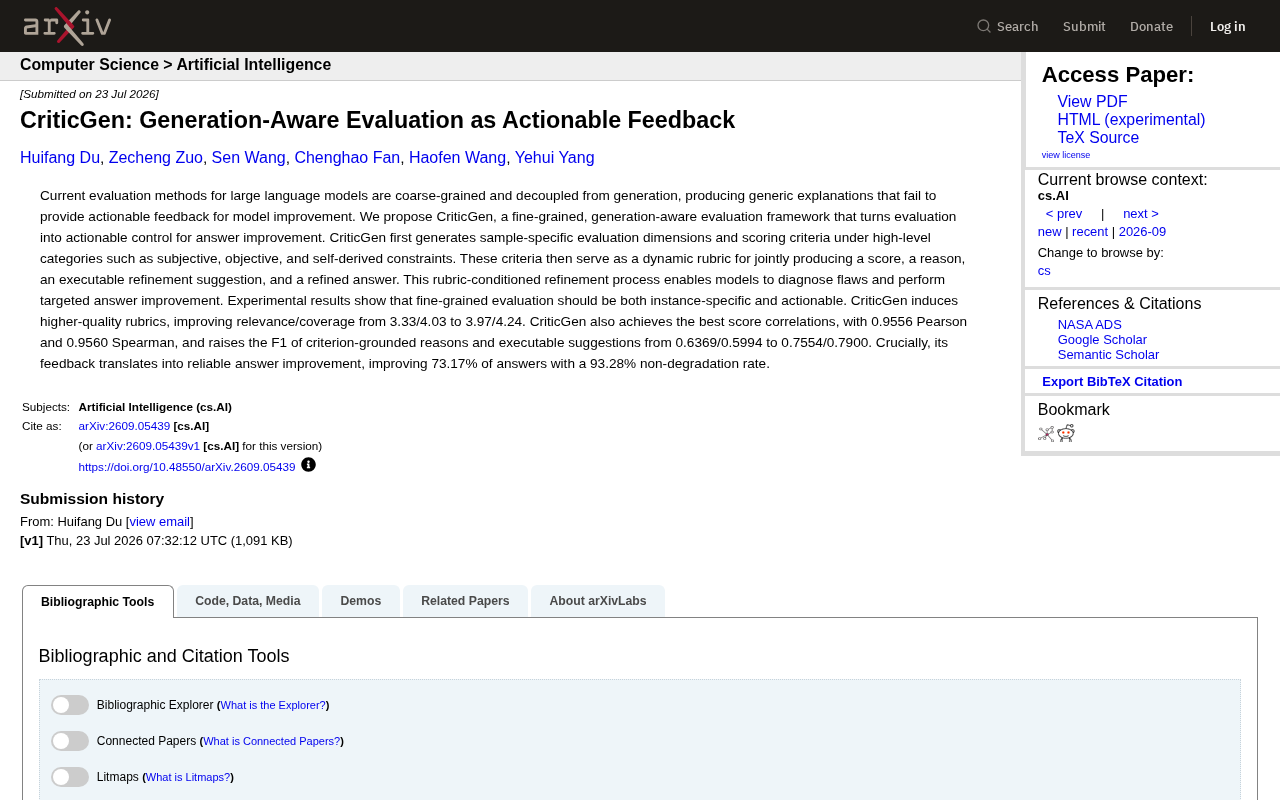
CriticGen: A New Framework That Transforms AI Evaluation into Actionable Improvement Feedback
CriticGen proposes a generation-aware evaluation framework that transforms AI assessment from passive scoring to an active optimization loop, achieving 73.17% answer improvement and 93.28% non-degradation rate.

Vercel AI SDK workflow-harness Update Analysis
Deep analysis of Vercel AI SDK workflow-harness 1.0.107 update: architecture design, engineering practices, and developer value for building reliable AI apps.

Rootless Containers Explained: Principles, Benefits, and Leading Implementation Approaches
A deep dive into rootless container principles and security benefits, comparing Podman, Docker Rootless mode, and Kubernetes integration with practical migration advice.