FLOPs Are Intelligence, Parameters Are Knowledge: Understanding the Essence of AI Large Models in One Sentence

FLOPs measure a model's reasoning ability while parameters store its learned knowledge.
A viral insight distills AI large models into two dimensions: FLOPs (compute) as intelligence for reasoning and inference, and parameters as knowledge for memory and storage. This distinction illuminates two optimization paths — enhancing reasoning through more computation or expanding knowledge through larger parameters — and explains trends like test-time compute and RAG.
A Brilliant Analogy
In AI technical discussions, occasionally a highly distilled insight emerges that reveals the essence of complex systems in the simplest language. A recent comment circulating on Twitter belongs to this category:
"FLOPs were intelligence; parameters were knowledge!"
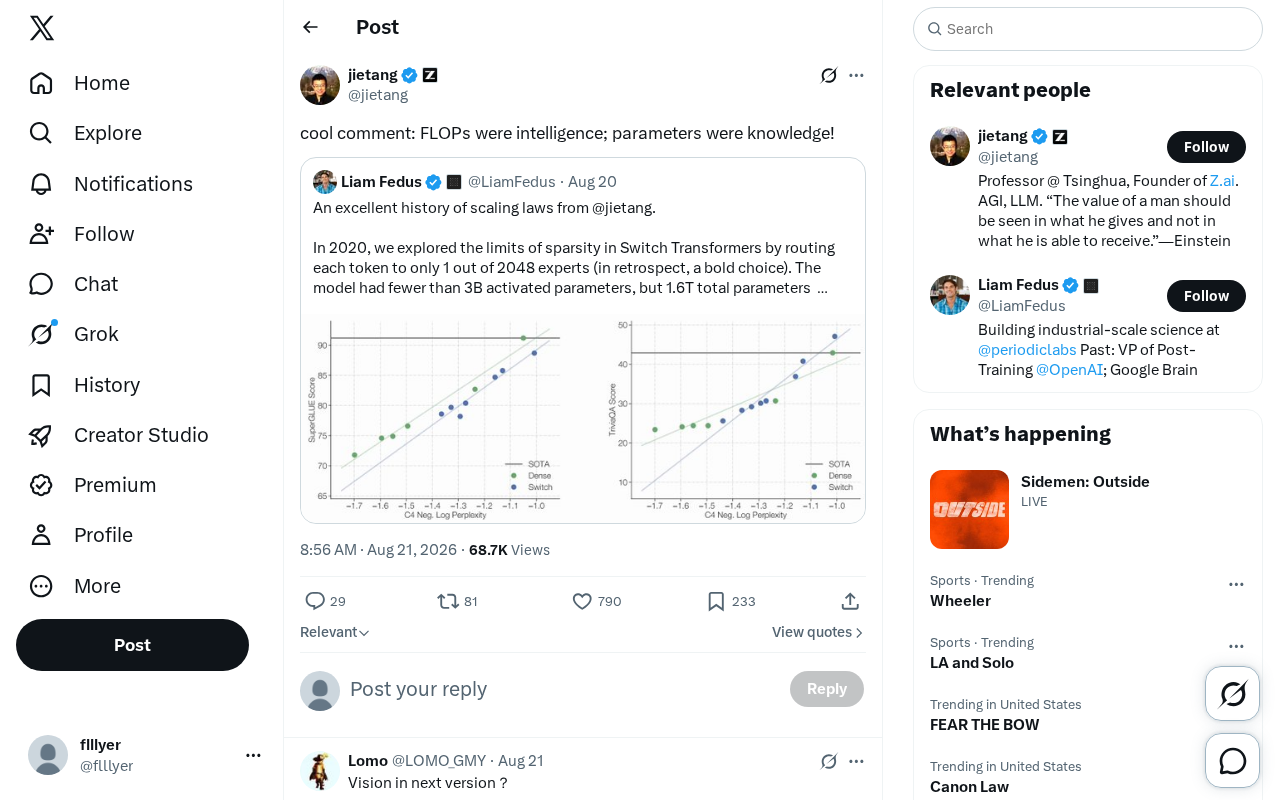
Though just a few words, this statement precisely distinguishes two core concepts frequently confused in modern large language models (LLMs) — compute (FLOPs) and model parameters. They correspond to two different capability dimensions: reasoning intelligence and knowledge storage.
FLOPs: The Computational Dimension of AI Intelligence
What Are FLOPs
FLOPs (Floating Point Operations) is the core metric for measuring model computation. During training and inference, every forward pass and backward pass requires massive amounts of floating-point operations. The scale of FLOPs directly reflects the computational resources invested in model "thinking."
The leap in AI capabilities in recent years largely comes from the exponential growth in training compute. From GPT-3 to GPT-4 to the latest reasoning models, the FLOPs consumed in training have continuously climbed. This computational investment enables models to learn more complex patterns and develop stronger reasoning and generalization abilities.
Why FLOPs Correspond to "Intelligence"
The underlying logic of comparing FLOPs to "intelligence" is this: the essence of intelligence is the ability to process information and reason. More computation means the model can perform deeper pattern recognition and more complex logical deduction.
This is particularly evident in the current wave of reasoning models. Models like OpenAI's o-series and DeepSeekAd-R1 achieve their core breakthroughs precisely by investing more computation during the reasoning phase — extending the chain of thought to allow the model to compute more thoroughly before producing an answer. The rise of test-time compute is essentially a strategy of trading more FLOPs for higher intelligence performance.
Model Parameters: The Storage Dimension of Knowledge
Parameters as Memory
Model parameters are the weight values learned and solidified during training. They function like the model's "long-term memory bank," storing world knowledge, linguistic patterns, and factual information distilled from massive training data.
Comparing parameters to "knowledge" captures a key fact: how much a model can "know" largely depends on its parameter capacity. A model with hundreds of billions of parameters can remember more facts, more linguistic nuances, and more domain expertise. This is why parameter scale is often considered a rough indicator of a model's "breadth of learning."
The Separation of Knowledge and Intelligence
The most profound aspect of this comment is its implication that knowledge and intelligence can be decoupled to a certain extent. A model with massive parameters but insufficient computational depth might be like someone who "has memorized extensively but reasons poorly"; conversely, a model with moderate parameters but sufficient reasoning computation might be like a thinker who "has limited knowledge but sharp thinking."
This insight has far-reaching implications in practical engineering. For example, Retrieval-Augmented Generation (RAG) technology attempts to externalize "knowledge" into databases, freeing the model from compressing all knowledge into parameters, thereby dedicating precious parameter capacity and computational resources more toward "intelligence"-level reasoning.
Implications of This Distinction for AI Practice
Two Optimization Paths for Model Design
Understanding the division of labor between FLOPs and parameters provides clear directions for model optimization:
- Enhancing knowledge: Expanding parameter scale, enriching training data, incorporating external knowledge retrieval
- Enhancing intelligence: Increasing training and inference computation, optimizing reasoning architectures, strengthening chain-of-thought training
In recent years, the industry has gradually realized that simply stacking parameters is not the optimal solution. Research like Chinchilla pointed out that given a fixed compute budget, parameter count and training data volume need to maintain a reasonable ratio. The rise of reasoning models further demonstrates that adding FLOPs during the inference phase can yield significant capability improvements.
Helping Understand AI Capabilities
For general users and practitioners, this analogy also provides a practical mental model: when evaluating an AI model, you can separately ask — how much does it "know" (knowledge/parameters), and how deeply can it "think" (intelligence/compute). These two dimensions together determine the model's performance on real-world tasks.
Conclusion: Depth Behind Simplicity
The comment "FLOPs are intelligence, parameters are knowledge" resonates because it captures, in the most economical language, two fundamental yet often confused dimensions of large model architecture. It reminds us that AI capability cannot be summarized by a single metric — it is the collaborative product of computation and storage, reasoning and memory.
In today's rapidly evolving AI landscape, such distilled insights may help us build correct intuitions more effectively than lengthy technical papers. Of course, as an analogy it is not perfect — in reality, the boundary between knowledge and intelligence is far more blurred — but as a key to understanding the essence of AI, it is undoubtedly worth remembering.
Related articles

Apple HomeView Hands-On Review: Is the $300 Smart Home Hub Worth It?
Apple HomeView hands-on: a $300 smart home hub with facial recognition for quick account switching, but no App Store or voice recognition. Is the wall-mounted version worth it? Should you buy the first generation?

Meta Muse Wonder Launch: What It Means for Meta's Return to the Frontier AI Race
Meta releases Muse Wonder and WonderFull, benchmarks reach the frontier, community feedback is polarized. An in-depth look at Meta's return to the frontier AI race, its personal agent strategy, and Zuckerberg's different path.

Apple Home Smart Home Lineup Leaked: LG and Schneider Team Up, UWB Door Lock on Board
Apple Home ecosystem gains new LG and Schneider devices: UWB smart lock with proximity unlock, 2.5K dual-camera doorbell, privacy indoor camera, and AirPods-like seamless pairing.