Florida Woman's Arrest Over AI Chat Threats Sparks Debate on Privacy and Speech

Florida woman arrested over AI chat threats raises legal questions about privacy and speech liability.
A Florida woman was arrested after allegedly making threatening statements in an AI chatbot conversation, thrusting the privacy and legal accountability of AI interactions into the spotlight. The core tension: users generally treat AI chats as private, but mainstream AI services store conversation data on cloud servers accessible to platforms and law enforcement. Whether speech directed at a non-sentient AI program constitutes a legally actionable "threat" remains legally ambiguous. The case highlights the gap between AI platforms' privacy promises and actual data practices, urging users and developers alike to rethink transparency and responsibility.
Overview
According to foreign media reports, a Florida woman was arrested after allegedly making threatening statements in a conversation with an AI chatbot. The case has sparked widespread debate in the tech community over AI conversation privacy, the limits of content surveillance, and how speech liability should be determined.
Based on publicly available information, the central controversy isn't really about the "threats" themselves — it's about a deeper question: when a user engages in what feels like a private conversation with an AI, should that content be treated as public speech? And can it serve as grounds for criminal charges?
The Technical and Legal Tensions Behind the Case
Private Conversation or Traceable Record?
Most users instinctively treat AI chatbot interactions as a kind of "private space" — similar to talking to themselves or writing in a diary. The reality, however, is that nearly all mainstream AI services store conversation logs on the server side. Many terms of service explicitly state that content may be reviewed, retained, and shared with law enforcement under certain circumstances.
This means that what users perceive as a "private chat" is, technically speaking, data that can be fully read and preserved by the platform. When conversation content crosses red lines such as violent threats, a platform's content safety mechanisms may automatically trigger alerts and report the matter to the relevant authorities.
From a technical architecture standpoint, mainstream AI chat services (such as ChatGPT, Claude, Gemini, etc.) all use cloud-based inference: every user input is sent to the service provider's remote servers for processing, and the response is returned to the client. This architecture means conversation content is inherently stored on third-party infrastructure, not solely on the user's local device. Some services offer a "don't save history" option, but even then, providers typically retain raw logs for a limited window for purposes such as security auditing, abuse detection, and model improvement. The U.S. Electronic Communications Privacy Act (ECPA) offers far weaker protection for stored communications of this kind than it does for real-time calls — law enforcement can request such records from platforms with proper legal documentation. For users who want truly local, private conversations, the only current option is running open-source models (such as the Llama family) locally, ensuring data never leaves the user's own machine.
The Challenge of Defining Threatening Speech
On the legal side, determining whether speech constitutes a threat typically involves assessing intent, the specificity of the target, and whether the threat is actionable. In a human-AI conversation, these elements become blurry — was the user venting to a program with no actual victim, or genuinely planning something?
This is precisely where the controversy lies. Critics argue that equating AI conversations with threats made to real people may over-extend the scope of criminal liability. Those who support law enforcement action counter that explicit violent content should be taken seriously regardless of the intended recipient, especially when public safety is at stake.
The U.S. Supreme Court reaffirmed the standard for threatening speech in its 2023 ruling in Counterman v. Colorado: beyond the objective standard of causing a reasonable person to feel fear, prosecutors must also prove the speaker had subjective "reckless disregard" — meaning they were aware their speech could be understood as a threat and proceeded anyway. In human-AI conversations, proving this subjective element faces additional hurdles: the recipient is a program incapable of experiencing fear, and the speaker's subjective expectations differ fundamentally from those of someone speaking to a real person. Some legal scholars also invoke the "catharsis hypothesis," arguing that venting intense emotions to an AI may itself be a stress-relief behavior rather than an expression of genuine intent. Of course, if the conversation involves specific targets, timelines, or methods, this line of defense becomes far less convincing.
The Tech Community's Perspective
On Hacker News, while the discussion wasn't particularly large, the topics it touched on were highly representative. The case exposed the gap between privacy promises and actual data handling in current AI products, prompting many developers and users to revisit their assumptions about trusting AI services.
The core questions can be summarized as follows:
- Do users fully understand that every exchange with an AI may be logged and reviewed?
- At what threshold should a platform proactively intervene and report content? Who defines that threshold, and is the process transparent?
- How can automated content monitoring systems avoid false positives while balancing security and privacy?
In the content safety field, platform intervention mechanisms are typically divided into two categories: one relies on keyword- or semantic model-based automated detection that scans conversation flows in real time and automatically flags or reports content when specific rules are triggered; the other involves human review queues, where content moderators review flagged material and decide whether to take action. The former is fast but prone to false positives; the latter is more accurate but faces scalability bottlenecks. AI chat contexts present a unique detection challenge: large language models themselves generate fictional content involving violence or crime (for example, when a user asks for a mystery story), and distinguishing creative expression from genuine threats remains an unsolved problem in content safety technology. The reporting thresholds platforms set are typically treated as trade secrets with little external transparency — a point that has been central to critics' concerns.
What This Means for Everyday Users
This case is a wake-up call for everyone who uses AI tools: the AI chat interface is neither a legal gray zone nor an absolutely private space. Whether it's a general-purpose assistant like ChatGPT or an emotional companion AI, what users type is fundamentally data transmitted to third-party servers.
For companies and developers, the case also highlights the importance of clearly communicating data handling practices in product design. Vague privacy policies don't just erode user trust — they can invite far greater legal disputes when liability questions arise.
Conclusion
As AI conversation tools become more deeply embedded in daily life, the legal and ethical questions surrounding them will only multiply. The Florida arrest case, though limited in publicly available detail, is a warning signal worth heeding: the convenience of technology often comes bundled with responsibilities and risk boundaries we don't yet fully understand.
As AI continues to proliferate, finding the right balance between public safety, personal privacy, and freedom of speech will be an ongoing challenge for society as a whole.
Related articles

M&M's Spent Millions Replacing Artificial Blue Dye — Why Is It So Hard?
Mars spent millions trying to replace artificial blue dye in M&M's with spirulina, but thick material clogs pipes and residue risks mold, forcing a full production-line rebuild. Here's the engineering behind the reformulation.

Teammate Wanted for Meta Global AI Developer Hackathon: Computer Vision & Medical AI
A Reddit developer seeks teammates for the Meta Global AI Developer Hackathon, focusing on computer vision and medical AI. This article analyzes the track logic, skills-complementarity needs, and topic selection strategy behind this teaming signal.
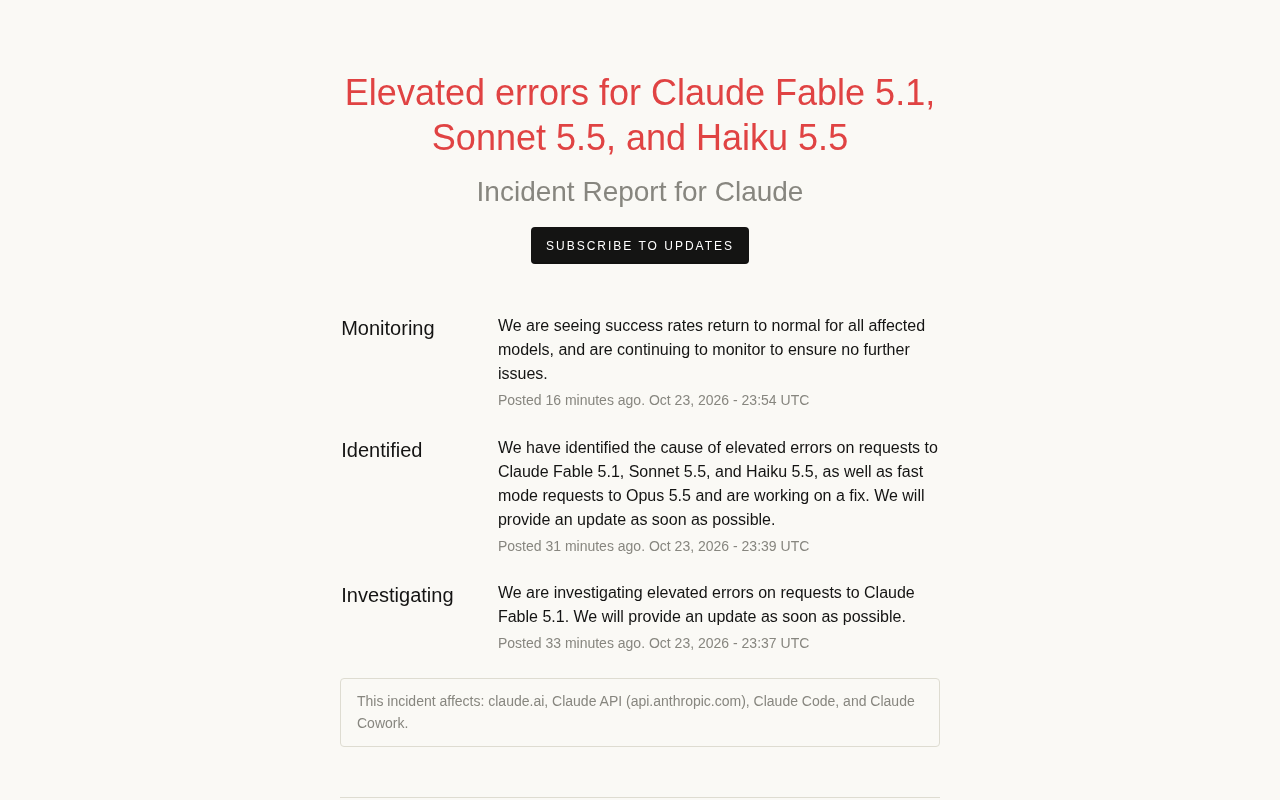
Multiple Claude Models Hit by Errors: A Postmortem of Fable 5.1, Sonnet 5.5, and Haiku 5.5
Claude Fable 5.1, Sonnet 5.5, Haiku 5.5, and Opus 5.5 fast mode saw elevated errors; Anthropic identified and resolved the issue in 17 minutes. This postmortem covers the timeline, the technical reasons for the multi-model cascading failure, and practical lessons for retry and degradation strategies.