Fluent 2: AI Teammates Running Locally on Mac, Combining Privacy and Unlimited Use
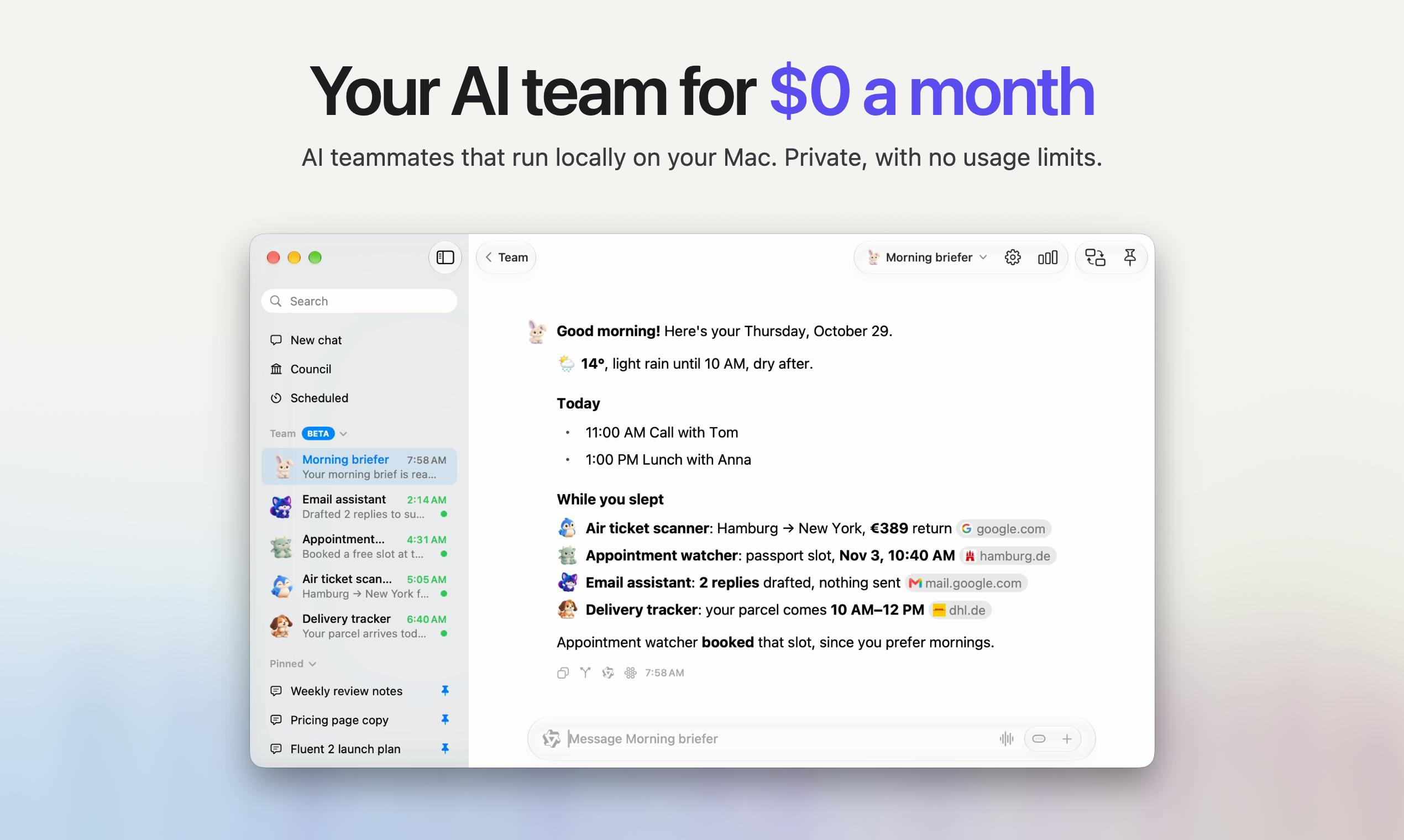
Fluent 2 launches local AI teammates that operate Mac apps like users do, emphasizing privacy, zero monthly fees, and unlimited use.
Fluent 2 introduced the "AI teammate" concept on Product Hunt. Unlike passive chat assistants, its AI can operate various Mac apps like a user and keep working while the user sleeps. Its biggest feature is support for local models, delivering full privacy, no usage limits, and zero monthly cost while retaining flexibility to connect to any cloud model. The article analyzes its core features, working approach, and market positioning, noting that its differentiation lies in local-first operation and zero cost, but it also faces uncertainties such as local model performance, hardware requirements, system permission security, and competition. Overall, it is an early-stage local AI agent attempt with a direction worth watching.
From "Assistant" to "Teammate": Fluent 2 Redefines Local AI
Fluent 2, which debuted on Product Hunt, proposes a compelling concept: AI teammates. Unlike typical chat-based assistants, these AI teammates are designed to "use your apps the way you do" and to "keep working while you sleep." This marks a shift in AI tools from passive responsiveness to proactive task execution.
Fluent 2's most striking feature is its support for running on local models. The official description emphasizes that local operation means "fully private, no usage limits, $0 a month." Amid widespread subscription-based cloud AI services and growing user sensitivity to data privacy, this combination hits a real pain point. Of course, users can also choose any cloud model, preserving flexibility.
Core Features: Local-First, a Win-Win for Privacy and Cost
Local Models: Data Never Leaves the Device
Fluent 2 allows users to run AI teammates entirely locally, with all data processing completed on the Mac. For users handling sensitive information, trade secrets, or personal data, this eliminates concerns about uploading data to the cloud. The official description explicitly states "fully private," with no hidden data collection or transmission.
Local models refer to machine learning models that run directly on a user's device (such as a Mac) rather than calling cloud servers over the internet. These models are typically compressed through techniques like quantization or distillation to reduce memory and compute requirements, enabling them to run on consumer-grade hardware. Common local model frameworks include Ollama, llama.cpp, and LM Studio, which support loading open-source models such as Llama, Mistral, and Qwen. The core advantage of local operation is that data never needs to leave the device, fundamentally avoiding the privacy risks of cloud transmission and storage; it is also free from network latency and API call quotas. The trade-off is that models are typically smaller than cloud flagship models, may perform weaker on complex reasoning and long-context tasks, and place higher demands on the device's unified memory and chip performance.
No Usage Limits, Zero Monthly Fee
Unlike cloud services billed by token or monthly subscription, local operation incurs no additional costs and has no call-count limits. Users can let AI teammates work continuously without worrying about accumulating bills. The officially promoted "$0 a month" directly addresses this pain point.
Cloud Model Compatibility, Flexible Choice
Despite its local-first focus, Fluent 2 is not closed off. Users can choose any cloud model as needed, balancing local privacy with cloud capabilities. This hybrid strategy serves both privacy-sensitive users and scenarios requiring stronger model capabilities.
Operating Apps Like You: How AI Teammates Work
Fluent 2's AI teammates are not simple chatbots but agents capable of "using your apps." This means they can simulate user operations on the Mac, interact with various applications, and automatically complete repetitive tasks.
The official description's phrase "saving hours on your routine" suggests these teammates are designed to handle daily routine work. Although the specific list of supported apps and operational details have not been fully disclosed, this direction aligns with the current trend of AI agents: moving from dialogue generation to actual execution.
"Keep working while you sleep" further emphasizes asynchronous working capability. Users can assign tasks before going offline, let AI teammates continue running in the background, and check results directly the next day. This mode is particularly suitable for time-consuming processes such as data organization, content scraping, or batch processing.
AI agents are AI systems capable of perceiving their environment, autonomously planning, and executing multi-step operations to accomplish goals. Unlike traditional chatbots that only generate text responses, agents can call tools, operate software interfaces, read and write files, and adjust subsequent actions based on execution results. In desktop scenarios, agents typically "understand" and control application interfaces through accessibility APIs (such as macOS's Accessibility API) or screen capture combined with visual recognition. This capability enables them to automatically complete repetitive tasks such as filling out forms, organizing files, and moving data across applications. Current agent technology still faces reliability challenges: interface element recognition may fail, and errors can accumulate across multi-step tasks, making permission isolation and operation confirmation mechanisms key aspects of product design.
Market Positioning and Potential Challenges
Targeting Mac Productivity Users
Fluent 2 explicitly targets the Mac platform, with category tags including Mac, Productivity, and Artificial Intelligence. Mac users typically have high expectations for experience and privacy, and the local AI positioning aligns closely with this group.
Apple Silicon (M-series chips) uses a unified memory architecture in which the CPU and GPU share the same high-bandwidth memory, giving Macs a unique advantage when running local large language models: models can reside directly in unified memory and be accelerated by the GPU for inference, without moving data between VRAM and RAM. A Mac with 16GB or more of unified memory can run quantized models in the 7B to 14B parameter range fairly smoothly, while 32GB or 64GB versions can accommodate larger models. This is also an important reason why many local AI tools in recent years prioritize Mac support. However, local model inference speed is still limited by the chip's GPU core count and memory bandwidth, and actual experience on complex tasks will vary noticeably with hardware configuration.
Competition and Uncertainty
The AI agent track is becoming crowded, with everything from open-source frameworks to commercial products competing for "automated workflow" scenarios. Fluent 2's differentiation lies in local operation and zero cost, but this also brings challenges: Is local model performance sufficient to support complex app operations? What are the Mac hardware requirements? Currently, official information is limited, and the vote count (7) and comment count (1) on Product Hunt also indicate the product is still at an early stage.
In addition, "using apps the way you do" involves system permissions and security issues. Users need to trust that AI teammates will not misoperate or leak data, which places high demands on the product's permission management and transparency.
Conclusion: A Local AI Agent Attempt Worth Watching
Fluent 2 presents a clear value proposition: running AI teammates locally, balancing privacy, cost, and unlimited use. For Mac users who want to automate daily tasks without relying on cloud services, this is a direction worth watching. Although the product is still early and its specific capabilities and experience remain to be verified, its "local-first" approach has differentiating significance in the current AI tool market.
As local model capabilities improve and agent technology matures, the model represented by Fluent 2 may become an important branch of productivity tools.
Related articles

9 AI Subscription Plans Compared: The Real Cost Per 100M Tokens Revealed
Bilibili creator tests 9 AI subscription plans from Volcano, Alibaba, Tencent, Baidu, Zhipu, Xiaomi, MiniMax and more, converting them all to real cost per 100M tokens, breaking down fixed-quota vs. three-tier coefficient billing and how caching, time-of-day discounts, and window limits affect actual quota.

Vibe Coding for Beginners: Expressing Intent Instead of Handwriting Code
What is Vibe Coding? A 137-episode Bilibili course defines it: the core is expressing intent, not writing code. This article analyzes Vibe Coding's productivity logic, target audience, and entry expectations to help beginners decide if it's worth learning.

LangChain Beginner's Guide: An Agent Development Roadmap from LangGraph to Deep Agents
Clarify the encapsulation relationship among LangChain, LangGraph, and Deep Agents, and master the learning path and selection logic for agent development frameworks—suitable for beginners in large model development.