Flush the Toilet and the Internet Drops? Using AI Agents to Find the Culprit

A blogger formed an IT department with AI agents and found that "flushing the toilet drops the network" was actually a physical switch link fault.
The article describes a studio suffering the absurd fault in which "whenever someone flushed the toilet, the whole company disconnected from the NAS." The blogger built an "agentic IT department" of AI agents on the Paperclip platform to investigate. The AI team concluded that the problem was not the toilet but four switch links that had been down for 15 months; physical vibration triggered the links to topple, while other devices on the same switch noticed nothing. The solution was to replace modules and repair the links. The article further notes that agentic IT's value lies in organizing agent collaboration through employee roles, tasks, and timelines to produce traceable conclusions, while human intuition remains irreplaceable for key hypotheses and hidden physical-layer faults should be included in routine inspections.
A "Toilet Fault" That Drove the Whole Company Crazy
According to a real experience shared by the YouTube channel Network Check Studios: at this studio, whenever someone flushed the toilet, everyone got disconnected from the NAS. The blogger recalled that during a meeting, the network suddenly dropped, and he walked out and asked, "Did someone just flush the toilet?" His colleague Mike openly admitted it. This phenomenon, which sounds like a joke, became the direct trigger for his plan to launch an "AI agent IT department."
The goal of this experiment was not simply to troubleshoot a fault, but to build a network and systems engineering, storage, and security team made up of AI agents—a "agentic IT department" running on the Paperclip platform. In Paperclip, agents are employees: there are managers and task assignments, and they communicate with intent and focus through tasks rather than casual chatter. All work has a timeline and is trackable and traceable.
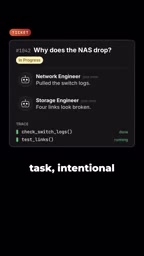
NAS (Network Attached Storage) is a storage device that provides file-level data access over a local area network and is often used by small studios as a shared file server. It does not depend on the internet itself, but it is highly dependent on the stability of LAN infrastructure such as switches and links. The reason "flushing the toilet disconnects the NAS" affects the whole company is precisely that the NAS carries the team's shared assets and project files. Once disconnected, all members reading from or writing to the NAS will simultaneously encounter errors or even lose unsaved work. This also explains why an apparently localized physical-layer fault is perceived as an event that drives the whole company crazy.
The "Official Conclusion" From the AI Team
After having the AI team investigate deeply, the blogger received the official conclusion: the problem was not the toilet. He himself was not convinced, but the investigation did point to another detail—on the Flupowder (the microphone he uses, i.e., the Microtech switch), four links had been down for 15 months.
The actual mechanism was this: any activity that disturbed the building would cause these links to "topple," while other devices on the same switch never noticed anything unusual. Based on this, the blogger offered his own hypothesis: when Mike flushed the toilet, he did so with great force and also opened the door forcefully. This motion shook the equipment in the adjacent server room, thereby triggering the link failure.

The solution therefore became clear: replace the modules and repair these links, rather than continuing to fight the toilet. The value of this conclusion lies in the fact that it reduced an apparently mystical phenomenon—"flush the toilet and the network drops"—to a physical-layer problem that could be located and fixed.
Link in the context of network equipment refers to the physical connection state established between a switch port and the peer device. Switches usually use port indicator lights to show link status: steady on means the link is established, while off or abnormally blinking means the link is down or negotiation has failed. In the article, "four links had been down for 15 months" means that the devices or lines corresponding to these four ports had long been in a physically disconnected state, but because these devices may not have been business-critical, or monitoring focused only on traffic rather than port status, the fault was concealed for a long time. A link "toppling" is usually caused by loose cables, aging modules, power fluctuations, or physical vibration, and is a typical physical-layer issue that requires port status logs and on-site troubleshooting to locate.
What Is Really Worth Noticing About an Agentic IT Department
The interesting part of this video is not just an absurd fault story, but the way AI agents work in IT operations. The blogger emphasized that communication among agents is done "through tasks," with intent, focus, and full traceability. This means they are not simply agreeing with one another in a pile of conversations, but collaborating within an organizational structure that has management relationships and task boundaries.
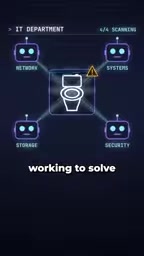
Judging from the state shown in the video, these agents were working simultaneously and continuously advancing tasks. The blogger repeatedly expressed surprise in the video, feeling that the whole scene was "too crazy." This reaction itself shows that when multiple AI agents are organized into a team with division of labor, the density and continuity of their collaboration already exceed many people's everyday expectations.
Agentic systems differ from ordinary chatbots or single-turn Q&A tools in a key way: agents are given goals, tool-calling permissions, and the ability to execute continuously, enabling them to plan, execute, and report autonomously across multi-step tasks. When multiple agents are organized into a team, it is usually necessary to introduce a manager role responsible for task assignment and result aggregation, and to coordinate through a task queue rather than free-form conversation, thereby preventing multiple agents from merely agreeing with one another or falling into endless discussion. The emphasis in the article on "communicating through tasks and full traceability" is precisely the core feature that distinguishes agentic collaboration from traditional automation scripts: every conclusion can be traced back to a specific task and execution record.
Several Lessons for Putting AI Operations Into Practice
First, the value of AI agents is not in replacing a particular tool, but in taking on an "organizational" role. Only when given managers, tasks, and a timeline can they produce traceable conclusions rather than a pile of recommendations that cannot be reproduced.
Second, human intuition still matters in troubleshooting. The AI's conclusion was "it's not the toilet," but the blogger insisted on asking "then what is it?" and ultimately traced the clue to the switch links and physical vibration. Agents are responsible for expanding the search space, while humans are responsible for proposing key hypotheses; neither can be dispensed with.
Third, "old problems" at the physical layer are often the easiest to overlook. Four links had been down for 15 months without anyone noticing, which shows that there is a blind spot in the monitoring system's sensitivity to physical disturbances. Incorporating such hidden faults into routine inspections is more cost-effective than investigating them after the fact.
The ending of this story is not grand: replace the modules, repair the links, and the problem is solved. But the fact that "flush the toilet and the network drops" could be broken down by an AI agent team into an executable maintenance checklist is itself a vivid example of agentic IT moving from concept to practical use.
One-line Summary
A blogger used AI agents to form an IT department and found that "flushing the toilet drops the network" was actually a physical switch link fault.
Paragraph Summary
The article tells how a studio suffered the absurd fault in which "whenever someone flushed the toilet, the whole company disconnected from the NAS," and how the blogger used this as an opportunity to build an "agentic IT department" made up of AI agents on the Paperclip platform for troubleshooting. The AI team's conclusion was that the problem was not the toilet, but four links on the switch that had been down for 15 months; physical vibration triggered the links to topple, while other devices on the same switch noticed nothing. The solution was to replace the modules and repair the links. The article further points out that the value of agentic IT lies in organizing agent collaboration through employee roles, tasks, and timelines to produce traceable conclusions, but human intuition remains irreplaceable in proposing key hypotheses, and hidden physical-layer faults also need to be included in routine inspections.
Related articles

9 AI Subscription Plans Compared: The Real Cost Per 100M Tokens Revealed
Bilibili creator tests 9 AI subscription plans from Volcano, Alibaba, Tencent, Baidu, Zhipu, Xiaomi, MiniMax and more, converting them all to real cost per 100M tokens, breaking down fixed-quota vs. three-tier coefficient billing and how caching, time-of-day discounts, and window limits affect actual quota.

Vibe Coding for Beginners: Expressing Intent Instead of Handwriting Code
What is Vibe Coding? A 137-episode Bilibili course defines it: the core is expressing intent, not writing code. This article analyzes Vibe Coding's productivity logic, target audience, and entry expectations to help beginners decide if it's worth learning.

LangChain Beginner's Guide: An Agent Development Roadmap from LangGraph to Deep Agents
Clarify the encapsulation relationship among LangChain, LangGraph, and Deep Agents, and master the learning path and selection logic for agent development frameworks—suitable for beginners in large model development.